

Introduction
Motion is one of the most fundamental physical phenomena in engineering, physics, and industrial applications. Whether it is the movement of mechanical parts in a manufacturing system, the rotation of turbine blades, or the trajectory of a robotic arm, accurately measuring and analyzing motion is essential. This is where motion instrumentation plays a vital role.
Motion instrumentation refers to the set of devices and techniques used to measure, monitor, and analyze motion parameters such as displacement, velocity, acceleration, and angular rotation. These instruments enable engineers and scientists to improve system performance, optimize design, ensure safety, and enhance automation.
In this article, we will explore the principles, types, applications, and future developments of motion instrumentation, giving you a comprehensive overview of its importance in modern technology.
1. Understanding Motion Instrumentation
Motion instrumentation involves a wide range of devices and sensors designed to capture and measure different aspects of motion. The key motion parameters include:
- Displacement: The change in position of an object.
- Velocity: The rate of change of displacement.
- Acceleration: The rate of change of velocity.
- Angular Motion: Rotation around an axis, which includes angular velocity and angular acceleration.
Each of these parameters can be measured using specific sensors, transducers, and instruments, depending on the required precision and application.
2. Principles of Motion Measurement
The measurement of motion relies on fundamental physics principles and sensor technologies. Here are some of the most common methods:
- Electromagnetic Induction
- Used in tachometers and velocity sensors.
- Based on Faraday’s law, where motion in a magnetic field induces voltage.
- Piezoelectric Effect
- Used in accelerometers and vibration sensors.
- Mechanical stress produces an electric charge in piezoelectric materials.
- Optical Techniques
- Used in laser displacement sensors and optical encoders.
- Involves reflection, diffraction, or interruption of light beams to track motion.
- Capacitive and Inductive Sensing
- Common in displacement sensors.
- Variations in capacitance or inductance correlate with position changes.
- MEMS Technology
- Micro-Electro-Mechanical Systems (MEMS) are widely used in compact devices such as smartphones, drones, and wearables.
- MEMS accelerometers and gyroscopes are standard in consumer electronics.
3. Types of Motion Instrumentation
Motion instrumentation can be classified into different categories depending on what aspect of motion is being measured:
a. Displacement Sensors
- Linear Variable Differential Transformers (LVDTs)
- Potentiometric displacement sensors
- Laser displacement sensors
b. Velocity Sensors
- Electromagnetic tachometers
- Doppler radar sensors
- Optical encoders
c. Acceleration Sensors
- Piezoelectric accelerometers
- MEMS accelerometers
- Capacitive accelerometers
d. Angular Motion Sensors
- Gyroscopes (mechanical, optical, MEMS-based)
- Rotary encoders
- Inertial Measurement Units (IMUs)
4. Applications of Motion Instrumentation
Motion instrumentation has a broad range of applications across industries, from simple monitoring tasks to advanced automation and robotics.
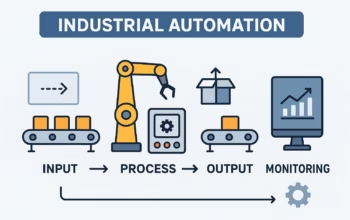
a. Industrial Automation
- Monitoring conveyor belt speeds
- Controlling robotic arms with precision motion data
- Measuring vibration for predictive maintenance
b. Aerospace and Defense
- Navigation systems using gyroscopes and IMUs
- Vibration analysis in aircraft engines
- Missile guidance and control systems
c. Automotive Industry
- Airbag deployment systems using accelerometers
- Vehicle stability control with gyroscopes
- Electric vehicle drivetrain monitoring
d. Healthcare and Biomechanics
- Motion analysis for rehabilitation and sports science
- Wearable devices for patient monitoring
- Robotic surgery tools requiring ultra-precise motion tracking
e. Consumer Electronics
- Smartphones with motion sensors for screen orientation
- Gaming controllers with accelerometers and gyroscopes
- VR/AR headsets requiring precise motion tracking
f. Precision Engineering
- CNC machines requiring precise displacement sensors
- Semiconductor manufacturing with nanometer-level motion control
- Optical alignment systems
5. Benefits of Motion Instrumentation
Implementing motion instrumentation provides several advantages:
- Enhanced Precision: Enables high accuracy in design and operation.
- Safety Assurance: Detects abnormal motion and prevents equipment failure.
- Efficiency Improvement: Optimizes system performance and reduces energy consumption.
- Predictive Maintenance: Identifies vibration anomalies to avoid costly breakdowns.
- Innovation Enablement: Powers advanced technologies like autonomous vehicles, drones, and robotics.


6. Challenges in Motion Instrumentation
Despite its benefits, motion instrumentation also faces several challenges:
- Environmental Factors: Dust, temperature, and vibrations can affect sensor accuracy.
- Calibration Needs: Regular calibration is essential to maintain reliability.
- Data Overload: Advanced systems generate massive amounts of motion data requiring processing and storage.
- Cost Constraints: High-precision instruments can be expensive for small-scale applications.
7. Future Trends in Motion Instrumentation
The future of motion instrumentation is shaped by advances in sensor technology, artificial intelligence, and data processing. Some key trends include:
- Integration with AI and Machine Learning
- Smart systems that not only measure but also predict motion behaviors.
- Miniaturization with MEMS
- More compact, cost-effective sensors for IoT and wearable applications.
- Wireless and Remote Monitoring
- Wireless motion sensors connected to cloud platforms for real-time monitoring.
- High-Resolution Optical Systems
- Nanometer-level displacement measurement for semiconductor and biomedical industries.
- Motion Instrumentation in Autonomous Systems
- Critical for self-driving cars, drones, and industrial robots.
Conclusion
Motion instrumentation is a cornerstone of modern technology, enabling precise measurement and control across industries. From industrial automation to healthcare and consumer electronics, motion sensors ensure efficiency, safety, and innovation.
As technology continues to evolve, motion instrumentation will become more compact, intelligent, and integrated into everyday devices. For engineers, researchers, and industries, investing in motion instrumentation is not just a technical necessity but also a strategic advantage in an increasingly automated world.