Limitations of Thermocouples ~ Thermocouples are among the most widely used temperature sensors in industrial settings. Their affordability, durability, and ability to measure a wide range of temperatures make them highly popular. However, while thermocouples have numerous advantages, they also come with certain limitations that engineers and plant operators must consider when selecting them for a specific application.
This article explores the key limitations of thermocouples, their impact on performance, and how these drawbacks can be mitigated in real-world industrial applications.
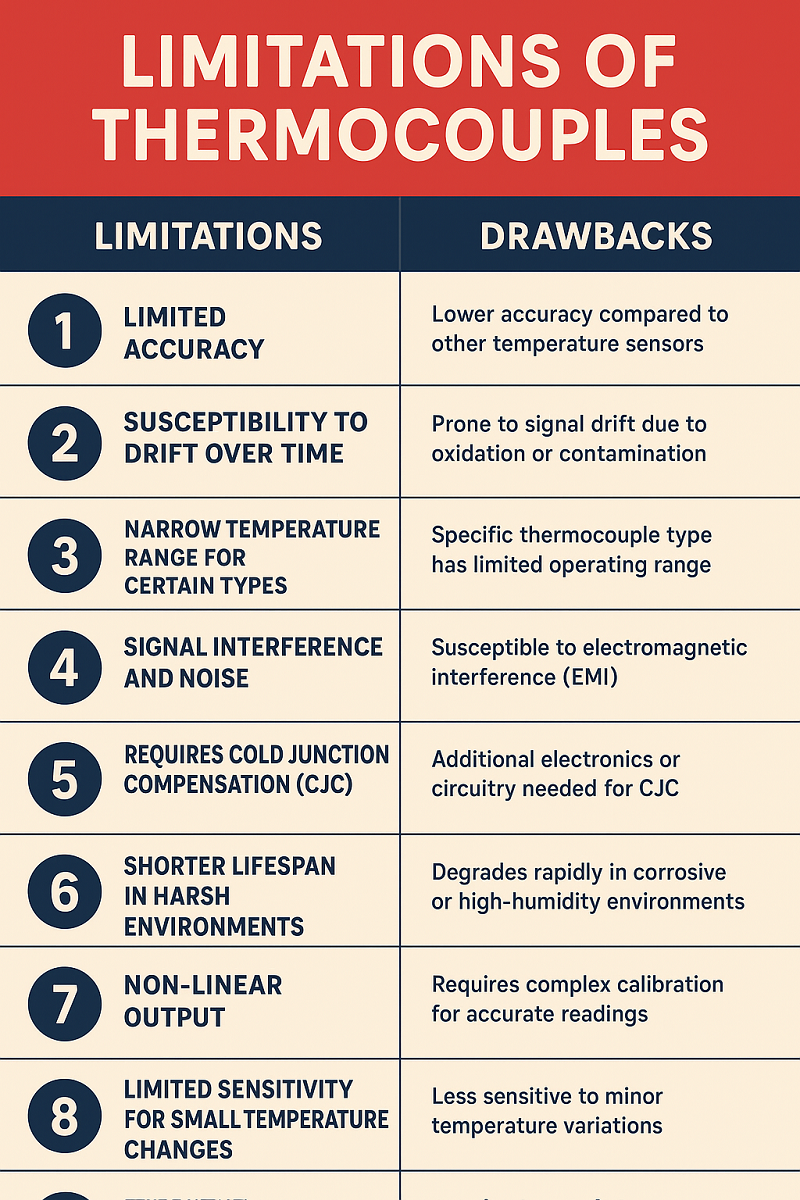
1. Limitations of Thermocouples: Limited Accuracy
One of the primary drawbacks of thermocouples is their lower accuracy compared to other temperature sensing devices like RTDs (Resistance Temperature Detectors) or thermistors.
- Typical accuracy range: ±1°C to ±2°C, depending on the type and calibration.
- Reason for accuracy issues: Thermocouples generate a voltage based on the Seebeck effect, and even minor changes in wire composition, environmental conditions, or connection quality can lead to variations in readings.
Example:
In pharmaceutical manufacturing, where temperature control must be within ±0.5°C, thermocouples may not be the ideal choice unless paired with a compensation system.
Mitigation tip: Regular calibration and using higher-grade thermocouple wires can help reduce errors.
2. Susceptibility to Drift Over Time
Thermocouples are prone to signal drift due to prolonged exposure to high temperatures, oxidation, or chemical contamination. Over time, the wire materials can degrade, altering the voltage output and leading to inaccurate readings.
Factors that cause drift:
- High-temperature oxidation
- Contamination from process gases
- Mechanical stress from vibration
Impact in industry:
In power plants, drift can lead to incorrect turbine temperature readings, potentially causing reduced efficiency or safety risks.
Mitigation tip: Implement a regular maintenance schedule and replace thermocouples after a set operational period.
3. Limitations of Thermocouples: Narrow Temperature Range for Certain Types
Although thermocouples as a category can measure extremely high temperatures (up to 2,300°C for some types), each specific thermocouple type has its own operating range.
Example:
- Type J: Suitable for -40°C to 750°C — not ideal for high-heat furnaces.
- Type T: Performs well at low temperatures but degrades quickly at high heat.
Selecting the wrong type can lead to premature failure or inaccurate readings.
Mitigation tip: Always match the thermocouple type to the process temperature requirements.
4. Signal Interference and Noise
Thermocouple signals are often in the microvolt range, making them susceptible to electromagnetic interference (EMI) from nearby machinery, power lines, or radio signals.
Industrial example:
In a manufacturing plant with heavy electrical equipment, thermocouple readings may fluctuate due to EMI, affecting process control accuracy.
Mitigation tip:
- Use shielded cables
- Ensure proper grounding
- Keep thermocouple wiring away from high-power lines
5. Limitations of Thermocouples: Requires Cold Junction Compensation (CJC)
Thermocouples measure the difference in temperature between the sensing tip and the reference (cold) junction. This means additional electronics or circuitry are required to compensate for the reference junction temperature.
Without proper CJC, readings can be significantly inaccurate.
Example:
In outdoor applications where ambient temperatures fluctuate widely, neglecting proper CJC can lead to errors exceeding several degrees Celsius.
6. Shorter Lifespan in Harsh Environments
Thermocouples are robust but can degrade rapidly in environments with corrosive chemicals, high humidity, or mechanical wear.
Example:
In chemical processing plants, acidic vapors can corrode the thermocouple sheath, causing early failure.
Mitigation tip: Use thermocouples with protective sheaths made from Inconel, stainless steel, or ceramic, depending on the application.

7. Limitations of Thermocouples: Non-linear Output
The voltage generated by a thermocouple is not directly proportional to temperature, meaning that complex calibration curves are required for accurate readings.
This can complicate integration with control systems, especially in older installations without advanced signal processing.
Mitigation tip: Use digital transmitters or PLC modules with built-in thermocouple linearization.
8. Limited Sensitivity for Small Temperature Changes
For processes requiring detection of very small temperature changes, thermocouples may not be the best option.
Example:
In precision semiconductor manufacturing, where variations of 0.1°C can affect yield, thermocouples may not offer the sensitivity needed compared to RTDs.
9. Frequent Calibration Needs
Due to drift, contamination, and wear, thermocouples require frequent calibration to maintain accuracy.
In industries like aerospace or energy production, this means higher maintenance costs and potential downtime.
10. Limitations of Thermocouples: Installation-Related Errors
Improper installation—such as poor insulation, incorrect wiring, or excessive bending of thermocouple wires—can lead to inaccurate readings or even device failure.
Best practices:
- Follow manufacturer installation guidelines
- Avoid sharp bends and mechanical strain
- Ensure correct polarity when connecting leads
Conclusion
While thermocouples remain a popular choice in industrial applications due to their durability, wide temperature range, and cost-effectiveness, understanding their limitations is crucial for optimal performance. Factors such as accuracy, drift, interference, and environmental durability must be considered during the selection, installation, and maintenance process.
In many cases, these drawbacks can be mitigated through careful thermocouple type selection, proper shielding, regular calibration, and the use of protective materials. Ultimately, knowing the strengths and weaknesses of thermocouples helps engineers make informed decisions that balance performance, reliability, and cost.