

1. Introduction
Level instrumentation is a critical aspect of industrial process control, enabling accurate monitoring and regulation of material levels in tanks, silos, hoppers, and other storage vessels. Whether dealing with liquids, solids, or slurry, knowing the exact level ensures optimal process efficiency, safety, and product quality.
This article explores the fundamentals of level instrumentation, its working principles, various measurement methods, and the industries that rely on it.
2. What is Level Instrumentation?
Level instrumentation refers to the set of devices and technologies used to determine the height or quantity of material—either liquid, solid, or slurry—within a container or process system.
The main purposes of level measurement include:
- Preventing overflow and spillage
- Ensuring consistent product quality
- Maintaining process efficiency
- Avoiding equipment damage caused by dry running or overfilling
- Supporting automated process control
3. Importance of Level Instrumentation in Industry
In modern industries, precise level measurement is vital for:
- Process Optimization: Ensuring raw materials and products are maintained within desired limits.
- Safety: Preventing accidents caused by overfilling or empty tanks.
- Regulatory Compliance: Meeting environmental and safety regulations for storage and handling.
- Cost Efficiency: Reducing waste and avoiding costly downtime.
4. Basic Principles of Level Instrumentation
Level instrumentation operates based on two main measurement approaches:
4.1 Direct Level Measurement
Measures the actual position of the material surface using physical contact with the medium. Examples include:
- Sight glasses
- Dip sticks
- Float-type level gauges
4.2 Indirect Level Measurement
Calculates level indirectly by measuring related parameters such as pressure, weight, or ultrasonic reflection. Examples include:
- Differential pressure transmitters
- Radar level sensors
- Ultrasonic level meters
5. Types of Level Instrumentation Methods
5.1 Point Level Measurement
Detects whether the level is above or below a certain set point. Used for high or low-level alarms.
- Example Devices: Float switches, capacitive level switches, vibrating fork switches.
5.2 Continuous Level Measurement
Provides real-time, continuous data on the level over the full range of the container.
- Example Devices: Ultrasonic level transmitters, radar sensors, magnetostrictive probes.
6. Common Technologies in Level Instrumentation
6.1 Float-Type Level Measurement
- Principle: A float moves with the surface level, mechanically or magnetically transmitting position to an indicator.
- Applications: Water tanks, fuel storage, and basic process vessels.
6.2 Differential Pressure (DP) Level Measurement
- Principle: Measures the hydrostatic pressure at the bottom of the vessel to determine liquid height.
- Applications: Pressurized tanks, boilers, chemical reactors.
6.3 Ultrasonic Level Measurement
- Principle: Uses sound waves to measure the distance from the sensor to the material surface.
- Applications: Water treatment plants, food processing, bulk solids handling.
6.4 Radar Level Measurement
- Principle: Employs microwave signals to detect level regardless of temperature, pressure, or vapor presence.
- Applications: Oil & gas, petrochemical storage, high-pressure vessels.
6.5 Capacitance Level Measurement
- Principle: Detects changes in capacitance caused by the material level in contact with the probe.
- Applications: Solids, powders, granules, and some liquids.
6.6 Guided Wave Radar (GWR)
- Principle: Sends microwave pulses along a probe to measure the level directly.
- Applications: Accurate level measurement in challenging process conditions.
7. Factors to Consider When Choosing Level Instrumentation
When selecting a level measurement device, engineers consider:
- Type of Material: Liquid, solid, slurry, or foam.
- Process Conditions: Temperature, pressure, chemical compatibility.
- Accuracy Requirements: Tolerance levels for process control.
- Installation Constraints: Mounting position, tank geometry.
- Maintenance Needs: Ease of calibration and cleaning.
- Budget: Balancing performance with cost efficiency.

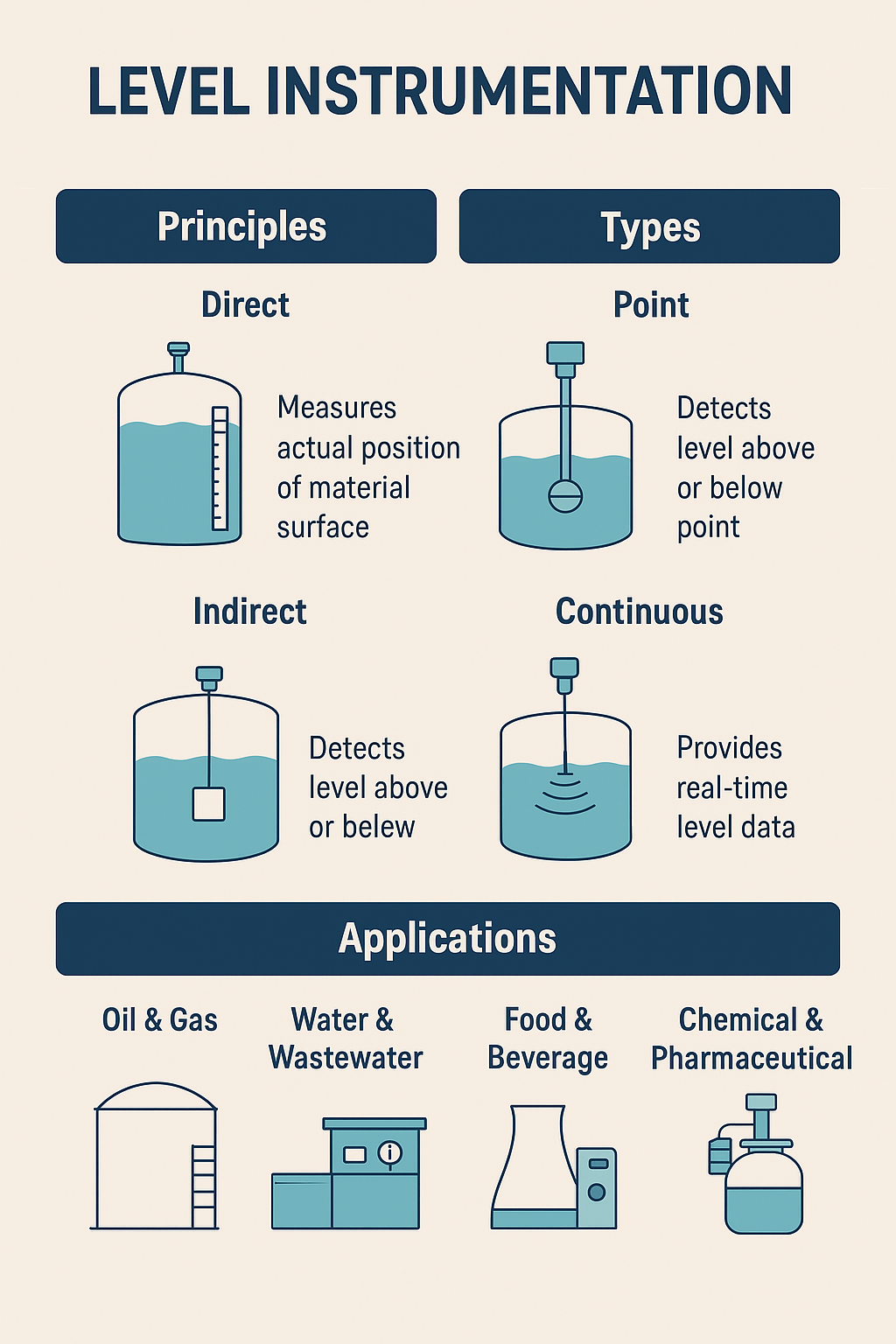
8. Applications of Level Instrumentation in Industry
8.1 Oil & Gas Industry
- Crude oil storage tanks
- LNG terminals
- Refinery process vessels
8.2 Water and Wastewater Treatment
- Reservoirs and water tanks
- Sludge level monitoring
- Chemical dosing tanks
8.3 Food and Beverage Industry
- Beverage mixing tanks
- Ingredient silos
- Fermentation vessels
8.4 Power Generation
- Boiler drum level control
- Cooling tower water level monitoring
8.5 Chemical and Pharmaceutical Industry
- Reactor vessels
- Chemical storage tanks
- High-precision batch processing
9. Calibration and Maintenance of Level Instrumentation
Regular calibration and maintenance are essential to ensure accuracy and reliability. Key practices include:
- Periodic sensor inspection for wear or fouling
- Recalibration according to manufacturer’s recommendations
- Cleaning sensors exposed to sticky or corrosive materials
- Updating firmware/software for smart transmitters
10. Trends in Level Instrumentation
With the rise of Industry 4.0 and Industrial IoT, modern level instrumentation is evolving to include:
- Wireless Communication: Reducing wiring and enabling remote monitoring.
- Smart Sensors: Self-diagnosing capabilities and predictive maintenance alerts.
- Data Integration: Cloud-based monitoring and analytics.
- Energy Efficiency: Low-power devices for sustainable operations.
11. Conclusion
Level instrumentation plays a vital role in ensuring industrial processes run smoothly, safely, and efficiently. The right choice of technology depends on the application, material properties, and operating environment. As technology advances, level measurement devices are becoming more accurate, reliable, and connected, supporting smarter industrial operations.
For more industrial instrumentation insights, visit Abi Royen – Instrumentation Solutions.