Introduction of Innovations in Automotive Industry
Innovations in Automotive Industry ~ The automotive industry has always been a hub of technological progress and groundbreaking innovations. From the invention of the internal combustion engine to the development of electric vehicles and self-driving cars, the sector continues to revolutionize the way people move. Today, automotive innovations are not only transforming transportation but also reshaping global economies, industries, and lifestyles.
This article explores the most significant innovations driving the automotive industry forward, including electric vehicles (EVs), autonomous driving technologies, artificial intelligence (AI), the Internet of Things (IoT), advanced manufacturing techniques, and sustainable mobility solutions.
1. Electric Vehicles: Powering a Sustainable Future
One of the most important innovations in the automotive industry is the widespread adoption of electric vehicles (EVs). With growing concerns about climate change and air pollution, the shift from gasoline-powered engines to EVs has become a global movement.
- Key Drivers of EV Growth
- Government regulations and incentives promoting clean energy.
- Technological advancements in lithium-ion batteries and solid-state batteries.
- Expansion of charging infrastructure worldwide.
- Leading EV Companies
Tesla, BYD, Rivian, and traditional automakers like Ford, Volkswagen, and Toyota are investing heavily in EV production. - Future Outlook
As battery technology improves and costs decrease, EVs are expected to dominate the automotive market by 2035, significantly reducing global carbon emissions.
2. Innovations in Automotive Industry: Autonomous Driving and Self-Driving Cars
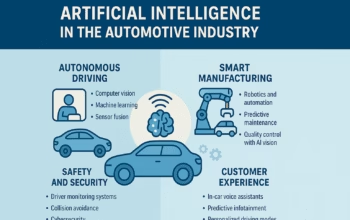
Another groundbreaking innovation is autonomous driving technology. With advancements in AI, sensors, and machine learning, vehicles are becoming smarter and more capable of driving without human intervention.
- Levels of Autonomy
- Level 1–2: Driver assistance systems (adaptive cruise control, lane assist).
- Level 3–4: Partial to full automation (currently under testing).
- Level 5: Fully autonomous vehicles with no human involvement.
- Benefits of Autonomous Vehicles
- Reduced traffic accidents caused by human error.
- Improved traffic flow and reduced congestion.
- Enhanced mobility for elderly and disabled individuals.
Companies such as Waymo, Tesla, Uber, and traditional automakers are racing to achieve safe and commercially viable autonomous cars.
3. Artificial Intelligence (AI) in Automotive
Artificial Intelligence plays a central role in modern automotive innovation. AI enhances various aspects of vehicle design, safety, and efficiency:
- AI-Powered Features
- Advanced Driver Assistance Systems (ADAS).
- Real-time traffic prediction and navigation.
- Voice recognition and personalized in-car experiences.
- Predictive maintenance to reduce breakdowns.
AI is also transforming manufacturing processes, enabling predictive quality control and robotics-driven assembly lines.
4. Innovations in Automotive Industry: Internet of Things (IoT) and Connected Cars
The Internet of Things (IoT) has paved the way for connected vehicles, enabling cars to communicate with each other and infrastructure systems.
- Key Applications of IoT in Automotive
- Vehicle-to-Vehicle (V2V) and Vehicle-to-Infrastructure (V2I) communication.
- Remote diagnostics and over-the-air (OTA) software updates.
- Real-time fleet management for logistics and transportation companies.
- Smart infotainment systems integrated with cloud services.
Connected cars not only improve driver experience but also enhance road safety and efficiency.
5. Advanced Manufacturing and 3D Printing
Manufacturing innovations are equally crucial in the automotive industry. Technologies like 3D printing, robotics, and digital twins are transforming the production process.
- 3D Printing in Automotive
- Rapid prototyping of car parts.
- Lightweight materials for improved fuel efficiency.
- Customized vehicle components.
- Smart Factories
Automation and robotics have streamlined production, reducing costs and improving quality control.
These innovations enable automakers to reduce production cycles and bring vehicles to market faster.
6. Sustainable Mobility and Green Technologies
Sustainability is a driving force behind many automotive innovations. Automakers are adopting eco-friendly technologies to reduce carbon footprints and support global climate goals.
- Key Sustainable Innovations
- Hydrogen fuel cell vehicles (FCEVs).
- Biodegradable materials for interiors.
- Renewable energy-powered manufacturing plants.
- Shared mobility and carpooling platforms.
By integrating sustainability into every stage of production and operation, the automotive industry is moving toward a greener and cleaner future.
7. Innovations in Automotive Industry: Smart Mobility and Urban Transportation Solutions
With rapid urbanization, cities face challenges like congestion, pollution, and limited parking. Automotive innovations are providing smart mobility solutions to tackle these issues:
- Ride-hailing and car-sharing services.
- Micro-mobility options such as e-scooters and e-bikes.
- Intelligent traffic management systems.
- Integration of public transportation with connected vehicle platforms.
Smart mobility is not just about cars but about building a seamless, efficient, and sustainable urban transportation ecosystem.
8. Future Trends in the Automotive Industry
The next decade will bring even more transformative innovations in the automotive sector. Some emerging trends include:
- Widespread adoption of solid-state batteries for longer EV range.
- Growth of 5G-powered connected vehicles.
- Expansion of autonomous delivery vehicles and drones.
- Increased use of blockchain technology for secure data sharing.
- Development of flying cars and advanced air mobility solutions.


Conclusion of Innovations in Automotive Industry
The automotive industry is undergoing a profound transformation driven by technological innovations, sustainability efforts, and changing consumer demands. From electric and autonomous vehicles to AI, IoT, and green mobility solutions, these innovations are shaping the future of transportation and redefining how we move around the world.
Companies that embrace these trends will lead the way in creating a smarter, safer, and more sustainable automotive ecosystem.
The future of mobility is not just about cars—it’s about building a connected and sustainable world where technology and innovation drive progress forward.