Infrared (IR) thermometers have become an essential tool in modern industries, healthcare, and daily applications. Their ability to measure temperature quickly and accurately without direct contact has made them highly valuable, especially in environments where traditional thermometers are impractical. This article explores the working principle of IR thermometers, their applications, advantages, and why they have become indispensable in various fields.
1. What is an Infrared (IR) Thermometer?
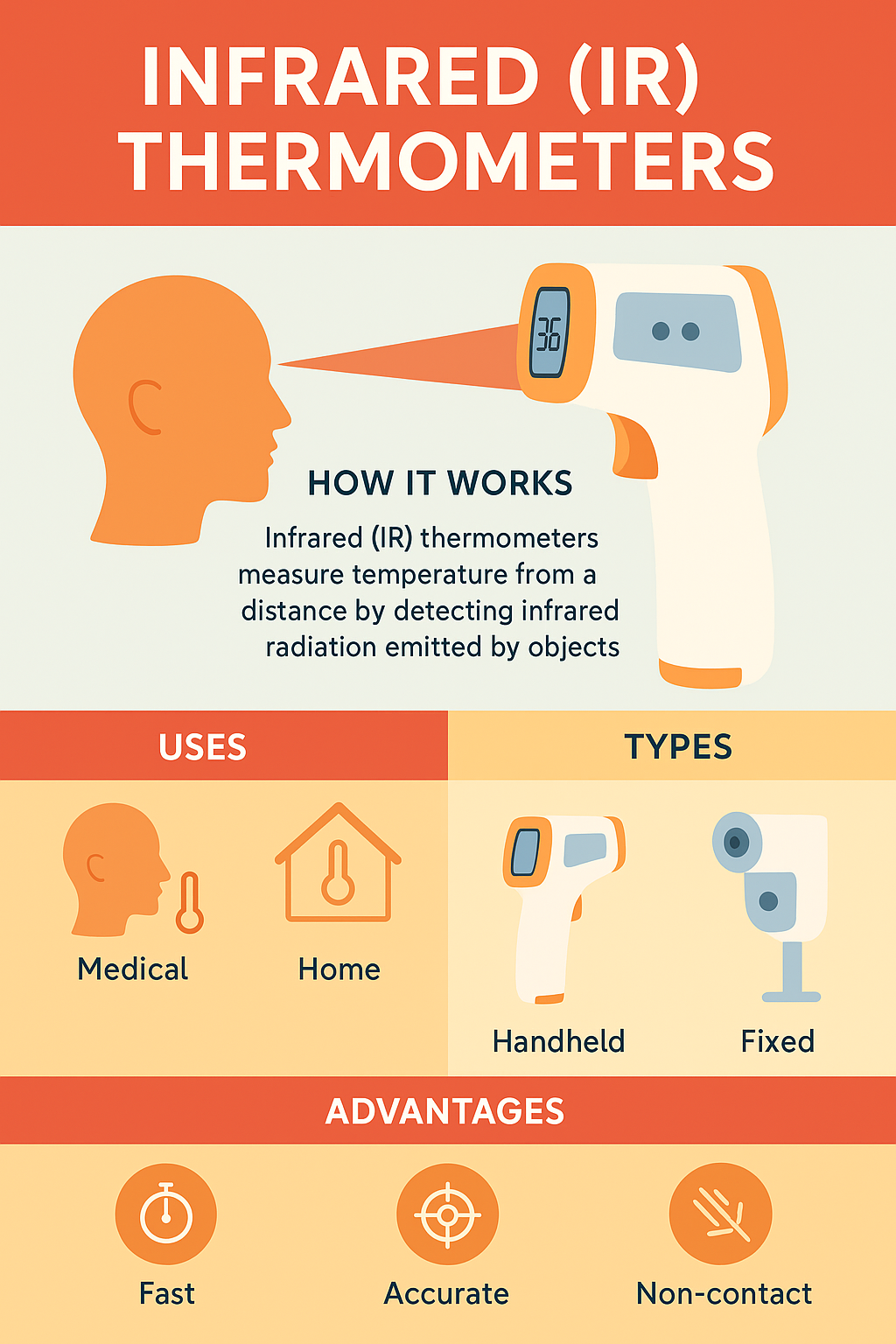
An Infrared (IR) thermometer is a device that measures temperature from a distance using infrared radiation emitted by objects. Unlike traditional thermometers that require direct contact with a surface or substance, IR thermometers rely on detecting thermal radiation to determine temperature. This non-contact feature makes them ideal for situations where safety, hygiene, or speed is crucial.
2. How Does an Infrared (IR) Thermometers Work?
Infrared thermometers operate based on the principle of thermal radiation. All objects with a temperature above absolute zero emit infrared radiation proportional to their temperature. An IR thermometer captures this radiation and converts it into an electrical signal, which is then processed to display the temperature reading.
Key Components of an IR Thermometer:
- Optical System: Focuses infrared energy emitted by the object onto the detector.
- Detector (Sensor): Converts infrared energy into an electrical signal.
- Signal Processor: Processes the electrical signal and translates it into a readable temperature value.
- Display Unit: Shows the temperature reading in °C or °F.
Measurement Process:
- The thermometer is aimed at the target object.
- The optical system collects infrared energy.
- The detector senses the energy and sends it to the processor.
- The processor calculates the temperature and displays the result.
This process happens almost instantly, enabling fast and accurate temperature measurements without any physical contact.
3. Advantages of Infrared (IR) Thermometers
Infrared thermometers offer numerous benefits over traditional contact thermometers:
- Non-contact measurement: Ideal for measuring moving objects, hazardous surfaces, or areas that are difficult to access.
- Speed: Provides readings in less than a second.
- Safety: Eliminates the risk of contamination or burns when measuring hot, cold, or toxic surfaces.
- Versatility: Can be used across various industries and applications.
- Durability: Designed to withstand harsh industrial environments.
4. Applications of Infrared (IR) Thermometers
IR thermometers are used in a wide range of fields:
a. Industrial Applications
- Monitoring machinery and electrical components for overheating.
- Measuring temperature in manufacturing processes such as metalworking and plastics.
- Quality control in food production and storage.
b. Medical and Healthcare
- Measuring body temperature in a hygienic, non-invasive way.
- Essential during pandemic situations for mass temperature screening.
c. HVAC (Heating, Ventilation, and Air Conditioning)
- Checking air conditioning vents and system performance.
- Detecting heat loss in buildings.
d. Automotive
- Diagnosing engine performance and exhaust systems.
- Checking brake and tire temperatures.
e. Scientific Research
- Measuring surface temperatures in laboratories.
- Monitoring experiments that require precise temperature control.
5. Factors Affecting Accuracy of Infrared (IR) Thermometers
Although IR thermometers are highly reliable, certain factors can affect their accuracy:
- Emissivity: Different materials emit different levels of infrared radiation. Most IR thermometers allow adjustment of emissivity settings for accurate readings.
- Distance-to-Spot Ratio (D:S): Determines how far you can be from the object and still get an accurate measurement. A higher D:S ratio means you can measure smaller areas from greater distances.
- Environmental Conditions: Dust, smoke, and steam can interfere with infrared radiation detection.
- Calibration: Regular calibration ensures accuracy over time.
6. Choosing the Right Infrared (IR) Thermometers
When selecting an infrared thermometer, consider the following:
- Temperature range: Ensure it covers the expected measurement range for your application.
- Accuracy and resolution: Critical for industrial and medical use.
- Emissivity settings: Adjustable settings improve versatility across different surfaces.
- Durability: Rugged designs are best for industrial environments.
- Response time: Faster response times are preferable for dynamic processes.

7. Future of Infrared (IR) Thermometers
With advancements in sensor technology and artificial intelligence, infrared thermometers are becoming smarter and more integrated. Modern devices now feature:
- Wireless connectivity for real-time data monitoring.
- Integration with IoT systems in industrial automation.
- Enhanced accuracy through AI-driven calibration.
- Compact designs for personal and professional use.
As industries continue to prioritize efficiency, safety, and hygiene, the role of IR thermometers will only expand.
Conclusion
Infrared (IR) thermometers have revolutionized the way we measure temperature. Their non-contact, fast, and accurate nature has made them a go-to tool for various applications—from industrial maintenance and medical diagnostics to everyday use in homes. Understanding how they work and how to select the right model ensures maximum efficiency and reliability.
As technology evolves, IR thermometers will remain at the forefront of temperature measurement, proving indispensable in a world that increasingly values precision, safety, and convenience.