History of radio ~ Radio has profoundly shaped the modern world, serving as a critical technology in communication, entertainment, military, and navigation. From its humble beginnings in scientific exploration to its current role in digital media, the story of radio is filled with groundbreaking inventions, rivalries, and global impact.
History of Radio
1. 1st History of Radio: The Birth of the Concept: Electromagnetic Waves
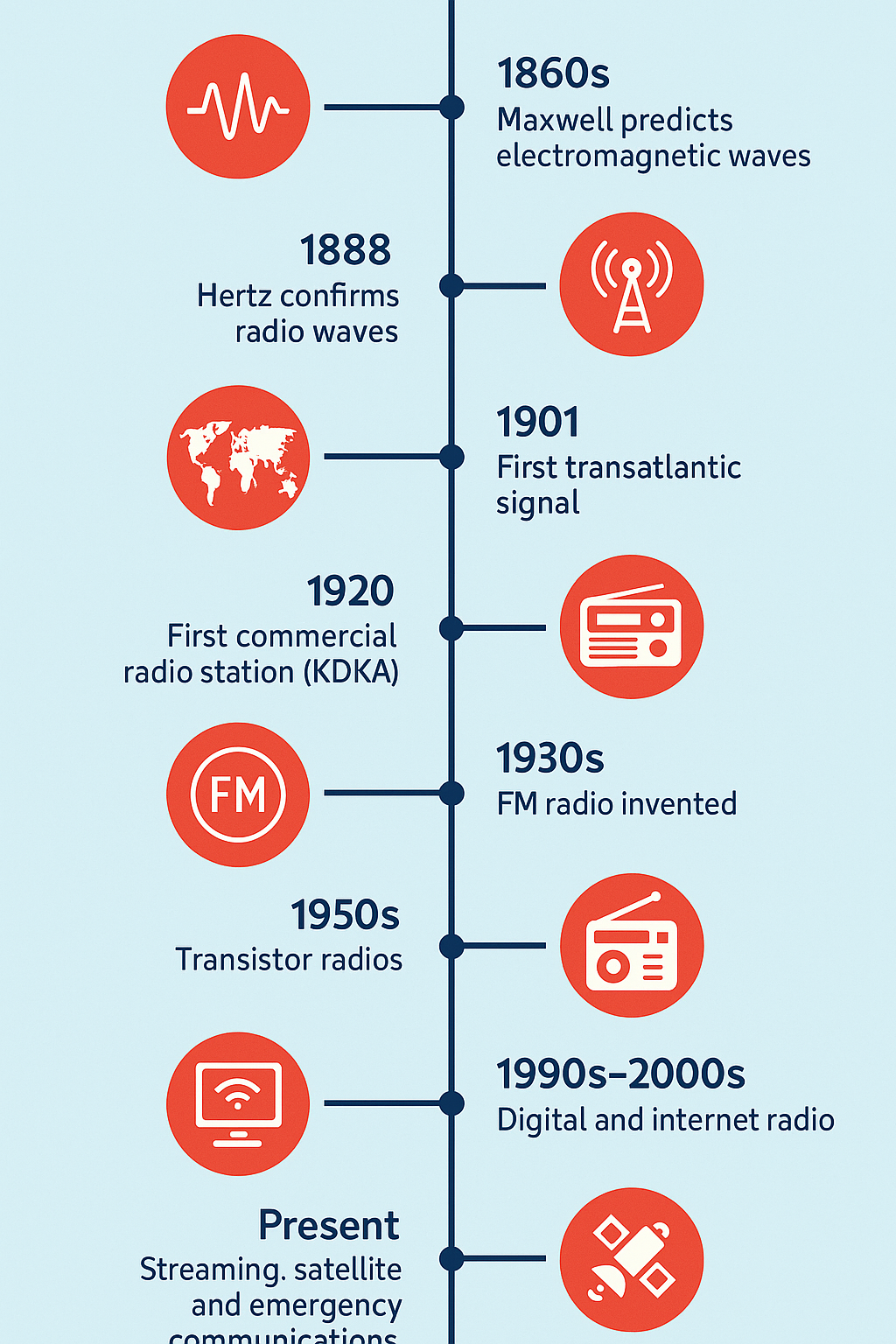
The theoretical groundwork for radio began in the 19th century with James Clerk Maxwell, who, in the 1860s, proposed the existence of electromagnetic waves. His equations showed that electric and magnetic fields could propagate through space as waves, predicting the possibility of wireless transmission of information.
In 1888, Heinrich Hertz experimentally proved Maxwell’s theory by generating and detecting electromagnetic waves in the laboratory. His success confirmed that radio waves could indeed travel through the air, laying the foundation for wireless communication.
“I do not think that the wireless waves I have discovered will have any practical application,” Hertz famously said—ironically, as his discovery would revolutionize the world.
More interesting to read in full: Understanding the Concept of Electromagnetic Waves: Properties, Types, and Applications
2. Early Experimenters and the Invention of Radio
The term radio originates from the Latin radius, meaning “ray” or “beam,” symbolizing the invisible transmission of signals. Several inventors and scientists contributed to the practical realization of radio technology:
📡 Nikola Tesla (1890s)
Tesla worked on wireless energy transmission and developed the Tesla coil, a key component in radio technology. He demonstrated wireless communication in 1893 and later filed several patents related to radio.
📡 Guglielmo Marconi (1895-1901)
Often credited as the father of radio, Marconi expanded on Hertz’s work and built the first practical radio transmitters and receivers. In 1901, he successfully transmitted a radio signal across the Atlantic Ocean—from Cornwall, England, to Newfoundland, Canada. This marked the beginning of long-distance wireless communication.
Note: In 1943, the U.S. Supreme Court recognized Tesla’s prior patents over some of Marconi’s, acknowledging Tesla’s contributions to the invention of radio.
More interesting to read in full: Early Experimenters and the Invention of Radio
3. History of Radio: The Rise of Radio Broadcasting
With the technology proven viable, the early 20th century saw rapid development in radio broadcasting.
📻 First Radio Broadcasts
- In 1906, Reginald Fessenden made the first audio radio broadcast on Christmas Eve, transmitting voice and music.
- 1920: KDKA in Pittsburgh, USA, became the world’s first commercial radio station, broadcasting news and music to the public.
🎶 Golden Age of Radio (1920s–1950s)
This era witnessed radio becoming a household staple. People gathered around radios for news, drama, comedy, and music. Shows like The War of the Worlds (1938) by Orson Welles demonstrated the medium’s immense influence.
More interesting to read in full: Rise of Radio Broadcasting: How Radio Shaped Communication and Culture
4. Radio in Wartime and Emergency Use
During World War I and II, radio played a strategic role:
- Used for military communication, reconnaissance, and propaganda.
- Civil defense and coded messages utilized shortwave radio.
- Families relied on radio for war updates and national morale.
Radio became essential for real-time information and remained a crucial tool in emergency communication.
More interesting to read in full: The Use of Emergency Radios in Times of War: Lifelines of Communication
5. Technological Advancements in Radio
The evolution of radio technology includes several milestones:
- AM Radio (Amplitude Modulation): Allowed simple voice and music transmission.
- FM Radio (Frequency Modulation): Invented by Edwin Armstrong in the 1930s, provided clearer audio with less interference.
- Transistors (1950s): Replaced bulky vacuum tubes, making radios portable and affordable.
- Digital Radio (1990s–2000s): Introduced digital audio broadcasting (DAB) with higher fidelity and more station options.
More interesting to read in full: Technological Advancements in Radio: From Analog Waves to Digital Innovation
6. Modern Applications and Internet Radio
Today, radio continues to evolve:
- Satellite Radio (e.g., SiriusXM): Provides a broad range of channels globally.
- Internet Radio: Online streaming platforms such as Spotify and iHeartRadio allow listeners worldwide to tune in live or on-demand.
- Emergency and Maritime Use: Radio remains crucial for aviation, marine communication, and disaster relief operations.
Even as digital media advances, radio persists due to its low cost, reliability, and accessibility—especially in remote or disaster-prone areas.
More interesting to read in full: Applications of Radio in the Modern World: Technology, Communication, and Innovation

7. The Enduring Legacy of Radio
Despite competition from television, the internet, and smartphones, radio has adapted and survived. In fact:
- Over 75% of the global population still uses some form of radio.
- In many rural areas, radio is the only form of accessible media.
Radio’s resilience lies in its simplicity, mobility, and real-time communication capability.
More interesting to read in full: The Evolution and Benefits of Internet Radio in the Digital Age
🎯 Conclusion History of Radio
The history of radio reflects a story of ingenuity, perseverance, and transformation. From Hertz’s invisible waves to Marconi’s transatlantic messages and today’s internet-powered streaming, radio remains a powerful medium that continues to inform, connect, and entertain billions.
As we venture into new frontiers of 5G and AI-driven communication, the legacy of radio endures—proving that even century-old technologies can evolve to stay relevant in a digital age.