

Introduction to Global Positioning System (GPS)
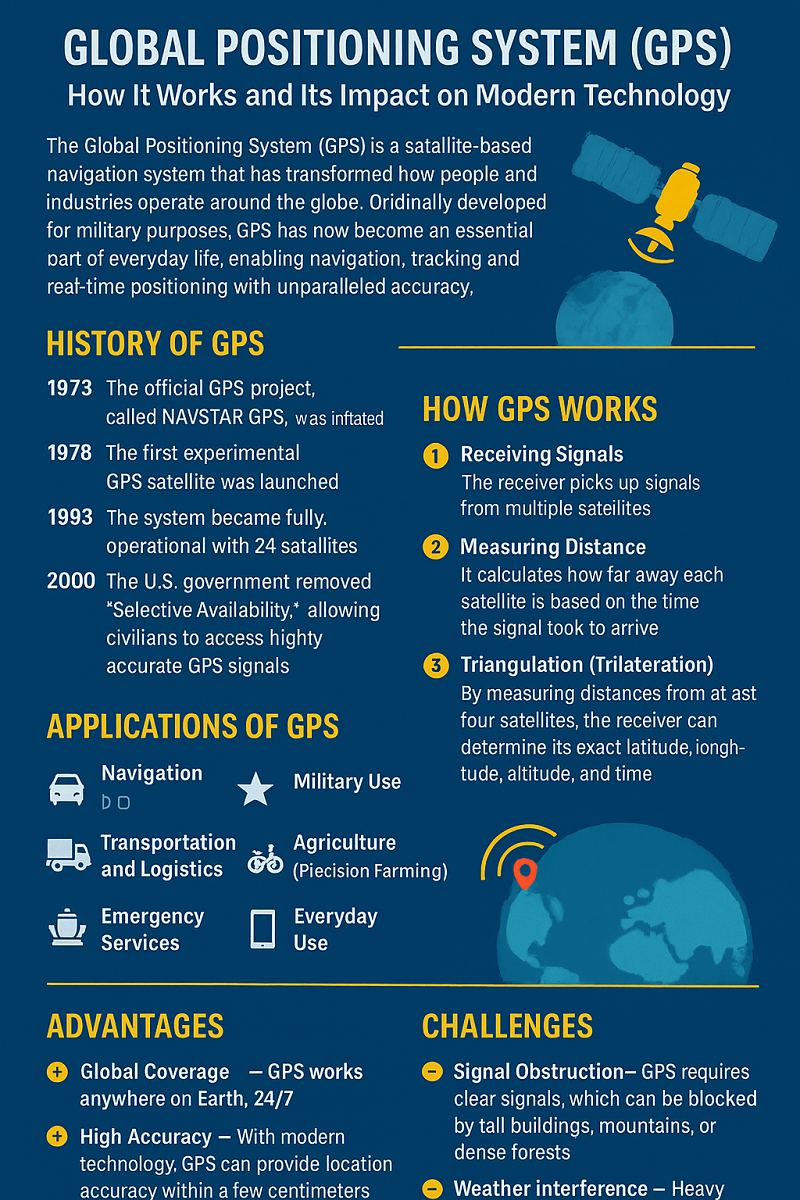
The Global Positioning System (GPS) is a satellite-based navigation system that has transformed how people and industries operate around the globe. Originally developed for military purposes, GPS has now become an essential part of everyday life, enabling navigation, tracking, and real-time positioning with unparalleled accuracy. From smartphones to aviation systems, from maritime navigation to precision farming, GPS is deeply embedded in modern society.
In this article, we will explore the history, principles, working mechanism, and applications of GPS, as well as its advantages, challenges, and future potential.
What is Global Positioning System (GPS)?
The Global Positioning System (GPS) is a satellite-based radio navigation system owned by the United States government and operated by the U.S. Space Force. It provides geolocation and time information to GPS receivers anywhere on Earth, regardless of weather conditions, as long as there is an unobstructed line of sight to four or more satellites.
History of GPS
The origins of GPS trace back to the Cold War era. In 1957, after the Soviet Union launched Sputnik 1, scientists discovered that the satellite’s radio signals could be tracked from Earth. This concept inspired the U.S. Department of Defense to develop a navigation system that could provide precise global positioning.
- 1973: The official GPS project, called NAVSTAR GPS, was initiated.
- 1978: The first experimental GPS satellite was launched.
- 1993: The system became fully operational with 24 satellites.
- 2000: The U.S. government removed “Selective Availability,” allowing civilians to access highly accurate GPS signals.
Today, GPS has become one of the most critical technologies worldwide, with constant upgrades for accuracy and reliability.
How Global Positioning System (GPS) Works
GPS relies on a constellation of at least 24 operational satellites orbiting Earth at an altitude of about 20,200 kilometers. These satellites continuously transmit signals containing their location and the exact time.
A GPS receiver (such as those in smartphones or car navigation systems) determines its position by:
- Receiving Signals – The receiver picks up signals from multiple satellites.
- Measuring Distance – It calculates how far away each satellite is based on the time the signal took to arrive.
- Triangulation (Trilateration) – By measuring distances from at least four satellites, the receiver can determine its exact latitude, longitude, altitude, and time.
Applications of Global Positioning System (GPS)
1. Navigation
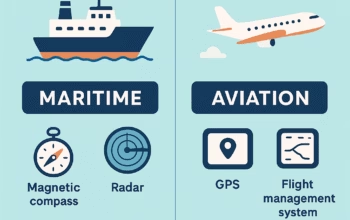
GPS is the backbone of modern navigation, helping cars, ships, and aircraft move safely and efficiently. Turn-by-turn driving directions, maritime route planning, and aviation guidance all rely on GPS.
2. Military Use
Initially designed for defense, GPS is crucial for military operations, enabling precise missile targeting, troop movement coordination, and reconnaissance missions.
3. Transportation and Logistics
In logistics, GPS ensures real-time tracking of vehicles and shipments. Fleet managers use GPS to monitor driver performance, reduce fuel costs, and optimize delivery routes.
4. Agriculture (Precision Farming)
Farmers use GPS for precision agriculture, including automated tractor guidance, crop monitoring, and efficient land management. This improves productivity and reduces resource waste.
5. Emergency Services
GPS assists emergency responders by locating accident scenes, tracking lost individuals, and improving disaster response operations.
6. Telecommunications and Banking
GPS provides accurate time synchronization, which is vital for data networks, mobile communications, and financial transactions.
7. Everyday Use
From fitness trackers and smartphones to ride-sharing apps and geotagging photos, GPS has become an inseparable part of modern life.
Advantages of Global Positioning System (GPS)
- Global Coverage: GPS works anywhere on Earth, 24/7.
- High Accuracy: With modern technology, GPS can provide location accuracy within a few centimeters.
- Free Access: Civilian GPS services are free of charge.
- Versatility: Useful across industries like transportation, healthcare, agriculture, and tourism.
- Reliability: Supported by continuous satellite upgrades and monitoring.

Challenges and Limitations of GPS
Despite its benefits, GPS also has challenges:
- Signal Obstruction: GPS requires clear signals, which can be blocked by tall buildings, mountains, or dense forests.
- Weather Interference: Heavy storms or solar activity can affect accuracy.
- Battery Consumption: Constant GPS use drains smartphone batteries quickly.
- Security Concerns: GPS signals can be jammed or spoofed, posing risks to both military and civilian systems.
- Dependency: Heavy reliance on GPS may cause critical issues if the system fails or is disrupted.
The Future of GPS
The evolution of GPS is ongoing, with improvements focusing on higher accuracy, stronger signals, and enhanced security.
- GPS III Satellites: The next generation of satellites, offering stronger anti-jamming capabilities and improved positioning accuracy.
- Integration with Other Systems: GPS is often combined with other global navigation satellite systems (GNSS) like Europe’s Galileo, Russia’s GLONASS, and China’s BeiDou for greater accuracy.
- Autonomous Vehicles: Self-driving cars will heavily depend on advanced GPS for safe navigation.
- Internet of Things (IoT): GPS will continue to play a central role in connecting smart devices and ensuring seamless operations.
Conclusion
The Global Positioning System (GPS) has revolutionized the way the world operates, bridging gaps in communication, navigation, and technology. From its military origins to its current role in everyday life, GPS has become one of the most important innovations of modern times. As technology advances, GPS will continue to evolve, offering even more precise, secure, and widespread applications.
Whether you are using a smartphone for directions, monitoring international shipping, or exploring new frontiers in space, GPS ensures that the world remains connected and accurately positioned.