

Introduction
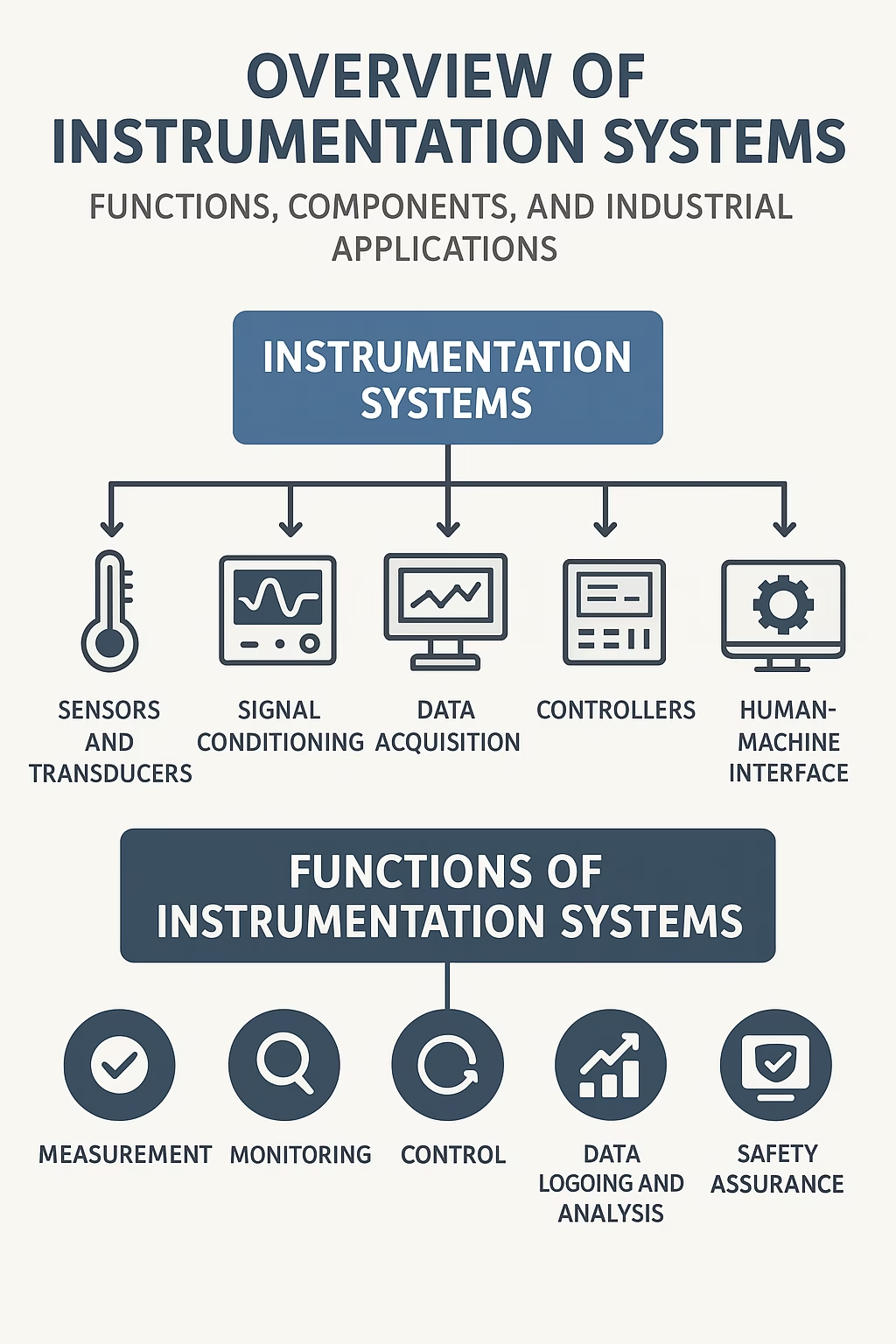
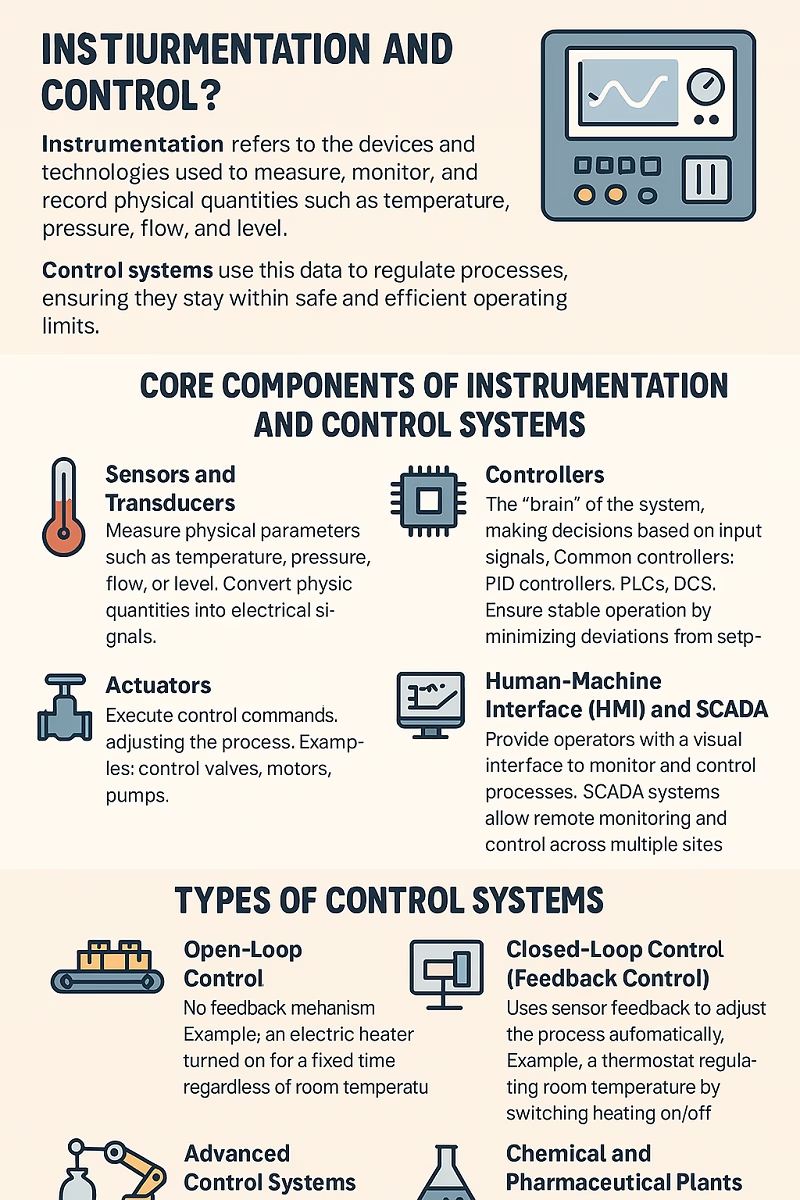
Future Trends in Instrumentation ~ Instrumentation has always been the backbone of industrial processes, ensuring accuracy, safety, and efficiency in manufacturing, energy production, transportation, and countless other sectors. As industries transition deeper into Industry 4.0—and prepare for Industry 5.0—instrumentation is undergoing a significant transformation. Future trends in instrumentation are not just about measuring parameters like pressure, temperature, or flow; they involve real-time data processing, AI-powered decision-making, and seamless integration with IoT systems.
This article explores the emerging trends shaping the future of instrumentation and how they will redefine industrial operations in the coming decades.
1. Future Trends in Instrumentation: AI and Machine Learning Integration
Artificial Intelligence (AI) and Machine Learning (ML) are revolutionizing the way instrumentation systems operate. Instead of simply collecting data, modern instruments can now analyze it, detect anomalies, and even predict potential failures.
Key benefits:
- Predictive maintenance reduces downtime and repair costs.
- Intelligent process control for improved efficiency.
- Fault detection before problems escalate.
Example:
An AI-enabled vibration sensor in a manufacturing plant can detect subtle changes in machinery performance, predicting bearing failure weeks before it happens.
2. Future Trends in Instrumentation: Internet of Things (IoT) in Instrumentation
The IoT revolution has connected millions of devices, and industrial instrumentation is no exception. IoT-enabled instruments can send data wirelessly to central control systems, cloud platforms, or even mobile apps.
Advantages of IoT-enabled instrumentation:
- Remote monitoring of equipment in hazardous or hard-to-reach locations.
- Real-time process adjustments without human intervention.
- Data-driven insights for better decision-making.
Real-world application:
In oil and gas pipelines, IoT sensors monitor pressure and temperature in real time, preventing leaks and ensuring safety.
3. Future Trends in Instrumentation: Wireless and Battery-Free Sensors
Future instrumentation will rely less on wired connections. Wireless sensors powered by energy harvesting (e.g., solar, vibration, or thermal energy) are already being tested in industrial applications.
Why this matters:
- Reduced installation cost and complexity.
- Greater flexibility in sensor placement.
- Sustainability through self-powered devices.
These sensors will be essential in remote monitoring for agriculture, mining, and offshore energy platforms.
4. Future Trends in Instrumentation: Digital Twins for Instrumentation
A Digital Twin is a virtual replica of a physical system. With accurate data from sensors and instruments, industries can simulate, monitor, and optimize operations before making physical changes.
Benefits:
- Predictive simulations to test new settings without downtime.
- Faster troubleshooting with accurate virtual models.
- Continuous optimization of industrial processes.
For example, a power plant can use a digital twin of its turbine system to forecast energy output under different operating conditions.
5. Future Trends in Instrumentation: Advanced Sensor Technologies
Sensor innovation is at the heart of modern instrumentation. Future trends include:
- Nano-sensors for detecting extremely small changes in chemical composition.
- Optical fiber sensors for high-precision measurements in harsh environments.
- MEMS (Micro-Electro-Mechanical Systems) sensors for compact, low-power applications.
These advanced sensors are vital in pharmaceuticals, aerospace, and environmental monitoring.
6. Future Trends in Instrumentation: Cybersecurity for Instrumentation
As instrumentation becomes more connected, cybersecurity risks grow. Hackers targeting industrial control systems can cause severe disruptions.
Future cybersecurity measures will include:
- End-to-end encryption of sensor data.
- AI-based intrusion detection for process control systems.
- Zero-trust architecture for industrial networks.
Cybersecurity will be just as important as measurement accuracy.

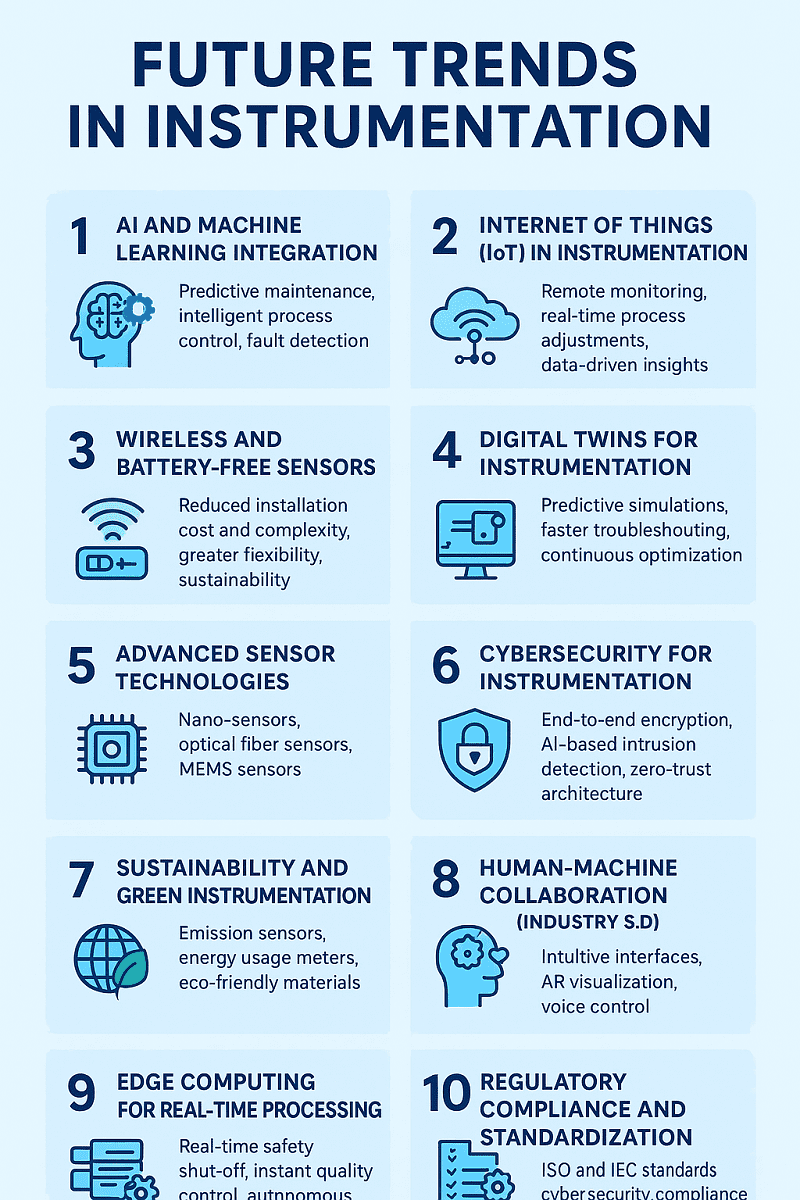
7. Future Trends in Instrumentation: Sustainability and Green Instrumentation
With global sustainability goals, instrumentation will focus on energy efficiency and environmental monitoring.
Examples:
- Emission sensors for factories to comply with environmental regulations.
- Energy usage meters for optimizing consumption.
- Instruments that operate with minimal environmental footprint.
The trend is toward eco-friendly materials and low-power operation.
8. Human-Machine Collaboration (Industry 5.0)
While Industry 4.0 emphasizes automation, Industry 5.0 will focus on human-machine collaboration. Future instrumentation will be designed with intuitive interfaces, augmented reality (AR) visualization, and voice control.
Impact:
- Faster decision-making with AR dashboards.
- Safer operations through wearable instrumentation.
- Improved workforce efficiency through guided workflows.
9. Edge Computing for Real-Time Processing
Instead of sending all data to the cloud, edge computing allows processing to happen near the source of data collection. This reduces latency and improves response time.
Applications:
- Real-time safety shut-off in chemical plants.
- Instant quality control in manufacturing lines.
- Autonomous control in remote facilities.
10. Regulatory Compliance and Standardization
Future instrumentation must comply with global industry standards for safety, accuracy, and interoperability. This includes:
- ISO and IEC standards for measurement devices.
- Cybersecurity compliance for connected systems.
- Environmental certifications for green technologies.
Conclusion
The future of instrumentation is smart, connected, and sustainable. From AI-powered analytics to IoT-enabled sensors and green technologies, these innovations will define how industries operate in the coming decades. Businesses that adopt these trends early will enjoy improved efficiency, safety, and profitability—positioning themselves as leaders in the next industrial revolution.