

Evolution Automotive Industry ~ The automotive industry has always been a driving force of innovation, shaping modern life in ways that go far beyond transportation. From the earliest steam-powered engines of the 18th century to today’s AI-driven smart vehicles, the evolution of the automotive industry reflects a story of constant progress, adaptation, and disruption. This transformation has not only changed how we move from one place to another but has also redefined cities, economies, and societies around the globe.
In this article, we will explore the history, milestones, and future trends of the automotive industry, examining how each stage of its evolution continues to influence the way we travel today.
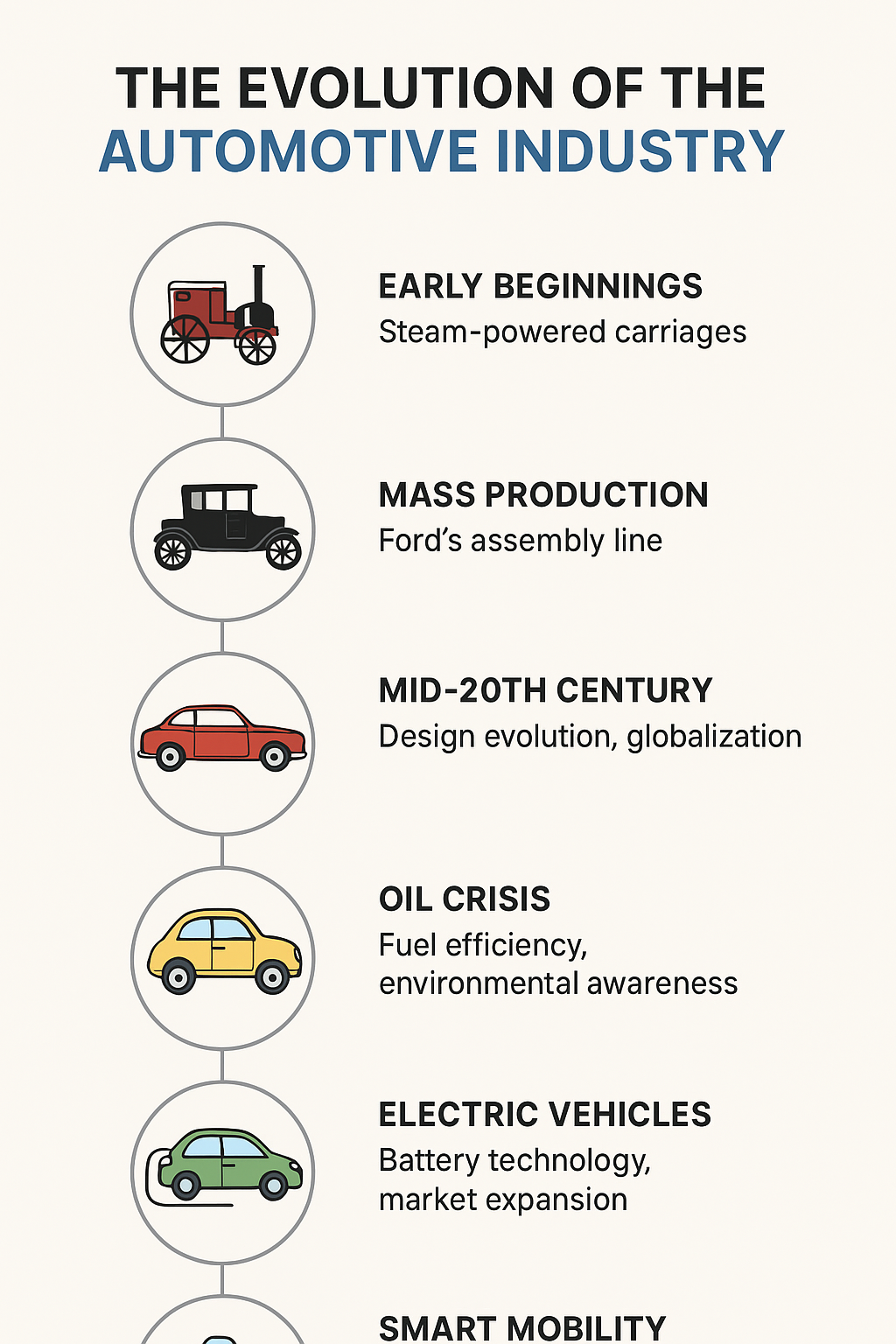
Early Beginnings: The Birth of Evolution Automotive Industry
The concept of self-propelled vehicles dates back centuries. In the late 18th century, inventors experimented with steam-powered carriages, which were large, slow, and impractical for everyday use. By the mid-19th century, internal combustion engines powered by gasoline and diesel began to emerge, laying the groundwork for the modern automobile.
The real breakthrough came in 1886, when Karl Benz patented the Benz Patent-Motorwagen, often considered the first true automobile. Around the same time, Gottlieb Daimler and Wilhelm Maybach developed similar gasoline-powered vehicles, igniting the birth of the automotive industry.
The Age of Mass Production: Ford’s Revolution
The early 20th century marked a turning point in the automotive industry with the introduction of mass production. Henry Ford, founder of Ford Motor Company, revolutionized car manufacturing with the Model T in 1908.
What made Ford’s contribution revolutionary was not just the car itself but the assembly line production method. This innovation drastically reduced the cost and time required to build vehicles, making cars more affordable for middle-class families. By the 1920s, automobiles were no longer luxury items but everyday necessities.
This era also gave rise to famous automotive brands such as General Motors, Chrysler, and Volkswagen, each contributing to global car culture.
Automotive Industry in the Mid-20th Century
The mid-1900s saw rapid growth in the automotive sector. Cars became symbols of status, freedom, and modern living. Key trends during this era included:
- Design evolution: Sleek, stylish vehicles replaced the boxy designs of earlier models.
- Expansion of highways: Infrastructure such as the U.S. Interstate Highway System boosted demand for automobiles.
- Technological improvements: Automatic transmissions, power steering, and air conditioning became standard features.
- Globalization: Japanese and European automakers, including Toyota, Honda, BMW, and Mercedes-Benz, emerged as strong competitors.
This period cemented the automobile as a cultural icon, shaping consumer lifestyles around the world.
Oil Crisis and Environmental Awareness
By the 1970s, the automotive industry faced new challenges. The oil crisis of 1973 exposed the vulnerability of a car-dependent society and highlighted the need for more fuel-efficient vehicles. At the same time, environmental concerns began to rise as cars were linked to air pollution and climate change.
Automakers responded with smaller, fuel-efficient cars and began investing in cleaner technologies. Japanese automakers such as Toyota and Honda gained global recognition for their reliable and efficient vehicles, reshaping the competitive landscape.
The Rise of Electronics and Computerization
The 1980s and 1990s introduced a technological revolution in the automotive industry. Cars became increasingly computerized, integrating features such as:
- Electronic fuel injection
- Anti-lock braking systems (ABS)
- Airbags and advanced safety measures
- Onboard diagnostics (OBD)
Luxury brands pioneered innovations like GPS navigation and in-car entertainment systems, setting the stage for connected cars.
The Electric Vehicle Movement
Although electric cars date back to the 19th century, they only began to gain serious traction in the 21st century. The Tesla Roadster (2008) and subsequent Tesla Model S brought electric vehicles (EVs) into the mainstream, proving that EVs could be fast, stylish, and practical.
Governments worldwide have since pushed for electrification to reduce carbon emissions. Today, nearly every major automaker has announced plans to transition toward electric mobility, with leading models such as:
- Tesla Model 3 and Model Y
- Nissan Leaf
- Chevrolet Bolt
- Volkswagen ID. series
- Hyundai Ioniq and Kia EV6
The shift to EVs represents one of the most significant transformations in the history of the automotive industry.
Autonomous Vehicles and Smart Mobility
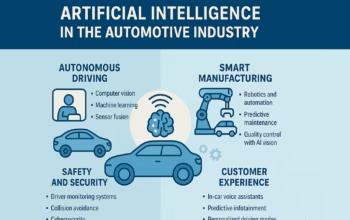
The future of the automotive industry is being shaped by autonomous driving and smart mobility. Companies like Waymo, Tesla, and Uber are investing heavily in self-driving technology. These vehicles use artificial intelligence (AI), sensors, and machine learning to navigate roads with minimal human intervention.
At the same time, the concept of mobility as a service (MaaS) is gaining popularity. Instead of owning cars, people are opting for ride-sharing, car-sharing, and subscription models. This trend is reshaping urban transportation, reducing congestion, and making mobility more sustainable.
Challenges and Opportunities Ahead
As the automotive industry continues to evolve, it faces both challenges and opportunities:
Challenges:
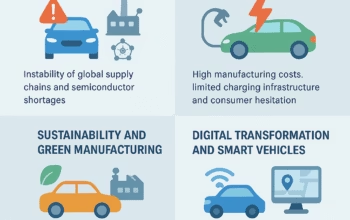
- Transition to fully electric fleets requires massive infrastructure investment.
- Autonomous vehicles raise ethical, legal, and safety concerns.
- Global supply chain disruptions (such as semiconductor shortages).
- Increasing competition among traditional automakers and tech companies.
Opportunities:
- Integration of AI and IoT for smarter, safer vehicles.
- Growth of sustainable transportation and green energy.
- Expansion into emerging markets with rising middle-class populations.
- Innovative materials like lightweight composites and 3D printing.

The Future of the Evolution Automotive Industry
Looking forward, the automotive industry will continue to undergo disruptive transformation. Key trends include:
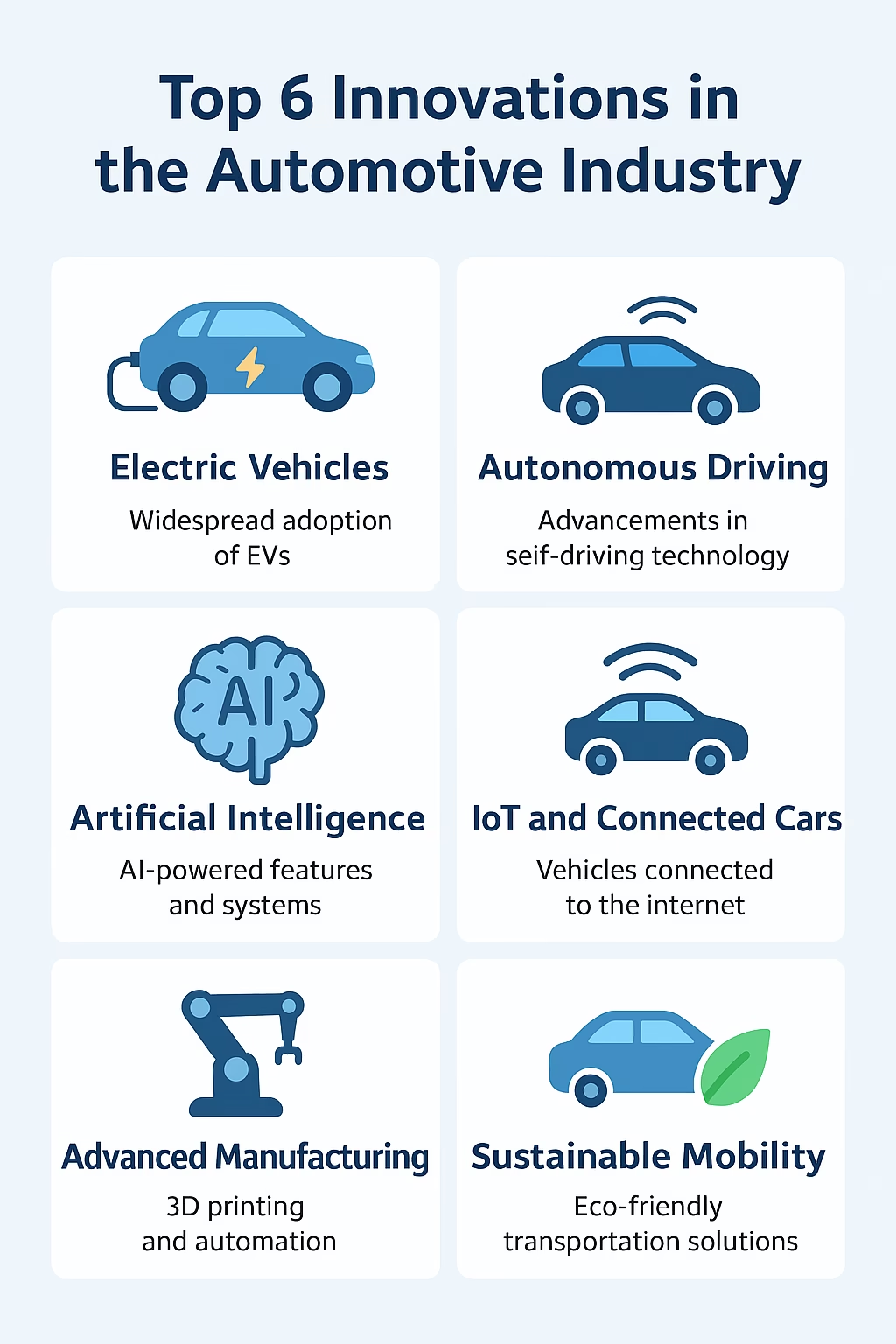
- Electric Dominance: Most new cars sold by 2035 may be fully electric in many regions.
- Smart Cities Integration: Vehicles will interact with infrastructure through 5G and IoT.
- Autonomous Driving: Self-driving taxis and trucks will revolutionize logistics and urban mobility.
- Sustainability: Circular economy practices, such as vehicle recycling and renewable energy, will become standard.
The industry is no longer just about building cars; it is about creating integrated mobility solutions for a connected and sustainable world.
Conclusion of Evolution Automotive Industry
The Evolution Automotive Industry is a story of continuous progress, shaped by technological innovation, cultural shifts, and global challenges. From the invention of the first steam-powered carriages to the rise of electric vehicles and AI-driven autonomous mobility, the industry has transformed how people live, work, and connect.
As we enter a new era defined by sustainability, electrification, and smart technologies, the automotive industry will remain at the forefront of global innovation. One thing is clear: the journey of the automobile is far from over—it is only accelerating toward the future.