

The Electromagnetic Spectrum Radio Frequencies is the foundation of modern communication, connecting billions of devices across the globe. At the heart of this spectrum lies radio frequencies (RF)—a critical range of electromagnetic waves that power wireless communication, broadcasting, navigation, and countless other technologies we rely on daily. This article explores the nature of radio frequencies within the electromagnetic spectrum, their classifications, applications, and significance in today’s world.
1. Electromagnetic Spectrum Radio Frequencies: What is the Electromagnetic Spectrum?
The electromagnetic (EM) spectrum encompasses the entire range of electromagnetic radiation, from extremely low frequencies (ELF) to extremely high frequencies like gamma rays. It includes various types of waves, each with unique properties and applications. These categories, arranged by frequency and wavelength, include:
- Radio Waves (3 Hz – 300 GHz)
- Microwaves (300 MHz – 300 GHz)
- Infrared (IR) (300 GHz – 400 THz)
- Visible Light (400–700 nm wavelength)
- Ultraviolet (UV) (400 THz – 30 PHz)
- X-Rays (30 PHz – 30 EHz)
- Gamma Rays (>30 EHz)
Radio waves occupy the lowest portion of the EM spectrum in terms of frequency but are indispensable for transmitting information wirelessly.
2. Electromagnetic Spectrum Radio Frequencies: What are Radio Frequencies (RF)?
Radio frequencies refer to the range of electromagnetic waves with frequencies between 3 Hz and 300 GHz. They are widely used to carry signals over long distances without the need for physical connections. Key characteristics of RF waves include:
- Long-distance propagation: Especially at lower frequencies, RF waves can travel over the horizon using ground-wave or sky-wave propagation.
- Non-ionizing: Unlike X-rays or gamma rays, RF waves do not carry enough energy to ionize atoms, making them safer for everyday applications.
- Versatility: RF signals can be modulated to carry voice, data, and video information.
3. Classification of Electromagnetic Spectrum Radio Frequencies
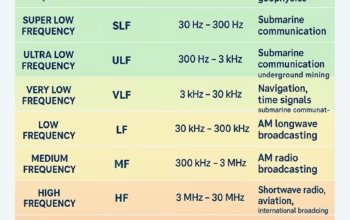
The International Telecommunication Union (ITU) classifies the radio spectrum into several bands:
- Extremely Low Frequency (ELF): 3 Hz – 30 Hz
Used for submarine communication. - Super Low Frequency (SLF): 30 Hz – 300 Hz
Limited military and scientific applications. - Ultra Low Frequency (ULF): 300 Hz – 3 kHz
Underground communication, seismology. - Very Low Frequency (VLF): 3 kHz – 30 kHz
Navigation, submarine communication. - Low Frequency (LF): 30 kHz – 300 kHz
Maritime communication, navigation beacons. - Medium Frequency (MF): 300 kHz – 3 MHz
AM radio broadcasting. - High Frequency (HF): 3 MHz – 30 MHz
Shortwave radio, aviation communication. - Very High Frequency (VHF): 30 MHz – 300 MHz
FM radio, television broadcasting, two-way radio. - Ultra High Frequency (UHF): 300 MHz – 3 GHz
TV broadcasting, mobile phones, Wi-Fi, GPS. - Super High Frequency (SHF): 3 GHz – 30 GHz
Radar, satellite communication, microwave links. - Extremely High Frequency (EHF): 30 GHz – 300 GHz
Millimeter-wave radar, advanced communication technologies like 5G.
4. Applications of Electromagnetic Spectrum Radio Frequencies
Radio frequencies have revolutionized modern life. Here are some of their key applications:
a. Broadcasting
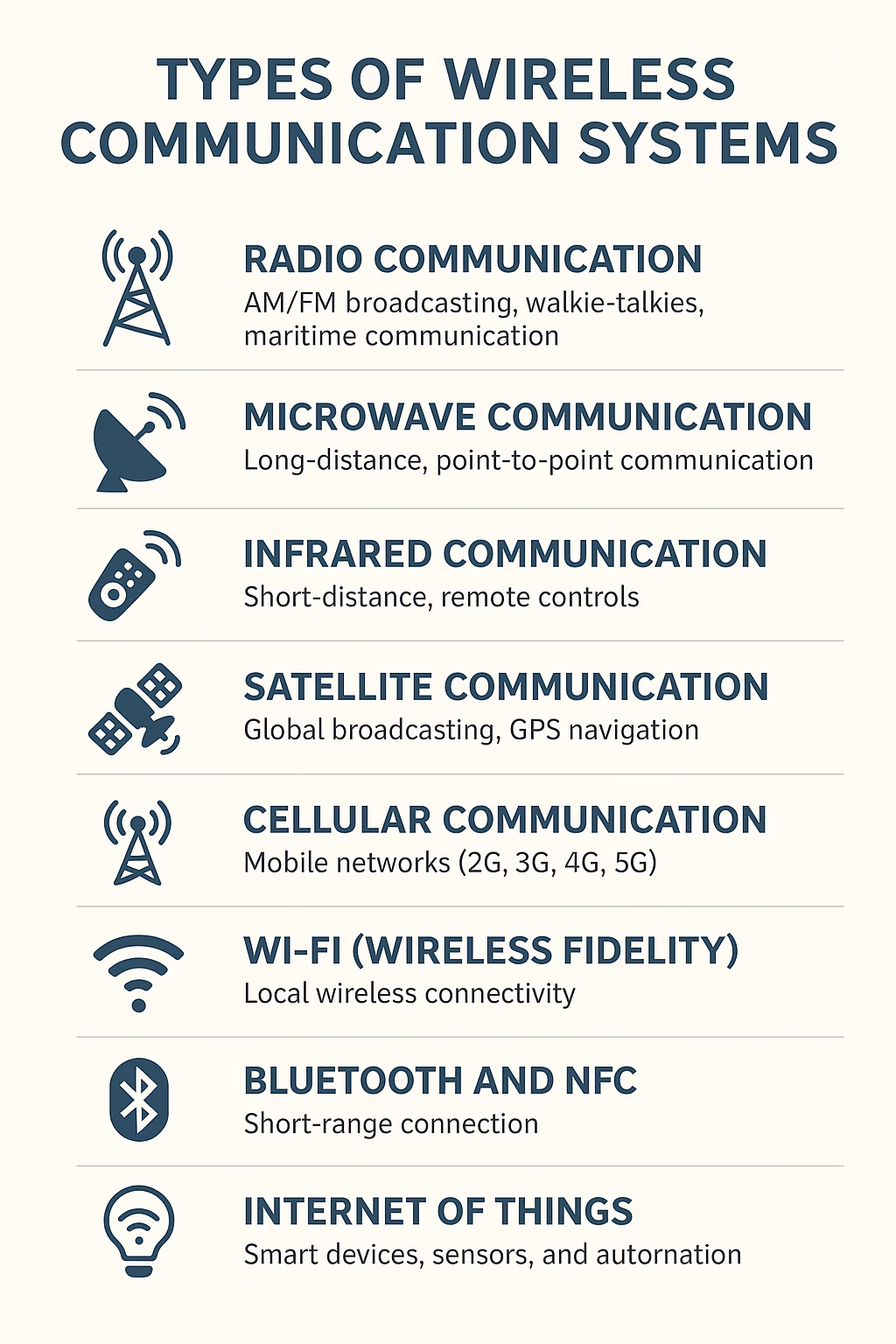
Radio and television rely heavily on RF signals to transmit audio and video content across large areas, connecting millions of people daily.
b. Telecommunications
Mobile phones, Wi-Fi, and Bluetooth utilize UHF, SHF, and EHF bands for high-speed data transfer, enabling global connectivity.
c. Navigation
Systems like GPS and maritime navigation use RF signals to provide accurate location and timing information essential for transportation and logistics.
d. Military and Aviation
RF communication is vital for aircraft communication, radar surveillance, and defense systems, ensuring safety and operational efficiency.
e. Medical Applications
RF is used in MRI machines, diathermy treatments, and other non-invasive medical technologies.


5. Importance of Radio Frequencies in Modern Technology
Radio frequencies are the backbone of wireless communication, supporting everything from smartphones and satellite communication to smart homes and industrial automation. The rise of the Internet of Things (IoT) and 5G networks further increases demand for RF spectrum, making efficient spectrum management critical.
6. Challenges in Radio Frequency Usage
Despite their benefits, RF systems face several challenges:
- Spectrum Scarcity: The growing number of wireless devices leads to congestion and competition for limited frequency bands.
- Interference: Overlapping signals can cause disruption, requiring advanced filtering and allocation strategies.
- Regulation: Governments and international bodies must coordinate to allocate frequencies effectively and prevent misuse.
7. The Future of Electromagnetic Spectrum Radio Frequencies
The evolution of 5G, satellite internet, autonomous vehicles, and AI-driven networks will push RF technologies to new limits. Higher frequency bands, such as millimeter waves (30 GHz and above), are expected to play a vital role in meeting future communication needs.
Conclusion of Electromagnetic Spectrum Radio Frequencies
The electromagnetic spectrum and its radio frequency segment form the invisible backbone of our connected world. From broadcasting and navigation to healthcare and defense, RF technologies touch nearly every aspect of modern life. As demand for wireless connectivity continues to grow, understanding and managing this finite resource will be crucial for sustaining innovation and progress.