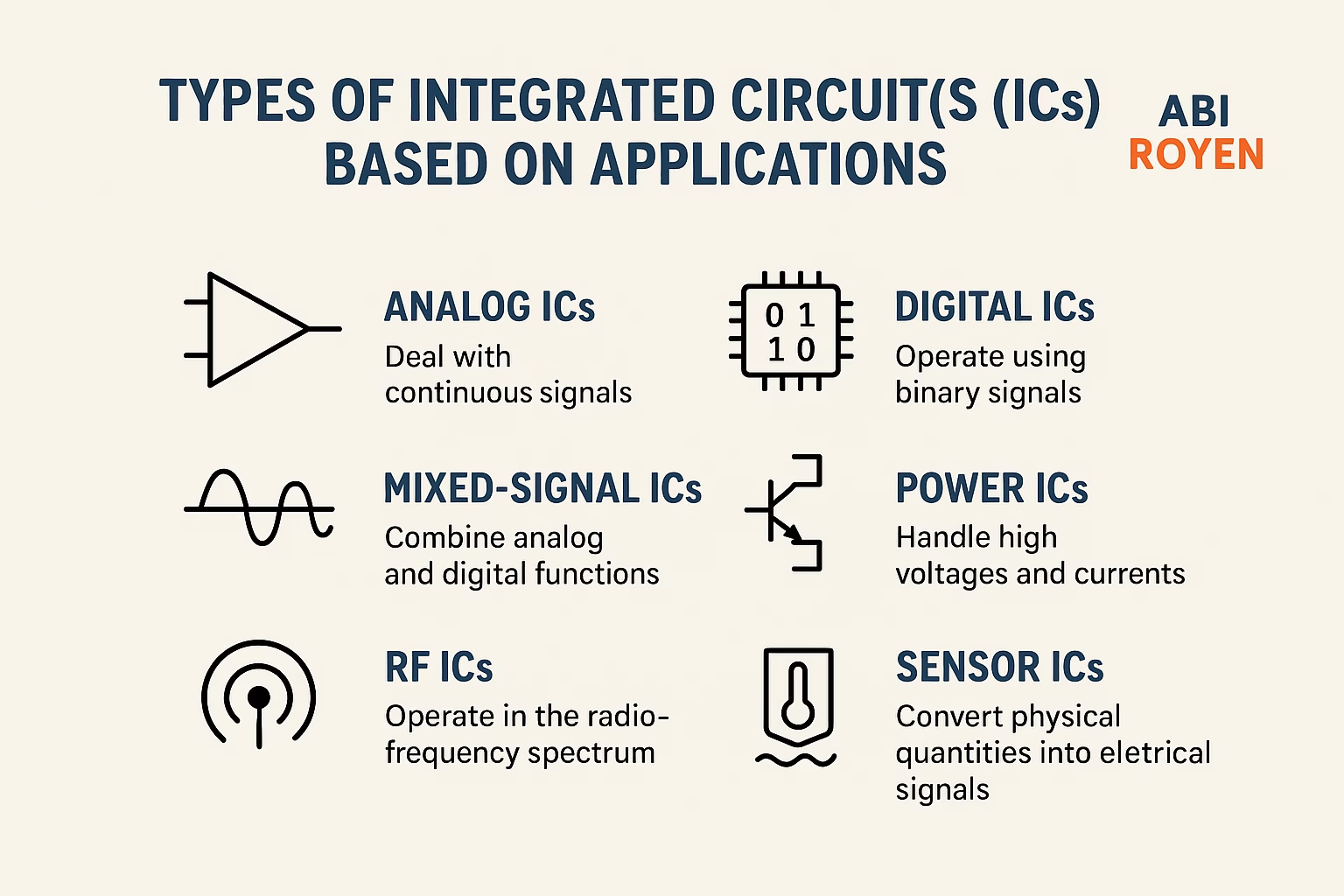
Digital Integrated Circuits (Digital ICs) are one of the most fundamental building blocks in modern electronics. From smartphones and computers to home appliances and industrial automation, these small yet powerful components enable devices to process and store information in digital form. Their development has transformed how we communicate, compute, and interact with technology.
In this article, we will explore what Digital Integrated Circuits are, how they work, their types, and their real-world applications.
What is a Digital Integrated Circuits?
A Digital Integrated Circuit is an electronic circuit built on a small semiconductor chip, designed to process digital signals. Unlike analog circuits, which handle continuous signals, digital ICs work with discrete binary values—0 (low) and 1 (high). This binary logic is the foundation of digital electronics.
Digital ICs are manufactured using semiconductor fabrication processes, typically on silicon wafers. They consist of millions—or even billions—of transistors interconnected to perform logical operations, arithmetic calculations, data storage, or signal processing.
How Do Digital Integrated Circuits Work?
Digital ICs operate by controlling the flow of electrical current through transistors, which act as tiny switches. These transistors form logic gates—such as AND, OR, and NOT—that process binary inputs to produce desired outputs.
For example:
- An AND gate outputs a “1” only if all inputs are “1”.
- An OR gate outputs a “1” if at least one input is “1”.
- A NOT gate inverts the input, turning a “1” into a “0” and vice versa.
By combining millions of these gates, complex digital functions such as addition, memory storage, and program execution become possible.
Types of Digital Integrated Circuits
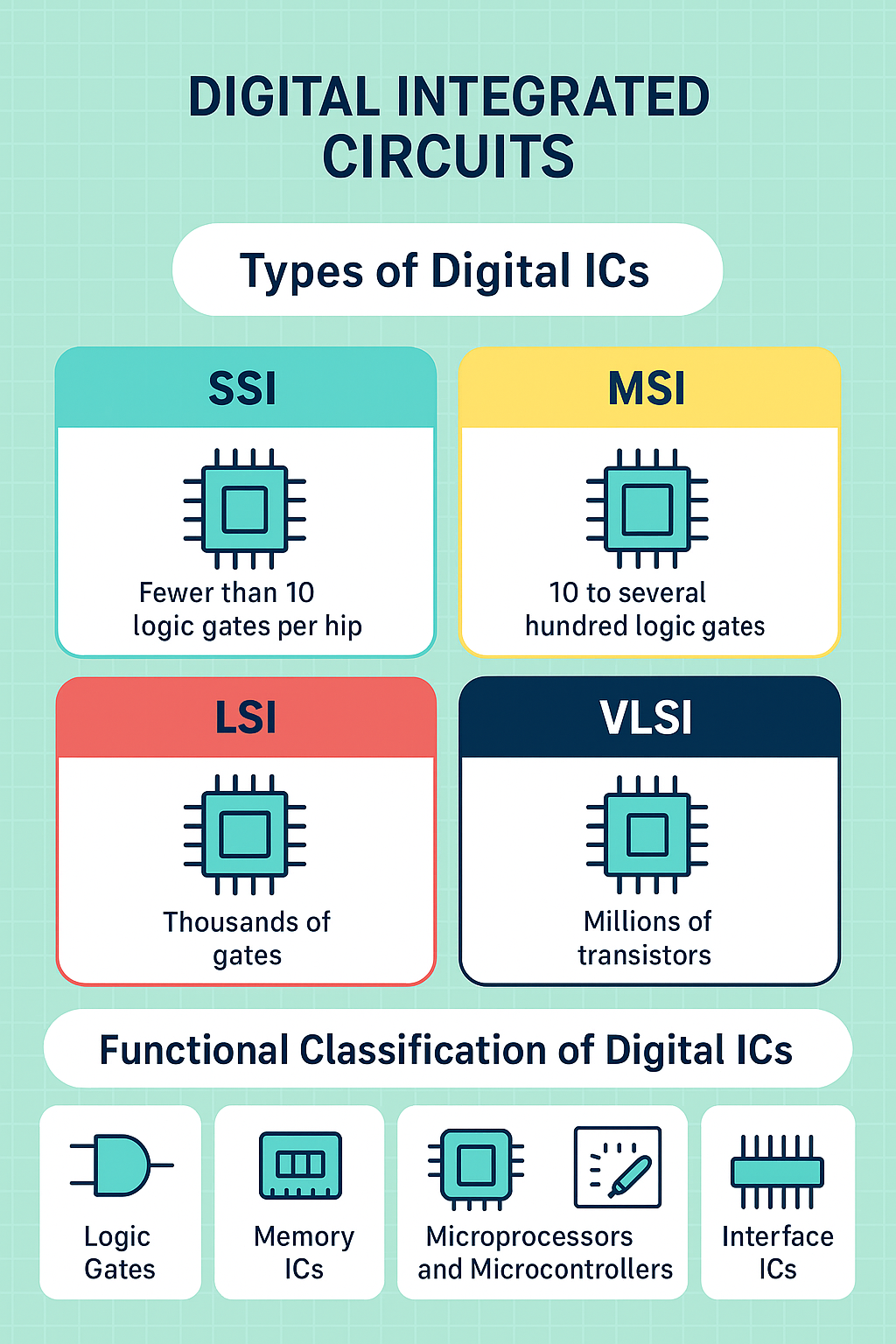
Digital ICs can be categorized based on their complexity, function, and the number of logic gates they contain. The most common classifications include:
1. SSI (Small-Scale Integration)
- Contains fewer than 10 logic gates per chip.
- Used in basic logic functions such as simple counters, encoders, and flip-flops.
- Early digital circuits in the 1960s were mostly SSI.
2. MSI (Medium-Scale Integration)
- Contains 10 to several hundred logic gates.
- Used for more complex circuits such as multiplexers, decoders, and small memory arrays.
- Popular in the 1970s for building functional modules in computing systems.
3. LSI (Large-Scale Integration)
- Contains thousands of gates on a single chip.
- Used in microprocessors, RAM chips, and programmable devices.
- Significantly reduced the size and cost of electronic systems in the 1980s.
4. VLSI (Very-Large-Scale Integration)
- Contains millions of transistors per chip.
- Used in modern microprocessors, GPUs, and FPGAs.
- Capable of executing complex operations at high speed.
5. ULSI (Ultra-Large-Scale Integration)
- Contains hundreds of millions or even billions of transistors.
- Found in cutting-edge processors for smartphones, supercomputers, and AI hardware.
Read this article for a more detailed explanation: Types of Digital Integrated Circuits: A Complete Guide
Functional Classification of Digital Integrated Circuits
Besides complexity, digital ICs can also be classified according to their function:
a. Logic Gates ICs
- Perform basic Boolean operations.
- Examples: 7400 series TTL ICs, 4000 series CMOS ICs.
b. Memory ICs
- Store digital data temporarily or permanently.
- Types: RAM (Random Access Memory), ROM (Read-Only Memory), Flash Memory.
c. Microprocessors and Microcontrollers
- The “brains” of computers and embedded systems.
- Microprocessors handle computation tasks.
- Microcontrollers integrate a processor with memory and input/output peripherals.
d. Programmable Logic Devices (PLDs)
- Customizable digital chips that allow users to program logic functions.
- Examples: FPGA (Field-Programmable Gate Array), CPLD (Complex Programmable Logic Device).
e. Interface ICs
- Handle communication between different systems or components.
- Examples: USB controllers, Ethernet transceivers.

Advantages of Digital Integrated Circuits
- High Reliability – Less affected by noise compared to analog circuits.
- Miniaturization – Thousands to billions of functions packed into a tiny chip.
- Low Power Consumption – Especially in CMOS-based digital ICs.
- Scalability – Can be designed for small gadgets or large-scale computing.
- Mass Production – Easily manufactured at scale, reducing costs.
Applications of Digital Integrated Circuits
Digital ICs are essential in almost every modern device. Common applications include:
- Computers and Laptops
- CPUs, RAM, and storage controllers are all digital ICs.
- Mobile Phones
- Digital ICs process signals, run apps, and manage data storage.
- Consumer Electronics
- Televisions, cameras, and game consoles rely on digital ICs.
- Industrial Automation
- Control systems and robotics use microcontrollers and programmable logic.
- Medical Devices
- Equipment like digital thermometers, ECG machines, and imaging systems.
- Automotive Systems
- Engine control units (ECUs), infotainment systems, and safety systems.
- Networking and Communication
- Routers, switches, and modems contain multiple digital ICs.
Future Trends in Digital Integrated Circuits Technology
The evolution of digital ICs is closely linked to Moore’s Law, which states that the number of transistors on a chip doubles roughly every two years. While physical limits are being reached, innovations such as 3D IC stacking, quantum computing, and neuromorphic processors promise to push the boundaries further.
Key trends include:
- AI-Optimized Chips for machine learning applications.
- Energy-Efficient Designs to reduce power consumption in IoT devices.
- Advanced Packaging Technologies to improve performance and heat dissipation.
Conclusion
Digital Integrated Circuits have revolutionized technology, enabling the compact, high-speed, and energy-efficient devices we rely on today. Whether in a simple digital watch or a powerful supercomputer, these chips are the heart of modern electronics.
As technology continues to evolve, digital ICs will only become more powerful, more efficient, and more integrated into every aspect of our lives.