

In the world of electronics, capacitors serve a wide range of purposes, from storing charge to filtering signals. Among their most critical uses are decoupling and bypassing capacitors. While often used interchangeably, these two terms describe slightly different but related functions. Both play a vital role in ensuring that electronic circuits remain stable, noise-free, and reliable.
This article explores the basics of decoupling and bypassing capacitors, how they work, their key differences, and why they are essential in modern electronics.
What Are Decoupling and Bypassing Capacitors?
- Decoupling Capacitors
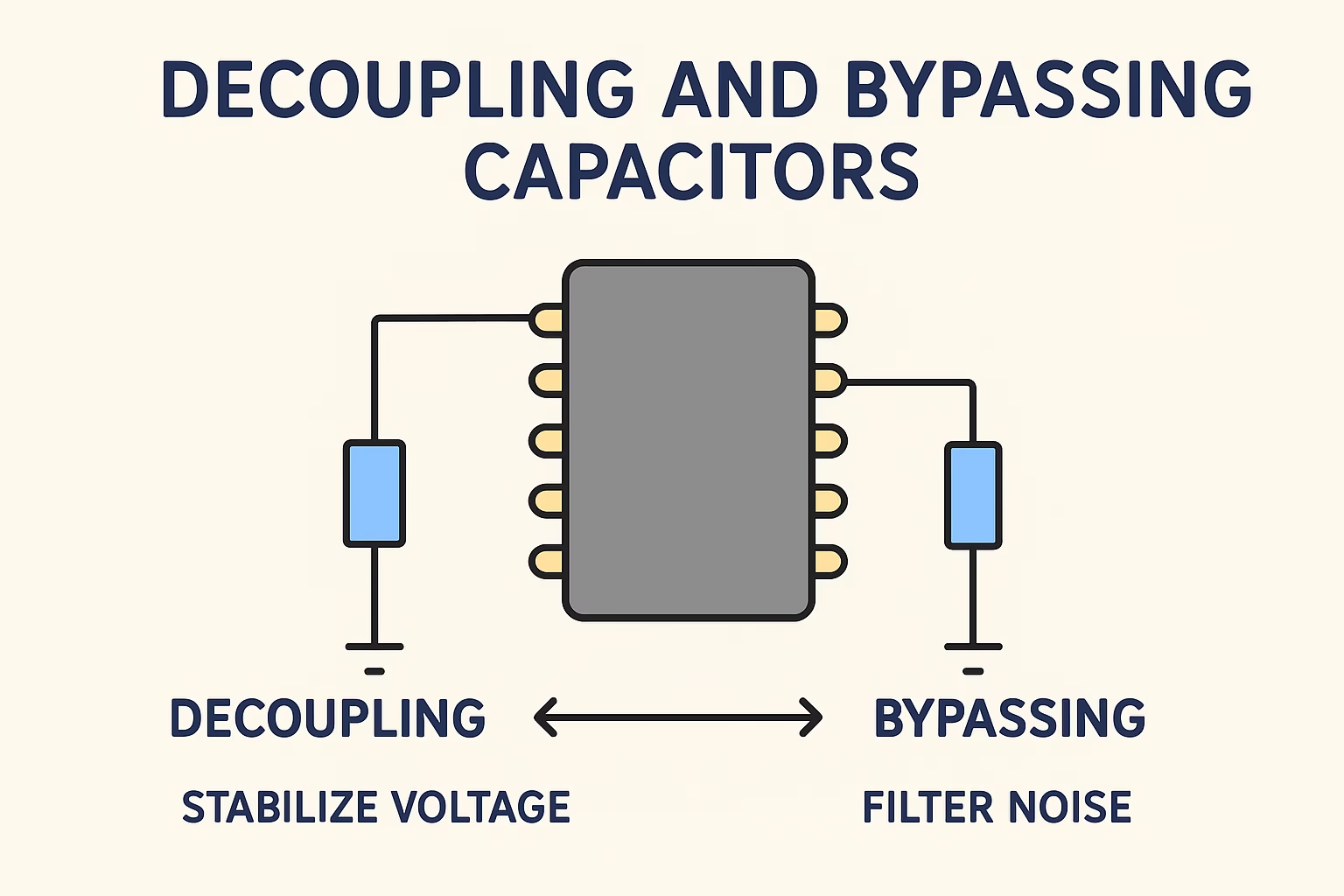
A decoupling capacitor is used to isolate one part of an electronic circuit from another. Its main function is to stabilize voltage levels by acting as a local energy reservoir. It helps prevent unwanted disturbances, such as voltage drops or noise, from propagating across different circuit sections. - Bypassing Capacitors
A bypassing capacitor is typically placed across a component, such as an integrated circuit (IC), to redirect high-frequency noise or alternating current (AC) signals to ground. Its job is to “bypass” noise away from sensitive components, allowing only the clean, stable direct current (DC) to reach them.
In practice, the same capacitor can often serve both decoupling and bypassing functions depending on its placement in the circuit.
Why Are They Important in Electronics?
Electronic circuits rely on steady voltage and current to function correctly. However, real-world systems are far from ideal. Power supplies introduce noise, ICs switch at high frequencies, and sudden current demands create voltage fluctuations.
Without decoupling and bypassing capacitors:
- Microcontrollers may reset unexpectedly.
- Amplifiers could pick up unwanted noise.
- Digital circuits may produce erratic outputs.
- Communication systems may lose signal integrity.
In short, these capacitors ensure circuit stability, noise reduction, and reliable performance.
How Do They Work (Decoupling and Bypassing Capacitors)
Capacitors store and release energy quickly, which makes them ideal for stabilizing voltage and filtering noise.
- For Decoupling:
When a circuit section suddenly requires more current (e.g., a microprocessor switching states), the decoupling capacitor supplies that current momentarily. This prevents a voltage dip that could disrupt nearby components. - For Bypassing:
When high-frequency noise is present on a supply line, the bypass capacitor provides a low-impedance path to ground, effectively filtering out the noise before it reaches the sensitive IC.

Key Differences Between Decoupling and Bypassing Capacitors
| Feature | Decoupling Capacitor | Bypassing Capacitor |
|---|---|---|
| Primary Role | Isolates circuit sections, stabilizes supply | Removes unwanted AC signals, filters noise |
| Placement | Between power supply and IC | Across IC power pins and ground |
| Frequency Range | Handles broader fluctuations | Targets high-frequency noise |
| Focus | Voltage stability | Noise suppression |
Where Are They Used?
1. Microcontrollers and Microprocessors
Every microcontroller or microprocessor typically has multiple decoupling/bypassing capacitors placed near its power pins. This ensures that rapid switching does not cause voltage fluctuations.
2. Power Supply Circuits
Bypass capacitors help reduce ripple and noise in regulated power supplies, ensuring smooth DC voltage output.
3. Analog Circuits
Operational amplifiers and audio circuits rely heavily on bypass capacitors to prevent high-frequency noise from corrupting the signal.
4. Communication Systems
Wireless modules and RF circuits use bypass capacitors to maintain signal clarity by eliminating high-frequency interference.
How to Choose the Right Capacitor
When designing circuits, selecting the right decoupling or bypassing capacitor is critical. Consider the following factors:
- Capacitance Value
- Small capacitors (e.g., 0.1 µF ceramic) are effective at high-frequency noise suppression.
- Larger capacitors (e.g., 10 µF electrolytic) help stabilize low-frequency voltage fluctuations.
- Dielectric Type
- Ceramic capacitors: Best for high-frequency applications due to low equivalent series resistance (ESR).
- Electrolytic capacitors: Provide higher capacitance values for bulk decoupling.
- Placement
The capacitor must be placed as close as possible to the IC power pin for maximum effectiveness. - Voltage Rating
Choose a capacitor with a voltage rating at least twice the supply voltage to ensure reliability.
Practical Design Tips
- Use multiple capacitors in parallel (e.g., 0.1 µF + 10 µF) to cover a wider frequency range.
- Place capacitors physically close to the IC pins for best performance.
- Ensure proper grounding, as a poor ground connection can reduce effectiveness.
- Distribute decoupling capacitors across the PCB to support different sections.
Real-World Example
In a microcontroller-based circuit:
- A 0.1 µF ceramic capacitor is placed directly across the Vcc and GND pins of the microcontroller to filter high-frequency noise.
- A 10 µF electrolytic capacitor is added near the power input to smooth out lower-frequency fluctuations.
Together, these capacitors ensure both decoupling and bypassing, resulting in stable and reliable operation.
Conclusion of Decoupling and Bypassing Capacitors
Decoupling and bypassing capacitors are essential for every electronic design. They provide voltage stability, reduce noise, and protect sensitive components from disturbances. While their roles overlap, understanding the subtle differences helps engineers design more reliable circuits.
Whether you are building a simple microcontroller project or designing complex communication equipment, including the right capacitors in the right places ensures performance, stability, and longevity of the system.
By paying attention to capacitor selection and placement, engineers can greatly enhance the quality of their electronic designs.