Introduction: What is an Inductor?
What is an Inductor? ~ In the world of electronics, certain passive components play crucial roles in shaping how electrical circuits function. Alongside resistors and capacitors, the inductor is one of the most fundamental and widely used components. Despite its simple construction, the inductor is indispensable in power electronics, signal processing, radio-frequency systems, and energy storage applications.
So, what is an inductor? In the simplest terms, an inductor is a passive electrical component that stores energy in the form of a magnetic field when electric current flows through it. Its primary role is to resist sudden changes in current, making it essential for circuits that require filtering, energy storage, or inductive coupling.
In this article, we will explore the definition of inductors, their working principle, types, characteristics, and applications across different industries.
What is an Inductor?
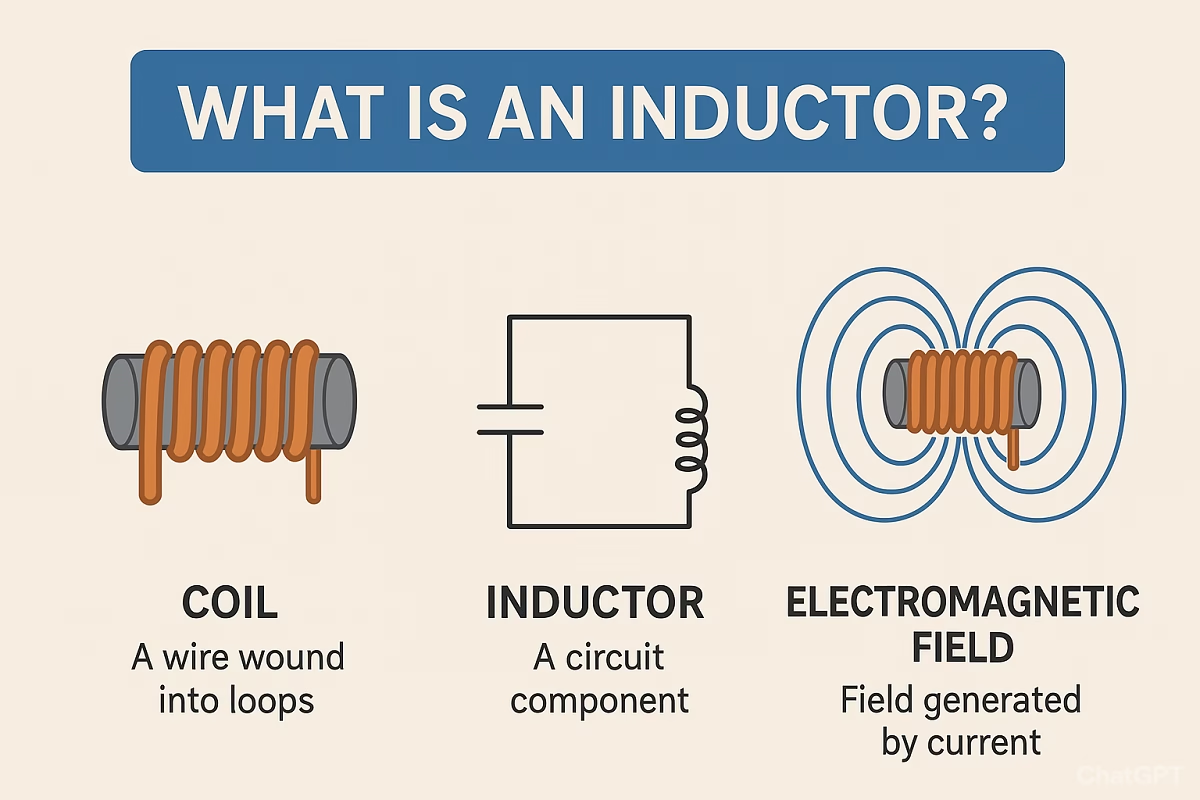
An inductor is a passive electronic component typically made by winding a wire into a coil. When current flows through this coil, it generates a magnetic field that stores energy. This property is called inductance, measured in Henrys (H).
The ability of an inductor to oppose changes in current makes it valuable in stabilizing circuits, filtering signals, and enabling power transfer. Unlike resistors, which dissipate energy as heat, inductors temporarily store energy in their magnetic field and release it when needed.
Working Principle of an Inductor
The principle behind inductors is rooted in Faraday’s Law of Electromagnetic Induction. According to this law, when the current flowing through a coil changes, it induces a voltage (electromotive force or EMF) that opposes the change in current. This effect is known as self-induction.
Mathematically, the induced voltage in an inductor is expressed as: V=LdidtV = L \frac{di}{dt}V=Ldtdi
Where:
- V = induced voltage
- L = inductance of the coil (measured in Henrys)
- di/dt = rate of change of current
This means that inductors resist sudden changes in current, acting as a kind of “buffer” in electrical circuits.

Key Characteristics of Inductors
When analyzing inductors in circuits, several important parameters come into play:
- Inductance (L): The ability of the inductor to store energy, measured in Henrys (H).
- Core Material: Air, iron, or ferrite cores affect the magnetic field strength and efficiency.
- DC Resistance (DCR): The resistance of the wire used to create the coil.
- Rated Current: The maximum current the inductor can handle before saturating.
- Quality Factor (Q): The efficiency of the inductor in terms of energy storage versus energy loss.
Types of Inductors
Inductors come in various designs to suit different applications. The major types include:
1. Air Core Inductor
- Uses air or non-magnetic material as the core.
- Offers low inductance but excellent high-frequency performance.
- Commonly used in RF circuits and communication systems.
2. Iron Core Inductor
- Uses laminated iron as the core material.
- Provides higher inductance and magnetic strength.
- Used in low-frequency power applications like transformers.
3. Ferrite Core Inductor
- Uses ferrite material for the core, offering high permeability.
- Reduces energy loss and improves efficiency at high frequencies.
- Commonly found in switching power supplies and RF circuits.
4. Toroidal Inductor
- Shaped like a ring (toroid), minimizing electromagnetic interference (EMI).
- Provides high efficiency and compact design.
- Widely used in power conditioning and audio systems.
5. Multilayer Inductor
- Built with multiple layers of windings and cores.
- Small and compact, ideal for surface-mount technology (SMT).
- Often used in smartphones, laptops, and other compact electronics.
Functions of Inductors in Electrical Circuits
Inductors serve various purposes depending on their placement and design. Key functions include:
- Energy Storage: Stores energy in the magnetic field for later use.
- Filtering Signals: Used in low-pass, high-pass, and band-pass filters to control frequencies.
- Inductive Coupling: Transfers energy between circuits, as in transformers.
- Chokes: Suppress unwanted high-frequency signals in circuits.
- Voltage Regulation: Help stabilize voltage in power supplies.
Applications of Inductors
Inductors are applied across industries ranging from consumer electronics to power grids. Some notable applications include:
1. Power Supplies
Inductors smooth out fluctuations in current, stabilize voltage, and improve efficiency in switching power supplies.
2. Radio-Frequency Circuits
Used in RF communication systems to tune frequencies and filter unwanted signals.
3. Transformers
By coupling inductors, transformers enable efficient voltage conversion and isolation.
4. Energy Storage Systems
In renewable energy (solar, wind) and electric vehicles, inductors store and release energy for stable operation.
5. Automotive Industry
Inductors are vital in electric vehicles (EVs) for motor drives, charging systems, and electronic control units.
6. Consumer Electronics
Smartphones, laptops, and TVs use inductors for power management, signal filtering, and EMI suppression.
7. Industrial Automation
Inductors help maintain consistent power flow in robotics, motor drives, and automation systems.
Advantages and Disadvantages of Inductors
Advantages:
- Efficient energy storage in magnetic fields.
- Effective in filtering and signal processing.
- Durable and long-lasting with minimal wear.
Disadvantages:
- Bulkier compared to capacitors and resistors.
- Can be expensive, especially at high inductance levels.
- Energy losses due to resistance and core hysteresis.
Inductors vs. Capacitors: Key Differences
Both inductors and capacitors are energy storage components, but they store energy in different forms.
- Inductors: Store energy in a magnetic field and resist changes in current.
- Capacitors: Store energy in an electric field and resist changes in voltage.
This complementary behavior is why inductors and capacitors are often paired together in filters, oscillators, and power circuits.
Future Trends in Inductor Technology
As technology advances, inductors are evolving to meet new demands:
- Miniaturization: Development of smaller, high-efficiency inductors for portable devices.
- High-Frequency Applications: Enhanced materials for faster data and communication systems.
- Sustainable Energy Systems: Use in renewable energy storage and smart grid technologies.
Conclusion of What is an Inductor?
So, what is an inductor? In short, it is a vital passive component that stores energy in a magnetic field, resists sudden current changes, and plays a crucial role in modern electronics. From powering smartphones and laptops to enabling renewable energy and electric vehicles, inductors are everywhere in our daily lives.
Understanding the definition, working principle, types, functions, and applications of inductors is essential for anyone interested in electronics and electrical engineering. As industries demand more efficient and compact solutions, inductors will continue to be a cornerstone of innovation in technology.