Introduction
Challenges and Future Computers ~ Computers have transformed the way humans live, work, and communicate. From large mainframes in the mid-20th century to today’s ultra-portable devices, computers have been central to technological progress. However, the world of computing is not without challenges. As the demand for faster, more secure, and more efficient systems increases, researchers, engineers, and companies face obstacles that will shape the next generation of technology.
In this article, we will explore the current challenges in computer technology and the future directions of computing, including artificial intelligence, quantum computing, cloud evolution, cybersecurity, and sustainability.
Current Challenges and Future Computers Technology
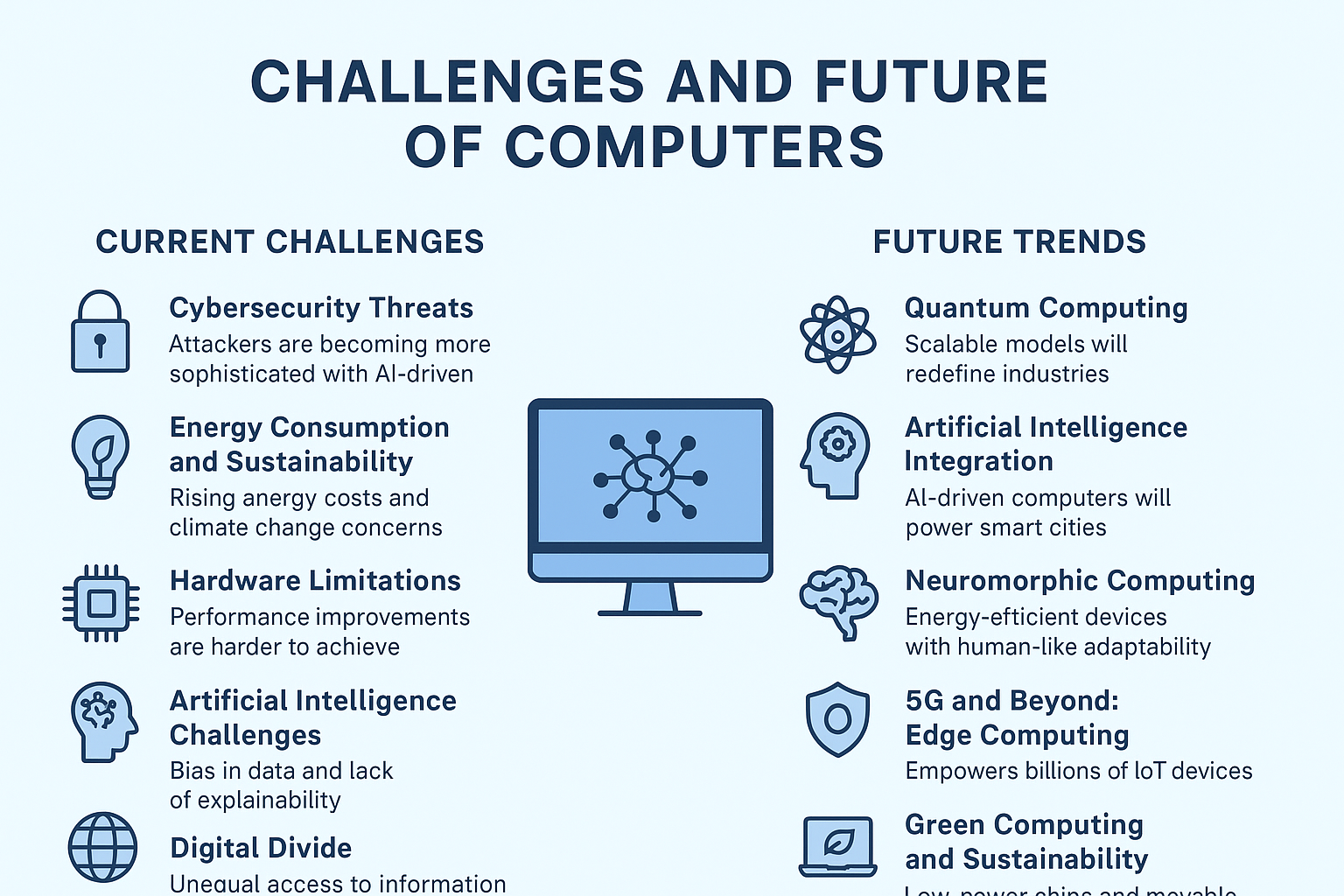
1. Cybersecurity Threats
With the growing reliance on digital systems, cybersecurity is one of the biggest challenges. Cyberattacks, data breaches, ransomware, and phishing have become daily threats. As computers manage sensitive data from governments, businesses, and individuals, security systems must constantly evolve to prevent malicious exploitation.
- Problem: Attackers are becoming more sophisticated with AI-driven attacks.
- Impact: Financial loss, privacy violations, and even national security risks.
- Solution: Advanced encryption, zero-trust architecture, and AI-based threat detection.
2. Energy Consumption and Sustainability
The energy demands of computers, especially data centers, are massive. Supercomputers and AI models require enormous computational power, leading to high electricity usage. This creates environmental challenges in terms of carbon footprint and sustainability.
- Problem: Rising energy costs and climate change concerns.
- Impact: Pressure on power grids and environmental damage.
- Solution: Energy-efficient processors, green data centers, and renewable-powered IT infrastructure.
3. Hardware Limitations
Moore’s Law, which predicted the doubling of transistors on a chip every two years, is slowing down. Traditional silicon-based computing faces physical limits as transistors reach atomic scales.
- Problem: Performance improvements are harder to achieve.
- Impact: Reduced growth in processing power.
- Solution: Development of new materials (graphene, carbon nanotubes) and alternative computing models.
4. Artificial Intelligence Challenges
While AI brings innovation, it also introduces unique challenges. Training large AI models requires massive resources, often leading to bias in data, lack of transparency, and ethical concerns.
- Problem: AI bias and lack of explainability.
- Impact: Mistrust in AI decisions (healthcare, law, hiring).
- Solution: Explainable AI (XAI), fair algorithms, and responsible AI frameworks.
5. Digital Divide
Access to computers and the internet is uneven across the globe. Many rural and underdeveloped regions still lack reliable access to computing resources.
- Problem: Unequal access to information and education.
- Impact: Widening global inequality.
- Solution: Affordable computers, satellite internet, and global digital inclusion programs.
The Future of Computers
Despite challenges, the future of computing is promising. With innovation in multiple fields, computers will become faster, smarter, more secure, and environmentally sustainable.
1. Quantum Computing
Quantum computing promises to revolutionize problem-solving by performing calculations beyond the reach of classical computers.
- Applications: Drug discovery, cryptography, climate modeling, logistics optimization.
- Future Outlook: Though still in early stages, quantum computers will redefine industries once scalable models are achieved.
2. Artificial Intelligence Integration
AI will continue to advance and integrate deeply into computing systems. Future computers will act more like intelligent assistants, capable of understanding context and making decisions.
- Applications: Personalized healthcare, predictive analytics, autonomous systems.
- Future Outlook: AI-driven computers will power smart cities, automation, and global industries.
3. Neuromorphic Computing
Neuromorphic chips mimic the human brain’s structure, enabling more efficient and adaptive computing.
- Applications: Robotics, machine learning, IoT.
- Future Outlook: These chips will create energy-efficient devices with human-like adaptability.
4. 5G and Beyond: Edge Computing
With the expansion of 5G networks, computing is moving closer to the edge (devices rather than data centers). This allows faster processing, reduced latency, and real-time decision-making.
- Applications: Autonomous cars, AR/VR, industrial automation.
- Future Outlook: Edge computing will empower billions of IoT devices worldwide.
5. Cybersecurity Evolution
The future of cybersecurity will involve AI-powered defense, quantum encryption, and decentralized systems to protect sensitive data.
- Future Outlook: Advanced protection will be essential for financial systems, defense networks, and personal privacy.
6. Green Computing and Sustainability
Future computers will prioritize energy efficiency. Renewable-powered data centers, recyclable materials, and low-power chips will be standard.
- Future Outlook: Computing will align with global sustainability goals, reducing environmental impact.

Conclusion of Challenges and Future Computers
Computers are at a critical point in their evolution. While challenges like cybersecurity, sustainability, and hardware limitations continue to pose barriers, the future of computers holds extraordinary possibilities. From quantum breakthroughs to sustainable solutions, the next era of computing will reshape industries, societies, and everyday life.
By addressing today’s problems with innovation and responsibility, computers will continue to drive progress, connecting humanity to a smarter and more sustainable digital future.