

Introduction
Applications of Radio ~ Radio technology has been a cornerstone of modern communication for over a century, but its applications have evolved far beyond traditional AM/FM broadcasting. In today’s fast-paced and interconnected world, radio waves power critical systems in transportation, healthcare, defense, entertainment, and even space exploration. This evolution is driven by advancements in electronics, miniaturization, and wireless connectivity, making radio technology an indispensable part of daily life and industrial progress.
This article explores the key applications of radio in the modern world, highlighting its importance in communication, navigation, safety, and innovation.
1. Applications of Radio: Radio Broadcasting: Entertainment and Information
One of the most well-known applications of radio technology is broadcasting. While television and the internet have gained dominance, radio remains a widely accessible and cost-effective medium for entertainment, education, and news.
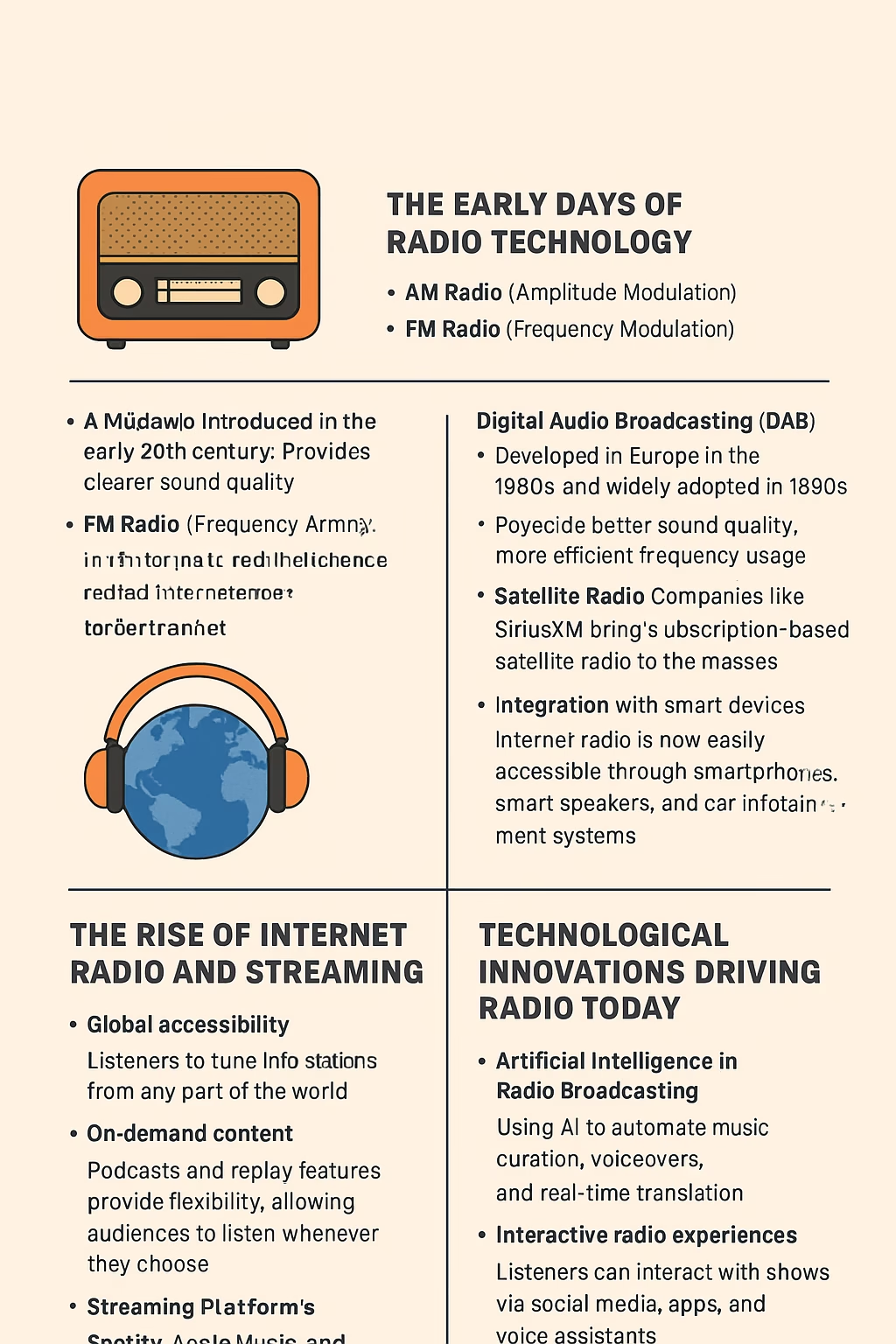
- AM/FM Radio: Delivers music, news, and talk shows to a wide audience.
- Digital Radio (DAB): Provides higher audio quality and more station options.
- Internet Radio: Combines radio broadcasting with online streaming for global access.
Radio broadcasting is especially vital in rural or disaster-prone areas where internet and television signals may be unavailable.
2. Two-Way Communication Systems
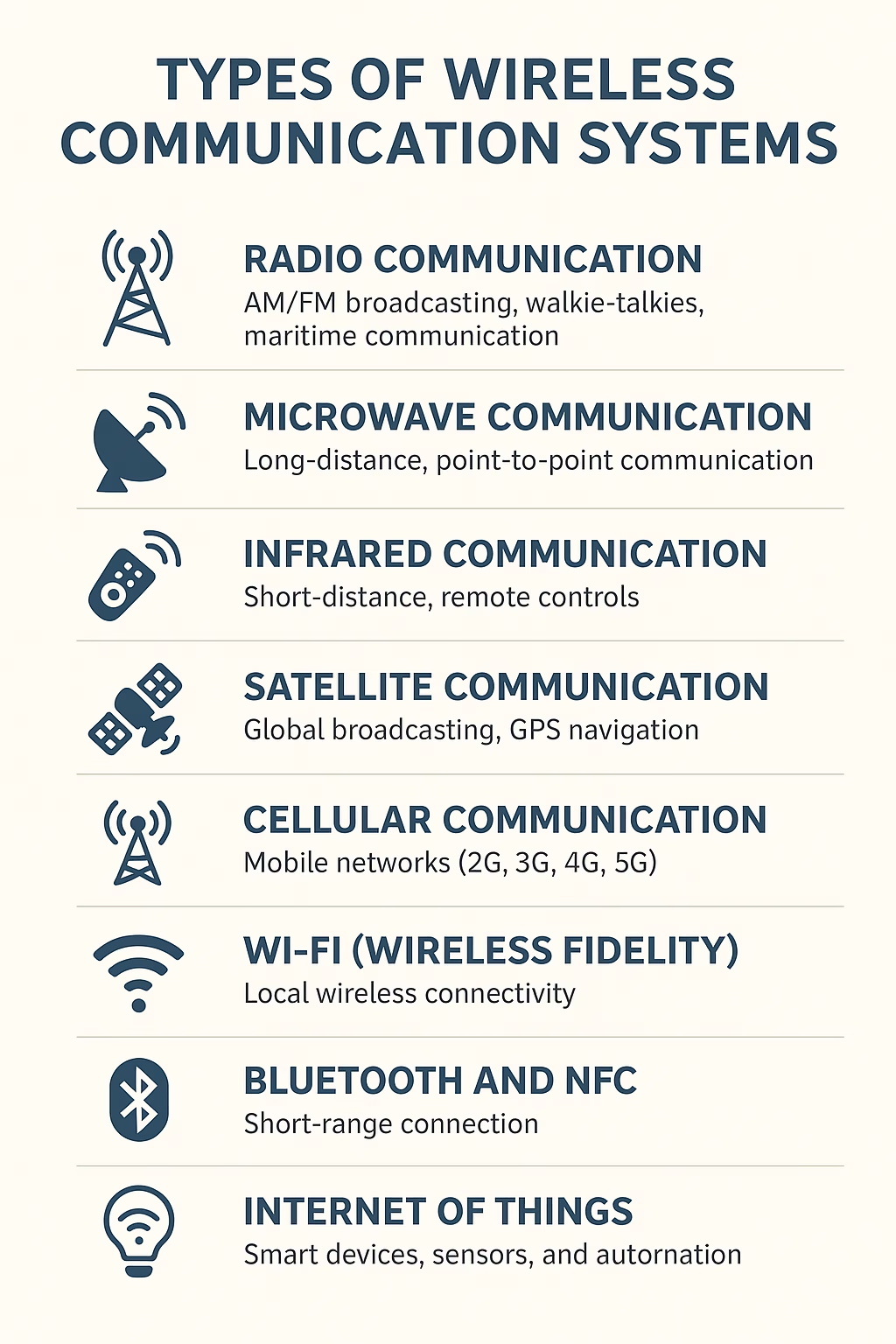
Two-way radios are crucial for instant communication in industries, public safety, and military operations. Unlike one-way broadcasting, these systems allow real-time voice transmission between two or more parties.
- Walkie-Talkies: Used in security, events, and outdoor activities.
- Marine and Aviation Radios: Enable pilots and ship captains to communicate with control towers and each other.
- Emergency Services Radios: Police, firefighters, and paramedics rely on secure and reliable radio channels.
3. Applications of Radio: Navigation and Positioning Systems
Modern navigation would be impossible without radio technology. Systems like GPS (Global Positioning System) depend on satellites that transmit radio signals to receivers on the ground.
- GPS: Used in smartphones, vehicles, and logistics for precise location tracking.
- Aviation Navigation: Aircraft use VHF and HF radio signals for navigation and landing assistance.
- Maritime Navigation: Ships use radio beacons and AIS (Automatic Identification System) for safe travel.
These radio-based systems ensure safety and efficiency in global transportation.
4. Applications of Radio: Radio in Healthcare
Radio technology plays a vital role in modern healthcare by enabling advanced diagnostic and therapeutic tools.
- MRI (Magnetic Resonance Imaging): Uses radio waves and magnetic fields to produce detailed images of the body.
- Wireless Medical Devices: Radio frequency communication allows remote monitoring of patients’ vital signs.
- Hearing Aids: Many modern devices use radio technology for wireless sound transmission.
These applications improve patient care, diagnosis speed, and treatment effectiveness.
5. Applications of Radio: Military and Defense Applications
Radio communication is essential for military coordination, intelligence, and defense operations.
- Encrypted Military Radios: Ensure secure communication between troops and command centers.
- Radar Systems: Use radio waves to detect aircraft, ships, and missiles.
- Remote-Controlled Drones: Operated via radio frequency links for surveillance and combat missions.
Radio technology ensures quick decision-making and operational safety in critical defense missions.
6. Applications of Radio: Industrial and Scientific Applications
In industry and research, radio frequencies are used in monitoring, control, and experimentation.
- Industrial Remote Controls: Used to operate cranes, mining equipment, and automated machinery.
- RFID (Radio Frequency Identification): Tracks goods in warehouses and supply chains.
- Scientific Research: Radio telescopes detect signals from deep space to study celestial bodies.
These applications drive efficiency, innovation, and discovery in multiple sectors.

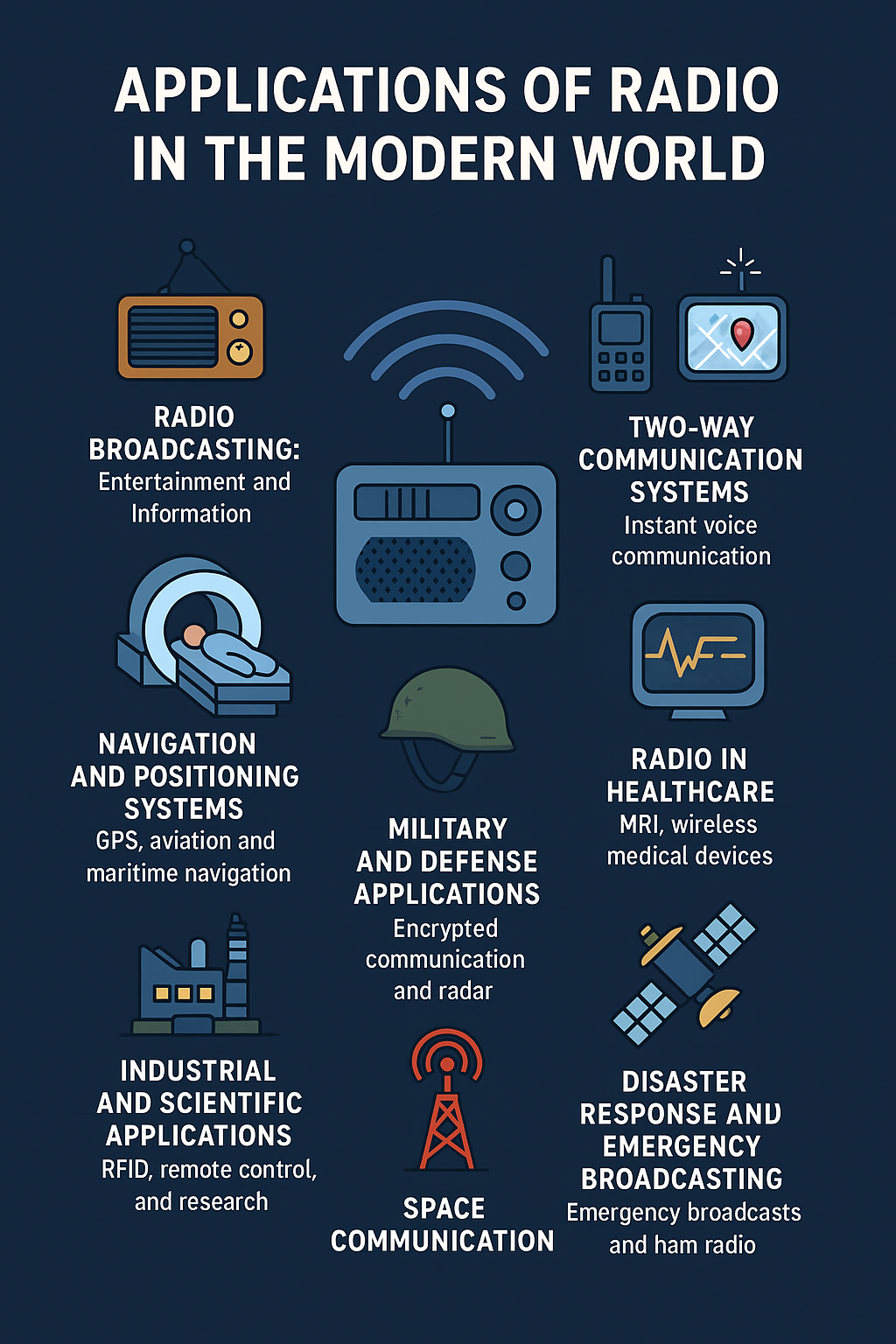
7. Space Communication
Space exploration would be impossible without radio technology. From the first moon landing to modern Mars rovers, all space missions depend on radio signals to communicate across vast distances.
- Deep Space Network (DSN): Uses high-powered radio antennas to communicate with spacecraft millions of kilometers away.
- Satellite Communication: Transmits data between satellites and Earth for weather monitoring, navigation, and scientific research.
Without radio waves, humanity would have no way to control or receive data from space missions.
8. Applications of Radio: Disaster Response and Emergency Broadcasting
In times of natural disaster or emergency, radio remains the most reliable form of mass communication.
- Emergency Broadcast Systems: Warn the public of impending danger.
- Amateur Radio (Ham Radio): Operates independently of the internet and telephone networks, making it crucial during outages.
- Rescue Operations: Radio communication allows coordination among rescue teams in disaster zones.
This resilience makes radio a life-saving technology during crises.
Conclusion
From broadcasting your favorite morning show to guiding spacecraft through deep space, radio technology has proven to be versatile, reliable, and essential in the modern world. Its applications span entertainment, navigation, healthcare, defense, industry, and scientific exploration—making it one of the most impactful technologies in human history.
As technology continues to evolve, radio will remain a foundation for communication and innovation, adapting to new challenges while preserving its unique strengths.