Applications of Multilayer Inductors ~ In the world of modern electronics, passive components play a crucial role in ensuring efficient performance and stability of circuits. Among these, multilayer inductors are highly valued due to their compact size, reliability, and ability to function effectively at high frequencies. They are widely used in smartphones, IoT devices, communication systems, medical electronics, and automotive technology.
This article explores the applications of multilayer inductors, their importance, and how they contribute to the advancement of electronic systems.
What Are Multilayer Inductors?
A multilayer inductor is a passive electronic component designed to store energy in the form of a magnetic field. Unlike traditional wire-wound inductors, multilayer inductors are manufactured by layering conductive and dielectric materials to create a compact and highly efficient structure.
Key features of multilayer inductors include:
- Miniaturization – ideal for compact devices like smartphones and IoT sensors.
- High-frequency performance – excellent for RF (radio frequency) circuits.
- Reliability – stable performance under various environmental conditions.
- Low loss characteristics – ensuring energy efficiency in electronic systems.
Major Applications of Multilayer Inductors
1. Applications of Multilayer Inductors: Smartphones and Mobile Devices
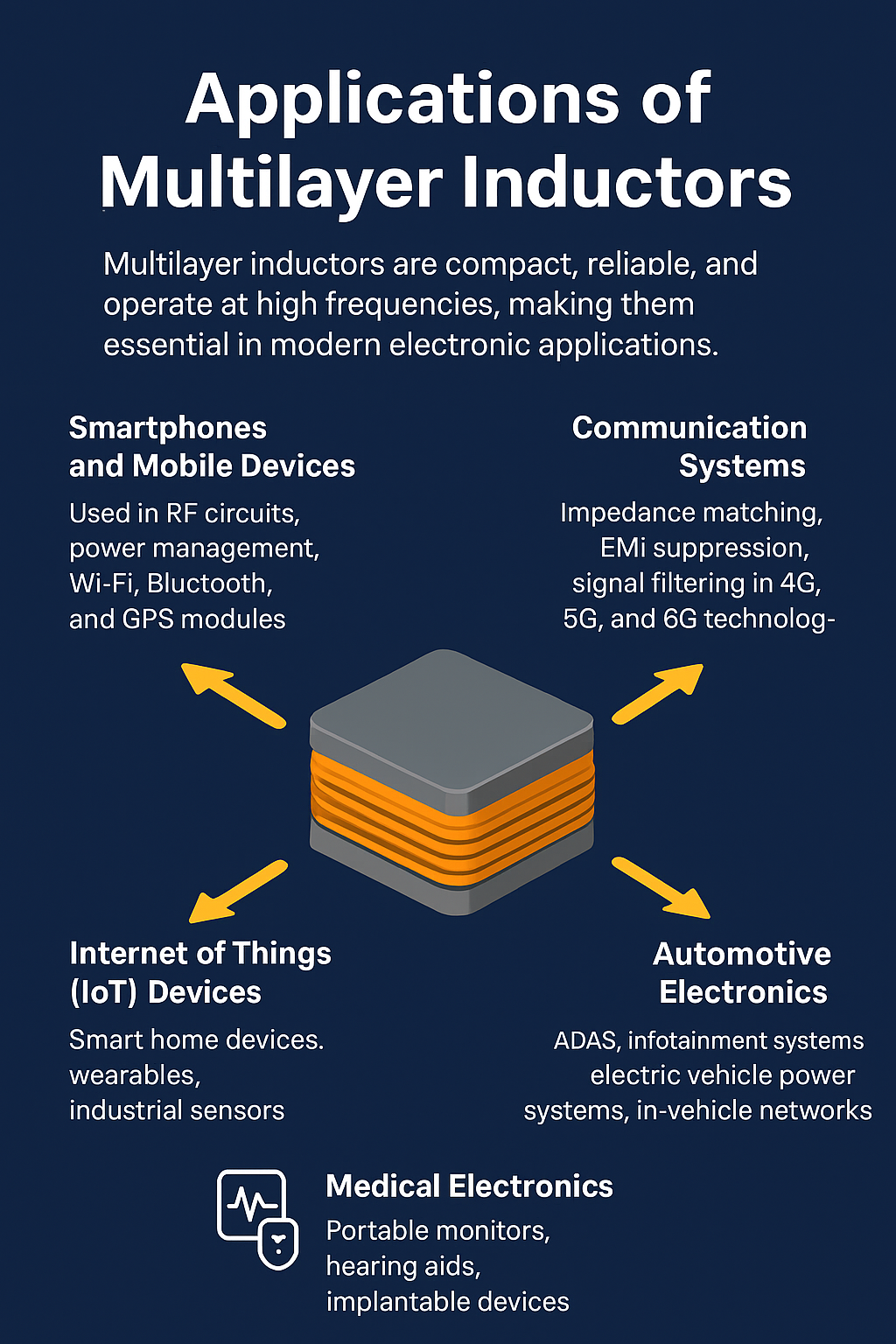
Multilayer inductors are essential in mobile communication technology. They are used in:
- RF circuits for signal filtering and noise suppression.
- Power management circuits to stabilize voltage and reduce interference.
- Wi-Fi, Bluetooth, and GPS modules to ensure reliable connectivity.
Since smartphones require high-density integration, multilayer inductors are preferred for their small size and ability to handle high frequencies.
2. Communication Systems
In wireless communication systems, multilayer inductors serve critical functions such as:
- Impedance matching in RF circuits.
- EMI (Electromagnetic Interference) suppression to reduce noise.
- Signal filtering in base stations and satellite communication devices.
They ensure stable transmission and reception of signals, making them indispensable in 4G, 5G, and emerging 6G technologies.
3. Applications of Multilayer Inductors: Internet of Things (IoT) Devices
With the growth of IoT technology, multilayer inductors are widely adopted in:
- Smart home devices like smart speakers, lighting systems, and thermostats.
- Wearable electronics including fitness trackers and smartwatches.
- Industrial IoT sensors used for automation and predictive maintenance.
The miniaturized structure of multilayer inductors makes them perfect for IoT devices that require long battery life and stable wireless communication.
4. Automotive Electronics
The automotive industry is increasingly dependent on advanced electronics for safety, efficiency, and connectivity. Multilayer inductors are applied in:
- Advanced Driver Assistance Systems (ADAS) for signal processing.
- Infotainment systems to ensure high-quality audio and video signals.
- Electric vehicle (EV) power systems for energy efficiency.
- In-vehicle communication networks such as CAN (Controller Area Network).
Their ability to withstand harsh environmental conditions makes multilayer inductors highly reliable for automotive use.
5. Medical Electronics
In healthcare technology, multilayer inductors are crucial in designing compact and reliable devices, including:
- Portable medical monitors such as ECG and blood pressure devices.
- Hearing aids where size and efficiency are critical.
- Implantable devices that require long-lasting and stable performance.
The compact structure of multilayer inductors supports the miniaturization of medical devices, enhancing patient comfort and usability.
6. Applications of Multilayer Inductors: Consumer Electronics
Everyday electronic devices also rely on multilayer inductors for:
- Noise suppression in laptops, tablets, and gaming consoles.
- Signal stability in wireless routers and smart TVs.
- Battery management systems in portable devices.
Their high reliability ensures consistent performance in consumer gadgets.
7. Applications of Multilayer Inductors: Industrial Electronics and Automation
In industrial environments, multilayer inductors help achieve:
- Power regulation in automation controllers.
- Signal filtering in industrial communication networks.
- EMI suppression in factory machinery and robotics.
By improving energy efficiency and reducing interference, multilayer inductors support advanced industrial automation systems.

Advantages of Using Multilayer Inductors
The widespread adoption of multilayer inductors is driven by several benefits:
- Compact design – suitable for portable and miniaturized devices.
- High reliability – stable under varying temperature and humidity.
- Superior high-frequency characteristics – ideal for RF and communication circuits.
- Cost efficiency – easier integration into mass-produced electronics.
- Wide application range – from consumer electronics to automotive and medical technology.
Future Trends in Multilayer Inductors
With the rapid growth of technologies like 5G, autonomous vehicles, IoT, and smart healthcare, the demand for multilayer inductors will continue to rise. Manufacturers are working to improve:
- Higher Q factor inductors for better efficiency.
- Ultra-miniaturized designs for wearable and implantable devices.
- Enhanced reliability for automotive and industrial applications.
As electronic systems become more advanced, multilayer inductors will remain one of the most critical passive components in circuit design.
Conclusion
Multilayer inductors are vital components in today’s electronics, providing stability, miniaturization, and efficiency across industries. From smartphones and IoT devices to automotive systems and medical electronics, their applications are vast and growing.
By supporting high-frequency performance, noise suppression, and energy efficiency, multilayer inductors enable the advancement of modern technologies that define our digital world.
For engineers, designers, and technology enthusiasts, understanding the applications of multilayer inductors is key to building reliable and innovative electronic systems.