

Introduction of What is Integrated Circuit?
What is Integrated Circuit? ~ In today’s digital era, almost every electronic device you use—whether a smartphone, computer, or television—relies on a small but powerful component called the integrated circuit (IC). These tiny chips, often no larger than a fingernail, contain thousands to billions of microscopic components that work together to process signals, perform calculations, and control electronic systems.
But what exactly is an integrated circuit, and why is it so crucial in modern electronics? This article explores the definition, history, working principle, types, and applications of integrated circuits, providing a comprehensive understanding for students, engineers, and technology enthusiasts.
What is Integrated Circuit?
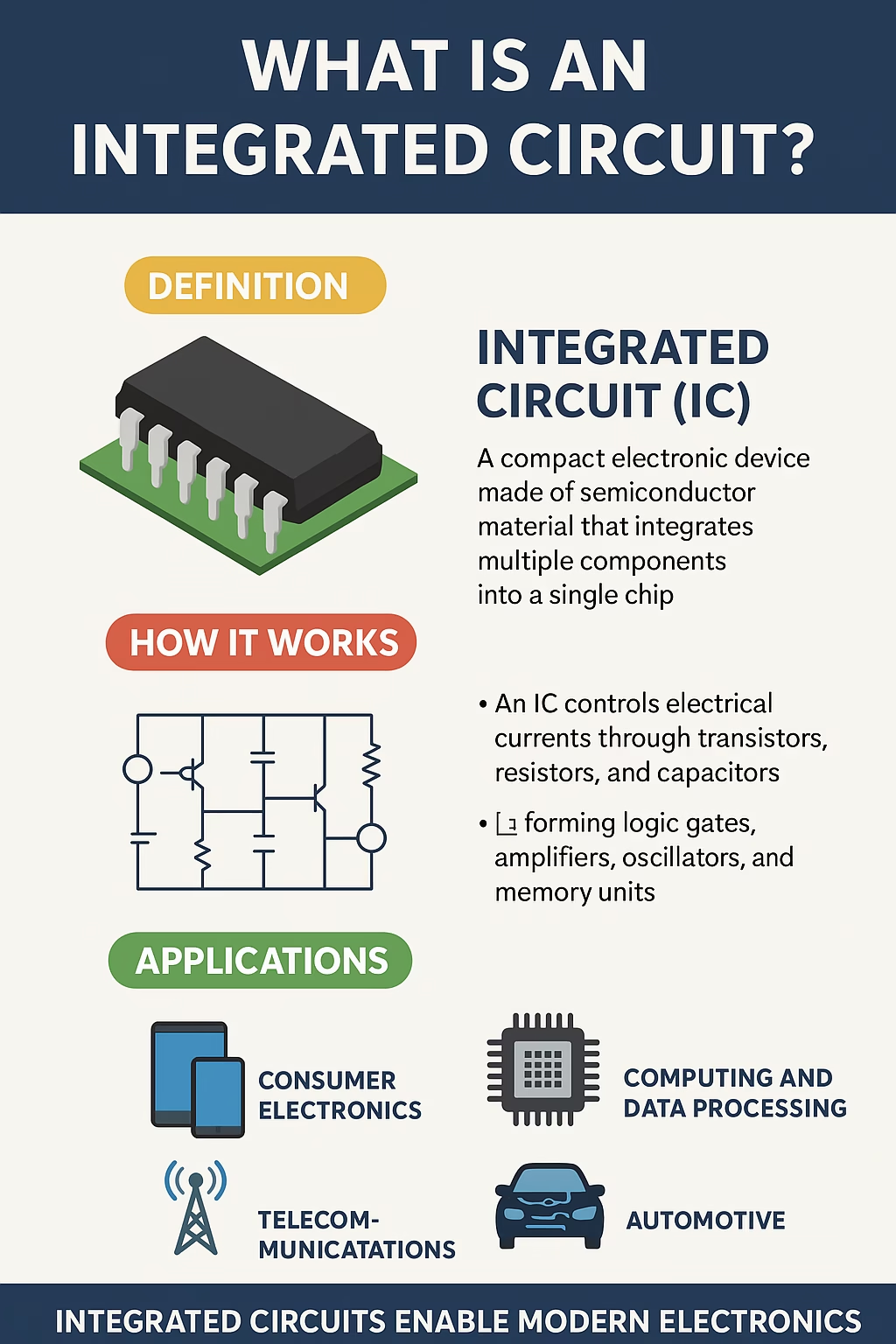
An Integrated Circuit (IC) is a compact electronic device made of semiconductor material, usually silicon, that integrates multiple components—such as transistors, resistors, capacitors, and diodes—into a single small chip.
Instead of building circuits using individual components connected by wires, engineers now design entire circuits on a semiconductor wafer. This advancement reduces size, increases efficiency, lowers costs, and makes electronics more reliable.
In short:
- IC = Miniaturized electronic circuit in a single chip
- Purpose = Process signals, store data, control systems, and enable communication
A Brief History of Integrated Circuits
The invention of the integrated circuit revolutionized electronics. Key milestones include:
- 1947 – The transistor was invented by John Bardeen, William Shockley, and Walter Brattain at Bell Labs. This became the foundation for ICs.
- 1958 – Jack Kilby of Texas Instruments created the first working integrated circuit.
- 1959 – Robert Noyce at Fairchild Semiconductor improved Kilby’s design using silicon, leading to scalable production.
- 1970s–1980s – The rise of microprocessors made ICs the heart of computers.
- 2000s–Present – Advances in nanotechnology allow billions of transistors to fit inside a single IC, powering AI, smartphones, and supercomputers.
Today, ICs are the backbone of modern technology.
How Does an Integrated Circuit Work?
An IC functions by controlling electrical currents through transistors.
- Transistors act as tiny switches that turn signals ON or OFF.
- Resistors and capacitors control voltage and current flow.
- Diodes guide current in one direction.
When combined, these components form logic gates, amplifiers, oscillators, and memory units, enabling ICs to perform calculations, amplify signals, and store data.
For example:
- In a computer processor, billions of transistors switch on/off billions of times per second, executing instructions.
- In an audio amplifier IC, components work together to strengthen weak sound signals for speakers.
Types of Integrated Circuits
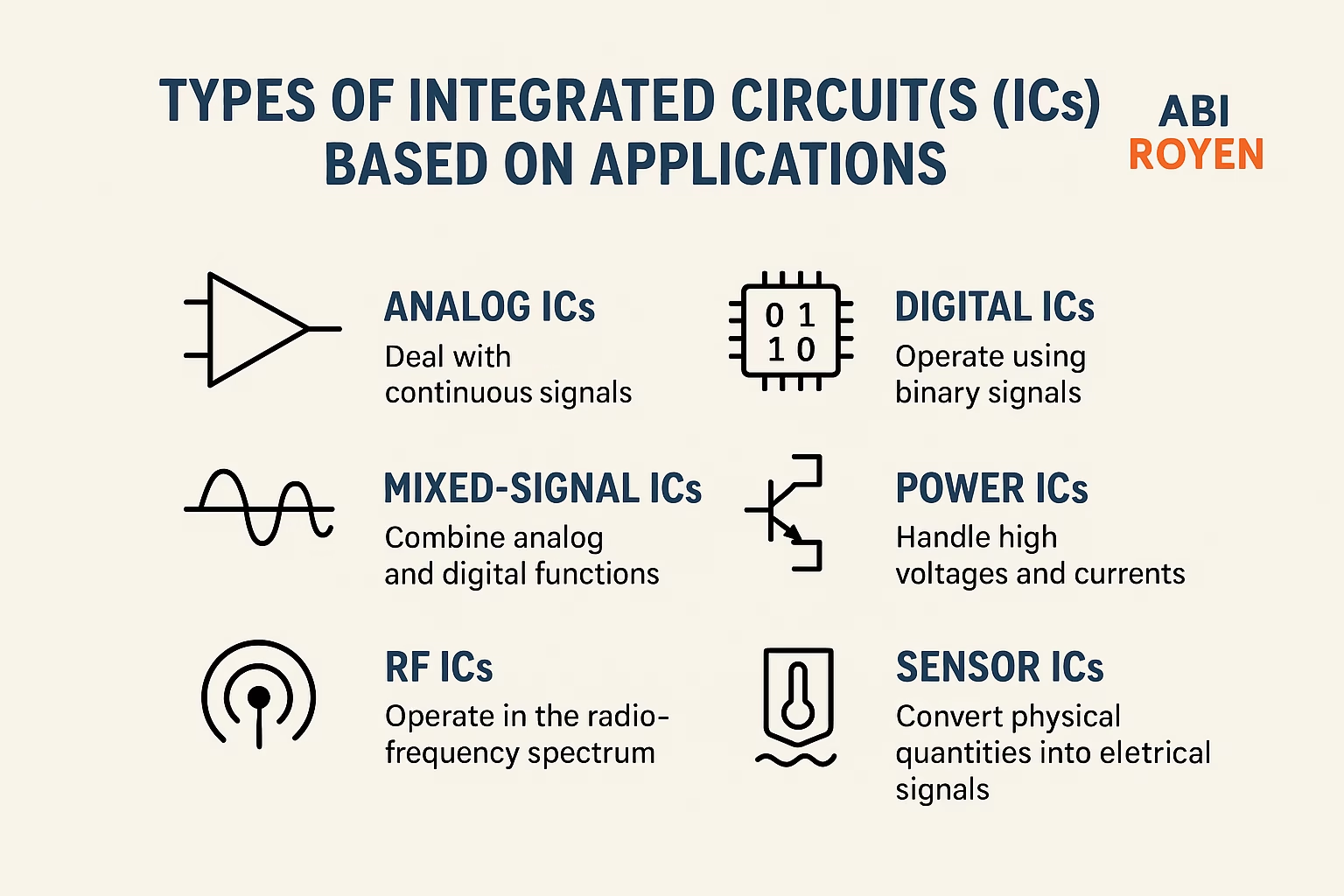
Integrated circuits can be classified into several categories based on function and technology.
1. Analog Integrated Circuits
- Work with continuous signals.
- Used in amplifiers, sensors, voltage regulators.
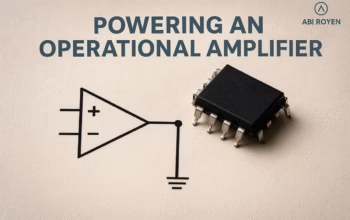
- Example: Operational Amplifier (Op-Amp).
2. Digital Integrated Circuits
- Process discrete signals (0 and 1).
- Found in microprocessors, memory chips, logic gates.
- Example: Intel or AMD CPUs.
3. Mixed-Signal Integrated Circuits
- Combine analog and digital functions in one chip.
- Common in smartphones, IoT devices, and wireless communication systems.
4. Microprocessors and Microcontrollers
- Microprocessor: A central processing unit (CPU) on a single chip.
- Microcontroller: A CPU with memory and input/output functions, widely used in embedded systems.
5. Application-Specific Integrated Circuits (ASICs)
- Custom-designed ICs for specific applications, like cryptocurrency mining or automotive control.
Applications of Integrated Circuits
ICs are everywhere. Their versatility makes them indispensable in multiple industries:
Consumer Electronics
- Smartphones, tablets, laptops
- Televisions, audio systems, gaming consoles
Computing and Data Processing
- Central Processing Units (CPUs)
- Graphics Processing Units (GPUs)
- Random Access Memory (RAM)
Telecommunications
- Mobile networks, Wi-Fi routers
- Satellite communication systems
Industrial Automation
- Robotics, factory machinery control
- Power management ICs
Medical Devices
- Pacemakers, hearing aids, diagnostic machines
Automotive Industry
- Engine control units (ECUs)
- Advanced driver-assistance systems (ADAS)
Aerospace and Defense
- Navigation systems, radar, satellite technology
Simply put: without ICs, modern technology would not exist.
Advantages of Integrated Circuits
Integrated circuits offer many benefits over traditional discrete circuits:
- Miniaturization: Millions of components in a chip smaller than a coin.
- High Reliability: Fewer soldered connections reduce failure.
- Low Cost: Mass production makes ICs affordable.
- Energy Efficiency: Lower power consumption compared to discrete components.
- High Performance: Faster processing and signal handling.

Challenges and Limitations
Despite their advantages, ICs face some challenges:
- Heat Generation: High transistor density produces heat.
- Design Complexity: Billions of transistors require advanced design tools.
- Manufacturing Cost: Initial setup for chip fabrication is expensive.
- Scalability Limits: Approaching physical limits in nanotechnology.
Researchers are now exploring alternatives like quantum computing and neuromorphic chips to overcome these barriers.
Future of Integrated Circuits
The future of ICs is exciting:
- Smaller, Faster, Smarter Chips with nanotechnology.
- AI-Powered ICs for self-learning machines.
- Flexible Electronics for wearable devices.
- Energy-Efficient Chips for sustainable technology.
- Quantum ICs that may revolutionize computing power.
Conclusion of What is Integrated Circuit?
The integrated circuit (IC) is one of the most important inventions of the 20th century. By integrating millions of electronic components onto a single chip, ICs have made modern technology possible—from smartphones and computers to medical devices and satellites.
Understanding what an integrated circuit is, how it works, and its applications helps us appreciate the foundation of today’s digital world. As technology advances, ICs will continue to evolve, enabling innovations in AI, IoT, robotics, and quantum computing.