

What is a Thyristor?
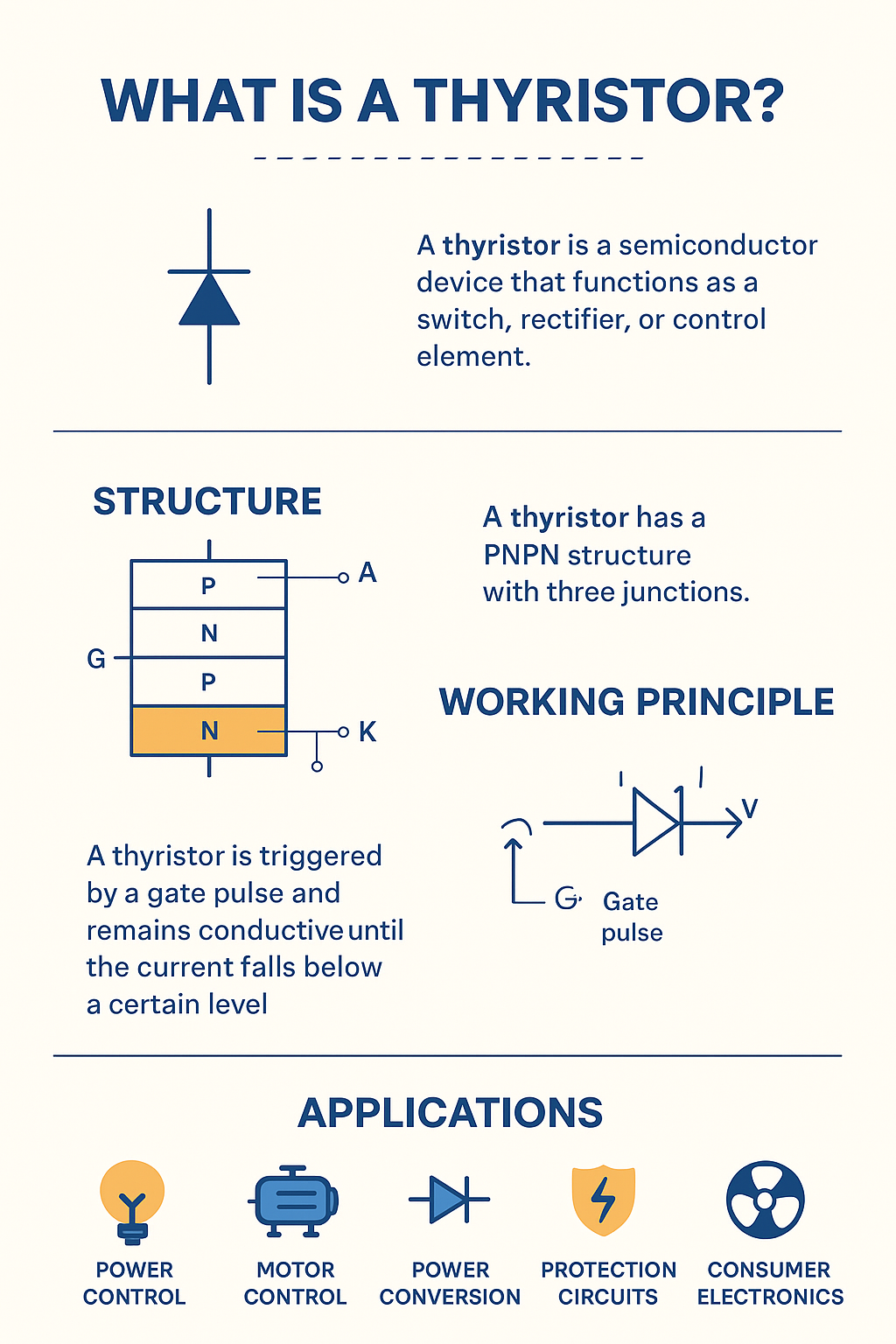
What is a Thyristor? ~ A thyristor is a solid-state semiconductor device that acts as a switch, rectifier, or control element in power electronics. It is widely used in circuits requiring high voltage and current handling capabilities. Thyristors are known for their ability to control large amounts of power using very small control signals, making them essential in power regulation and conversion systems.
The term “thyristor” is often associated with Silicon Controlled Rectifiers (SCRs), which are the most common type of thyristor. However, the thyristor family includes several variants such as GTO (Gate Turn-Off Thyristor), TRIAC (Triode for Alternating Current), and DIAC (Diode for Alternating Current).
Structure of a Thyristor
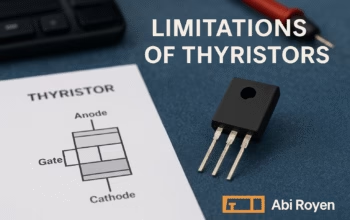
A thyristor is essentially a four-layer semiconductor device made of alternating P-type and N-type materials, creating a PNPN structure. This structure forms three junctions, often referred to as J1, J2, and J3.
- Anode (A): The positive terminal.
- Cathode (K): The negative terminal.
- Gate (G): The control terminal used to trigger the thyristor into conduction.
When a small current is applied to the gate, the thyristor switches from a non-conducting state (OFF) to a conducting state (ON), allowing current to flow between the anode and cathode.
Working Principle of a Thyristor
The thyristor operates on the principle of latching. Once it is triggered into the ON state by applying a gate pulse, it remains in conduction as long as the current through it exceeds a certain minimum value called the holding current. To turn it OFF, the current must fall below this threshold.
This makes the thyristor ideal for switching and rectification applications in AC and DC circuits, especially where controlled power delivery is required.
Key Functions of a Thyristor
- Controlled Rectification – Converts AC to DC with the ability to control output voltage.
- Switching – Acts as a high-speed switch for power control.
- Phase Control – Used in dimmer switches, motor speed control, and heater regulation.
- Overvoltage Protection – Certain thyristor types protect circuits against voltage surges.
- Inverter Operations – Helps in converting DC back to AC for renewable energy systems.
Types of Thyristors
The thyristor family includes several specialized devices:
- Silicon Controlled Rectifier (SCR):
The most common thyristor, widely used in rectifiers and controlled power systems. - Gate Turn-Off Thyristor (GTO):
Can be turned ON and OFF using gate signals, unlike SCRs which need current reduction to turn OFF. - TRIAC (Triode for AC):
Conducts in both directions, making it ideal for AC power control, such as in dimmers. - DIAC (Diode for AC):
A bidirectional trigger device used to activate TRIACs. - Light-Activated SCR (LASCR):
Turned ON using light instead of an electrical gate signal. - MOS-Controlled Thyristor (MCT):
Combines the features of thyristors and MOSFETs for high-performance applications.
Advantages of Thyristors
- Can handle high voltage and current efficiently.
- Very low power consumption at the gate terminal.
- Compact size compared to mechanical switches.
- High switching speed for modern electronic applications.
- Long lifespan with reliable solid-state construction.
Limitations of Thyristors
- Cannot turn OFF easily once triggered (except special types like GTO).
- Sensitive to high voltages and surges.
- Requires proper heat management due to power dissipation.
- Limited in very high-frequency applications compared to MOSFETs or IGBTs.

Applications of Thyristors
Thyristors are widely used in both industrial and consumer electronics:
- Power Control:
- Light dimmers
- Electric heater control
- Industrial furnace regulation
- Motor Control:
- Speed control in DC motors
- Soft starters for AC induction motors
- Power Conversion:
- AC to DC rectifiers
- DC to AC inverters in solar and wind power systems
- Protection Circuits:
- Surge protection devices
- Crowbar circuits for overvoltage protection
- Consumer Electronics:
- Fan regulators
- Temperature controllers
- Washing machines and air conditioners
Future of Thyristors in Modern Electronics
Although newer semiconductor devices like IGBTs and MOSFETs are gaining popularity due to their efficiency in high-frequency applications, thyristors remain indispensable in high-power and high-voltage environments. Their robustness, reliability, and cost-effectiveness ensure continued use in industries like energy, transportation, and manufacturing.
With the rise of renewable energy systems and smart grids, thyristors play a vital role in power conversion, grid stability, and efficient energy distribution.
Conclusion of What is a Thyristor?
A thyristor is a crucial component in power electronics, serving as a switch and controller for high-voltage and high-current applications. From industrial machinery to household appliances, thyristors ensure reliable and efficient power management. Understanding their types, functions, and applications helps engineers and technicians design better systems for both present and future technologies.