Introduction of What Are Sensors?
What Are Sensors? ~ In today’s digital and industrial world, sensors play a crucial role in connecting the physical environment with technological systems. From smartphones and cars to industrial machinery and healthcare devices, sensors are everywhere. They enable machines to detect, measure, and respond to changes in the environment, making automation and intelligent systems possible. But what exactly are sensors, how do they work, and why are they so important?
This article will explore the definition of sensors, their working principles, major types, and applications across multiple industries. By the end, you’ll understand why sensors are considered the backbone of modern technology.
What Are Sensors?
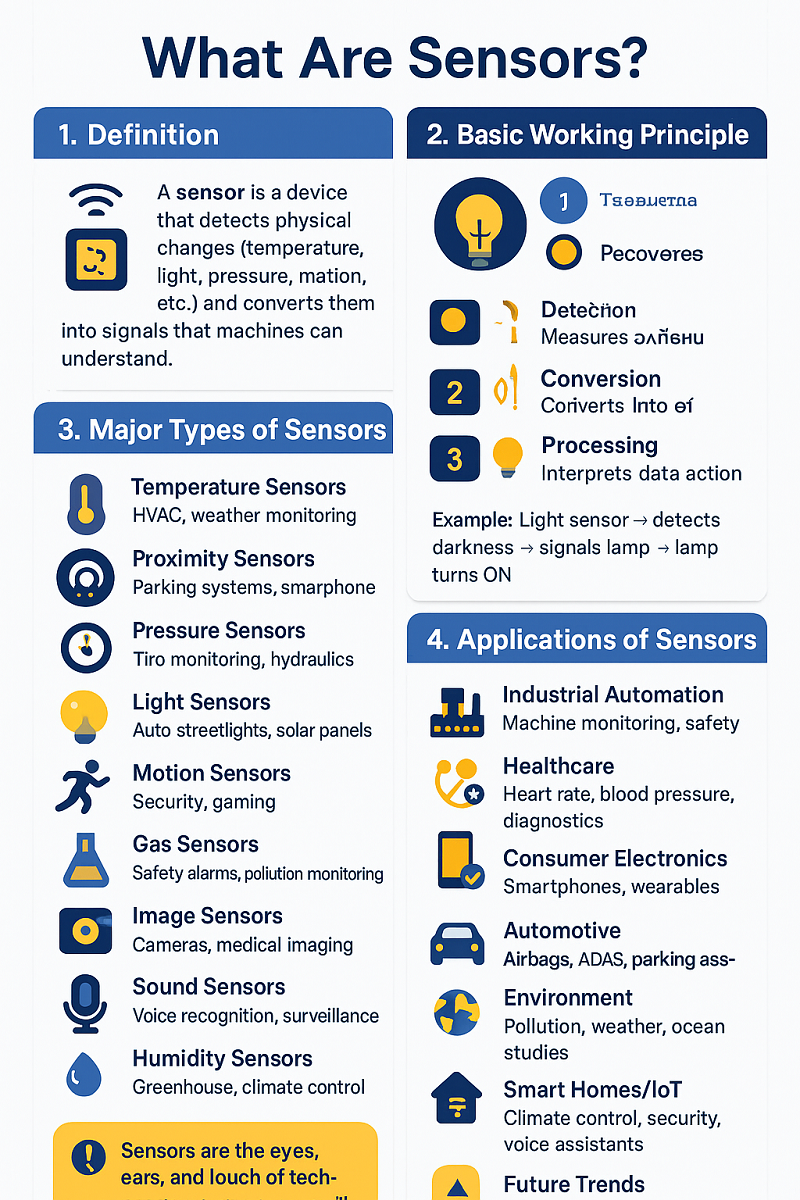
A sensor is an electronic or mechanical device that detects changes in physical conditions or environmental parameters and converts them into measurable signals. These signals can be electrical, optical, or digital, depending on the type of sensor and its application.
In simpler terms, sensors act as the “eyes and ears” of machines, enabling them to perceive their surroundings. For example:
- A temperature sensor measures heat.
- A motion sensor detects movement.
- A pressure sensor measures force per unit area.
Without sensors, automation, robotics, medical devices, and even consumer electronics like smartphones would not function effectively.
Basic Working Principle of Sensors
The functioning of a sensor typically involves three steps:
- Detection: The sensor detects a physical change (temperature, light, pressure, sound, etc.).
- Conversion: The detected change is converted into an electrical signal.
- Processing: The signal is processed, either by a microcontroller, display system, or a larger machine to trigger specific actions.
For instance, in an automatic lighting system, a light sensor detects the ambient light level. If the environment becomes dark, the sensor sends a signal to switch on the lights.
Types of Sensors
There are numerous types of sensors, each designed for specific applications. Below are the most common categories:
1. Temperature Sensors
- Definition: Measure heat or temperature changes.
- Examples: Thermocouples, thermistors, infrared sensors.
- Applications: HVAC systems, weather monitoring, industrial processes, food storage.
2. Proximity Sensors
- Definition: Detect the presence or absence of an object without physical contact.
- Examples: Inductive, capacitive, ultrasonic sensors.
- Applications: Parking systems, smartphones (screen auto-off during calls), automation in factories.
3. Pressure Sensors
- Definition: Measure pressure of gases or liquids.
- Examples: Piezoresistive and capacitive pressure sensors.
- Applications: Tire pressure monitoring, industrial hydraulics, medical devices.
4. Light Sensors
- Definition: Detect the intensity of light.
- Examples: Photodiodes, photoresistors, LDRs (Light Dependent Resistors).
- Applications: Automatic streetlights, smartphones (auto-brightness), solar panels.
5. Motion Sensors
- Definition: Identify movement within a given area.
- Examples: PIR (Passive Infrared), ultrasonic, microwave sensors.
- Applications: Security systems, gaming consoles, smart home automation.
6. Gas and Chemical Sensors
- Definition: Detect the presence of gases or chemicals in the environment.
- Examples: Carbon monoxide sensors, methane sensors.
- Applications: Industrial safety, pollution monitoring, household safety alarms.
7. Image Sensors
- Definition: Convert optical images into electronic signals.
- Examples: CCD (Charge-Coupled Device), CMOS (Complementary Metal Oxide Semiconductor).
- Applications: Digital cameras, smartphones, medical imaging.
8. Sound Sensors
- Definition: Detect and measure sound waves.
- Examples: Microphones, piezoelectric sensors.
- Applications: Voice recognition, surveillance, acoustic analysis.
9. Humidity Sensors
- Definition: Measure the amount of water vapor in the air.
- Examples: Capacitive, resistive humidity sensors.
- Applications: Weather stations, HVAC systems, greenhouses.
Applications of Sensors
Sensors are embedded in almost every modern technology. Here are some key industries where sensors play a vital role:
1. Industrial Automation
- Monitoring machinery conditions.
- Automating production lines.
- Ensuring worker safety through gas leak detectors and proximity sensors.
2. Healthcare and Medicine
- Blood pressure monitoring.
- Heart rate and glucose sensors.
- MRI and CT scan imaging sensors.
3. Consumer Electronics
- Smartphones use accelerometers, gyroscopes, and proximity sensors.
- Laptops use temperature sensors for cooling control.
- Wearables like fitness trackers rely on motion and heart rate sensors.
4. Automotive Industry
- Airbag deployment through pressure sensors.
- Parking assistance using proximity sensors.
- Advanced Driver Assistance Systems (ADAS) using radar and lidar sensors.
5. Environmental Monitoring
- Air pollution measurement with gas sensors.
- Climate monitoring with humidity and temperature sensors.
- Oceanographic studies using pressure and water quality sensors.
6. Smart Homes and IoT
- Motion sensors for security.
- Temperature and humidity sensors for climate control.
- Voice recognition sensors for smart assistants like Alexa and Google Home.

Importance of Sensors in Modern Technology
The importance of sensors cannot be overstated. They:
- Enable automation and reduce human intervention.
- Improve safety by detecting hazards in real time.
- Provide data for decision-making in industries.
- Enhance efficiency in manufacturing and energy management.
- Make everyday life more convenient with smart devices.
With the rise of Artificial Intelligence (AI) and the Internet of Things (IoT), sensors are becoming even more critical. They serve as the foundation of data collection, feeding intelligent systems with the necessary information to function effectively.
Future of Sensor Technology
The future of sensor technology looks promising, with advancements in miniaturization, sensitivity, and connectivity. Some key trends include:
- Wireless sensors for IoT-enabled devices.
- Nanotechnology-based sensors for medical diagnostics.
- AI-powered sensors capable of analyzing data locally.
- Sustainable sensors that consume less energy and use eco-friendly materials.
As industries move towards smart factories, autonomous vehicles, and personalized healthcare, sensors will continue to evolve, playing a central role in innovation.
Conclusion of What Are Sensors?
So, what are sensors? They are devices that bridge the physical and digital worlds, enabling machines and systems to sense, measure, and respond to their environment. From the simplest temperature sensor in your thermostat to advanced imaging sensors in medical devices, sensors have become the foundation of modern technology.
With continuous advancements, sensors are set to revolutionize industries, making processes smarter, safer, and more efficient. Whether in consumer electronics, healthcare, industry, or smart homes, sensors are truly the silent heroes of the digital age.