Transformers are essential components in modern electrical systems. They are widely used in power generation, transmission, and distribution to change voltage levels efficiently. Depending on their function, construction, and usage, there are various types of transformers, each designed for a specific application. This article provides a comprehensive overview of the different types of transformers, helping engineers and enthusiasts understand their design and utility.
1. What is a Transformer?
A transformer is a static electrical device that transfers electrical energy between two or more circuits through electromagnetic induction. It typically consists of two windings—the primary and secondary—wrapped around a magnetic core. When an alternating current (AC) flows through the primary winding, it generates a magnetic field that induces a voltage in the secondary winding.
Transformers are used for:
- Stepping up (increasing) or stepping down (decreasing) voltage
- Isolating electrical circuits
- Matching impedance in communication systems
2. Classification Types of Transformers
Transformers can be categorized based on various factors:
A. Types of Transformers Based on Function
1. Power Transformers
- Use: High-voltage transmission networks
- Rating: Above 200 MVA
- Location: Installed at generating stations and substations
- Design: Optimized for maximum efficiency at full load
2. Distribution Transformers
- Use: Distribute electricity to residential and commercial areas
- Rating: Below 200 MVA
- Location: Mounted on poles or platforms near end users
- Design: Operates efficiently at variable loads
3. Instrument Transformers
Used for measurement and protection in high-voltage circuits.
- Current Transformer (CT): Measures high current by stepping it down to a safe value
- Potential Transformer (PT): Steps down voltage for metering and relaying
- Applications: Electrical metering, protective relays
4. Isolation Transformers
- Use: Isolate electrical equipment from power sources
- Feature: Equal primary and secondary voltage
- Benefit: Prevents electric shock, improves safety
Read More: Understanding Transformers Based on Usage: Applications, Types, and Benefits
B. Types of Transformers Based on Construction
1. Core Type Transformer
- Windings are placed around the two limbs of a rectangular magnetic core.
- Common in low-voltage applications.
2. Shell Type Transformer
- Windings are surrounded by the core, offering better insulation and protection.
- Used in high-voltage applications.
Read More: Understanding Transformers Based on Construction: Core Type and Shell Type Explained
C. Based on Phase
1. Single-Phase Transformers
- Use: Residential and light commercial applications
- Supply: Single-phase AC
2. Three-Phase Transformers
- Use: Industrial and high-power systems
- Supply: Three-phase AC
- Can be built by combining three single-phase transformers or as a single unit.
Read More: Understanding Phase-Based Transformers: Single-Phase vs Three-Phase Explained
D. Types of Transformers Based on Cooling Method
1. Dry-Type Transformers
- Cooling: Air natural or air forced
- Use: Indoor, fire-sensitive environments
- Advantage: Low maintenance
2. Oil-Immersed Transformers
- Cooling: Mineral oil or synthetic fluids
- Use: Outdoor and high-power applications
- Benefit: Excellent cooling efficiency
E. Based on Voltage Regulation
1. Tapping Transformers
- Have multiple connection points (taps) to adjust output voltage.
- Useful in varying load conditions.
2. Autotransformers
- Share common winding for primary and secondary.
- Advantage: Compact, cost-efficient
- Disadvantage: No electrical isolation between windings
Read More: Understanding Voltage Conversion Transformers: Types, Applications, and How They Work

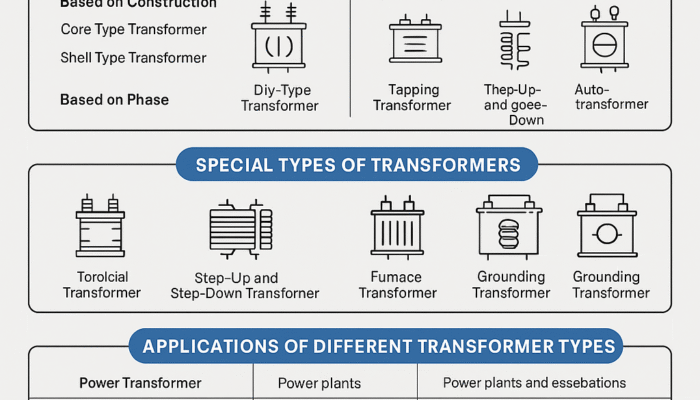
3. Special Types of Transformers
1. Toroidal Transformers
- Doughnut-shaped core
- Compact, low electromagnetic interference
- Used in medical and audio equipment
2. Step-Up and Step-Down Transformers
- Step-up: Increases voltage from primary to secondary
- Step-down: Decreases voltage from primary to secondary
- Widely used in power transmission and distribution
3. Furnace Transformers
- Designed to handle high current for induction furnaces
- Heavy-duty, built for harsh environments
4. Grounding Transformers
- Provides a neutral point in a three-phase system
- Ensures system stability and fault protection
4. Applications of Different Transformer Types
| Transformer Type | Application Areas |
|---|---|
| Power Transformer | Power plants, substations |
| Distribution Transformer | Local utility distribution, buildings |
| Autotransformer | Audio systems, railways, substations |
| Instrument Transformer | Metering, protection systems |
| Isolation Transformer | Medical equipment, sensitive electronics |
| Toroidal Transformer | Audio amplifiers, control circuits |
| Furnace Transformer | Industrial induction furnaces |
| Grounding Transformer | Electrical grid stabilization |
5. Key Differences Between Transformer Types
| Criteria | Power Transformer | Distribution Transformer | Autotransformer |
|---|---|---|---|
| Voltage Level | High | Low to medium | Variable |
| Efficiency | High at full load | High at varied loads | High, compact |
| Isolation | Yes | Yes | No |
| Cost | High | Moderate | Low |
| Application Area | Transmission lines | Local distribution | Substations, labs |
6. Conclusion of Types of Transformers
Transformers are the backbone of modern electrical infrastructure. Understanding the different types of transformers and their specific roles in the power system is essential for engineers, technicians, and students alike. From stepping up voltages in transmission lines to isolating sensitive equipment in hospitals, transformers come in a variety of types tailored to specific requirements.
Choosing the right type ensures operational safety, cost-efficiency, and system stability. As electrical technologies evolve, transformer design and application continue to adapt, further strengthening their relevance in power systems worldwide.
✅ For More Engineering Insights, Visit:
https://abiroyen.com
Explore practical guides, tutorials, and in-depth articles on electrical components and power systems.