Types of thermistors ~ Thermistors are essential components in the world of electronics and temperature sensing technology. These temperature-dependent resistors change their resistance value according to temperature variations, making them ideal for measuring, monitoring, and controlling thermal conditions in various devices.
If you’ve ever used an air conditioner, a digital thermometer, or a battery charger, chances are you’ve benefited from a thermistor’s accuracy and reliability. But thermistors aren’t all the same — they come in different types, each designed for specific applications.
In this guide, we will explore the two main types of thermistors — PTC (Positive Temperature Coefficient) and NTC (Negative Temperature Coefficient) — and examine their characteristics, working principles, and uses.
1. What is a Thermistor?
A thermistor is a type of resistor whose resistance changes significantly with temperature. The term “thermistor” is derived from “thermal” and “resistor”. Unlike standard resistors, thermistors are highly sensitive to temperature changes, allowing them to serve as precise temperature sensors or thermal protection devices.
Thermistors are typically made from metal oxides such as manganese, cobalt, and nickel, which are sintered and encapsulated to provide stability and durability.
Key Features of Thermistors:
- High sensitivity to temperature changes
- Compact size and low cost
- Excellent stability and repeatability
- Available in various shapes (beads, discs, rods, surface-mount packages)
2. Types of Thermistors
Thermistors are broadly classified into two main categories based on how their resistance changes with temperature:
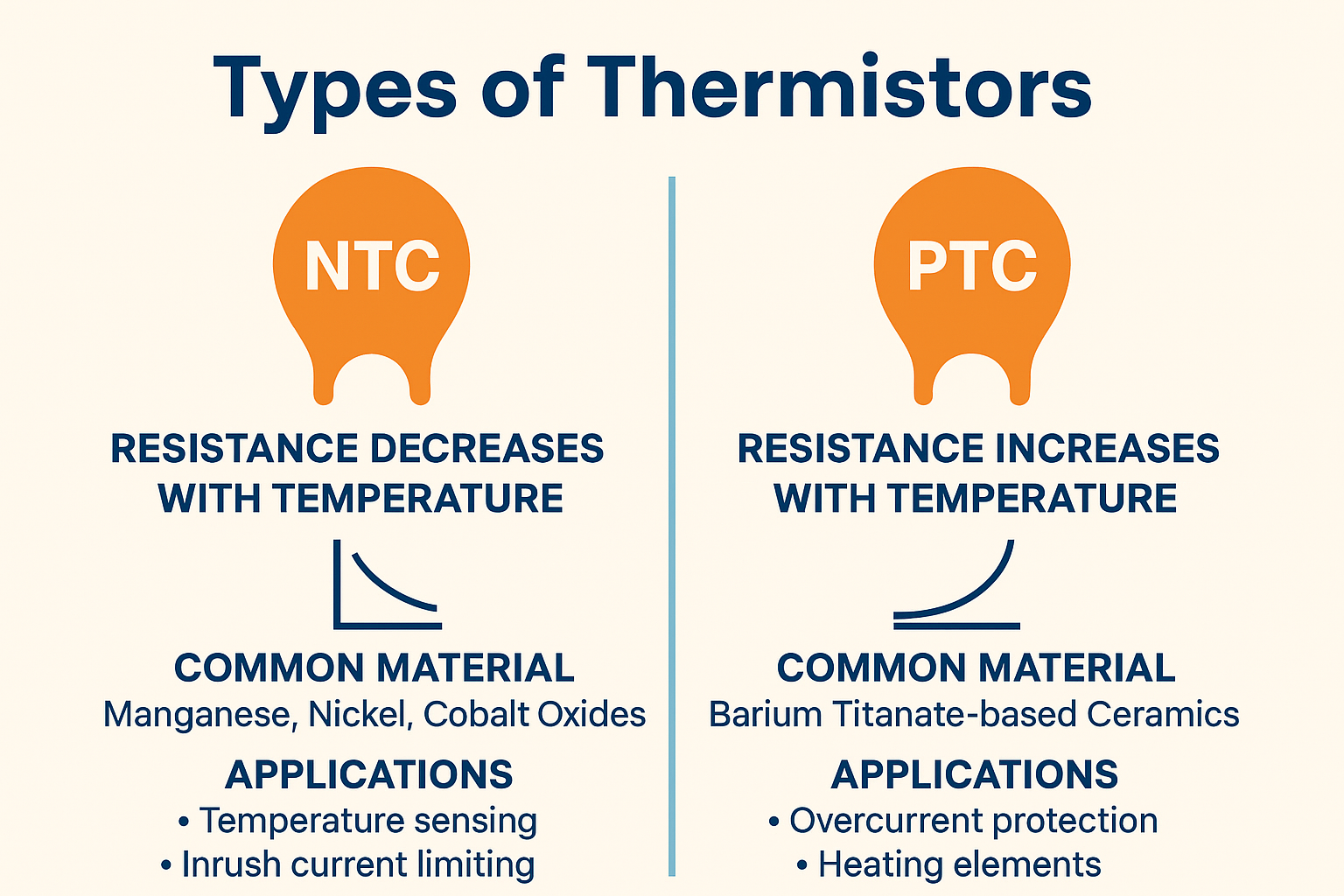
- NTC Thermistors (Negative Temperature Coefficient) – Resistance decreases as temperature increases.
- PTC Thermistors (Positive Temperature Coefficient) – Resistance increases as temperature increases.
3. Types of Thermistors: NTC Thermistors (Negative Temperature Coefficient)
3.1 Working Principle
In NTC thermistors, the resistance decreases as temperature rises. This inverse relationship is due to the increased mobility of charge carriers in the thermistor’s semiconductor material at higher temperatures.
Formula:
The resistance-temperature relationship for an NTC thermistor is often described by the Steinhart–Hart equation: 1T=A+B⋅ln(R)+C⋅[ln(R)]3\frac{1}{T} = A + B \cdot \ln(R) + C \cdot [\ln(R)]^3T1=A+B⋅ln(R)+C⋅[ln(R)]3
Where:
- TTT = Temperature in Kelvin
- RRR = Resistance in ohms
- A,B,CA, B, CA,B,C = Calibration constants
3.2 Applications
NTC thermistors are widely used for:
- Temperature sensing in thermometers and HVAC systems
- Battery temperature monitoring in chargers and smartphones
- Inrush current limiting in power supply circuits
- Automotive temperature sensors for coolant and air intake
3.3 Advantages
- High accuracy in temperature measurement
- Wide temperature sensing range
- Low cost and small size
3.4 Disadvantages
- Non-linear response
- Limited high-temperature operation compared to PTC types
4. Types of Thermistors: PTC Thermistors (Positive Temperature Coefficient)
4.1 Working Principle
PTC thermistors exhibit a direct relationship between resistance and temperature: as the temperature increases, the resistance also increases. This effect is especially noticeable after reaching a specific threshold temperature, known as the Curie point.
PTC thermistors are usually made from polycrystalline ceramic materials that undergo a sharp resistance change at the Curie temperature.
4.2 Applications
PTC thermistors are ideal for:
- Overcurrent protection in electronic circuits
- Self-regulating heating elements
- De-icing and defrosting systems
- Motor protection in appliances
4.3 Advantages
- Automatic reset after cooling
- Can be used as a heating element
- Excellent overcurrent protection
4.4 Disadvantages
- Slower response time compared to NTC thermistors
- Not suitable for precision temperature measurement

5. Key Differences Between NTC and PTC Thermistors
| Feature | NTC Thermistor | PTC Thermistor |
|---|---|---|
| Resistance vs Temperature | Decreases as temperature increases | Increases as temperature increases |
| Common Material | Manganese, Nickel, Cobalt Oxides | Barium Titanate-based ceramics |
| Applications | Temperature sensing, inrush current limiting | Overcurrent protection, heating elements |
| Response Time | Fast | Slower |
| Accuracy | High | Moderate |
| Cost | Low | Moderate |
6. Choosing the Right Thermistor for Your Application
When selecting a thermistor, consider:
- Temperature Range – Ensure the thermistor operates effectively in your desired range.
- Accuracy – For precise measurements, choose NTC thermistors.
- Response Time – Applications needing quick detection should opt for small-sized NTC sensors.
- Purpose – Use NTC for sensing, PTC for protection or heating.
- Environmental Conditions – Consider humidity, vibration, and chemical exposure.
7. Advantages of Using Thermistors in Electronics
Thermistors have several benefits:
- Compact and versatile – Easy to integrate into small devices.
- Cost-effective – Cheaper than many other temperature sensors.
- Reliable performance – Stable over long periods.
- Multiple functions – Can serve as both sensors and protectors.
8. Conclusion of Types of Thermistors
Thermistors — whether NTC or PTC — play a crucial role in modern electronics. NTC thermistors are perfect for accurate temperature measurement and inrush current limiting, while PTC thermistors excel in overcurrent protection and self-regulating heating applications.
Understanding the differences between these types ensures you choose the right component for your project, whether you’re building consumer electronics, automotive systems, or industrial machinery.
As technology advances, thermistors will continue to be a cornerstone in temperature sensing and protection circuits, offering a blend of simplicity, accuracy, and reliability.