Introduction
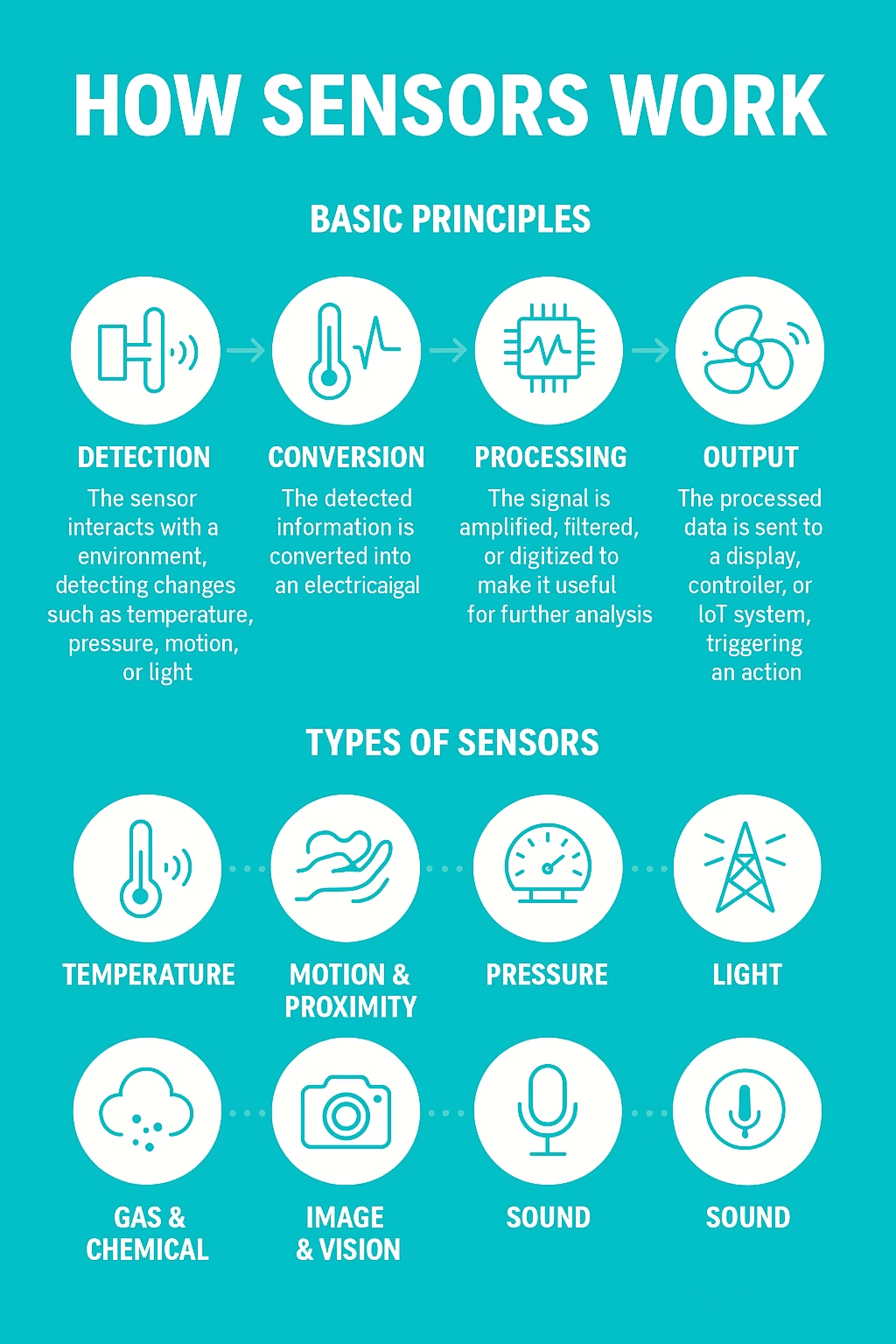
Types of pressure sensors ~ Pressure sensors are crucial components in modern industrial, automotive, medical, and aerospace systems. They convert pressure—typically the force of a fluid (liquid or gas)—into an electrical signal that can be measured and analyzed. Choosing the right type of pressure sensor is essential for ensuring accurate data and optimal system performance.
In this comprehensive guide, we will explore the different types of pressure sensors, their working principles, advantages, limitations, and applications in various industries.
1. What Is a Pressure Sensor?
A pressure sensor is a device that measures the pressure of a gas or liquid and converts this measurement into an electrical signal. This signal can then be displayed, recorded, or used to control a system.
Pressure is typically measured in:
- Pascals (Pa)
- Pounds per square inch (psi)
- Bar
The sensor’s function is critical for monitoring system conditions, maintaining safety, and improving operational efficiency.
2. Classification of Pressure Sensors
Pressure sensors are typically classified based on:
- The type of pressure they measure
- Their sensing technology
- The output signal they generate
Let’s look at the major types of pressure sensors based on the type of pressure they measure:
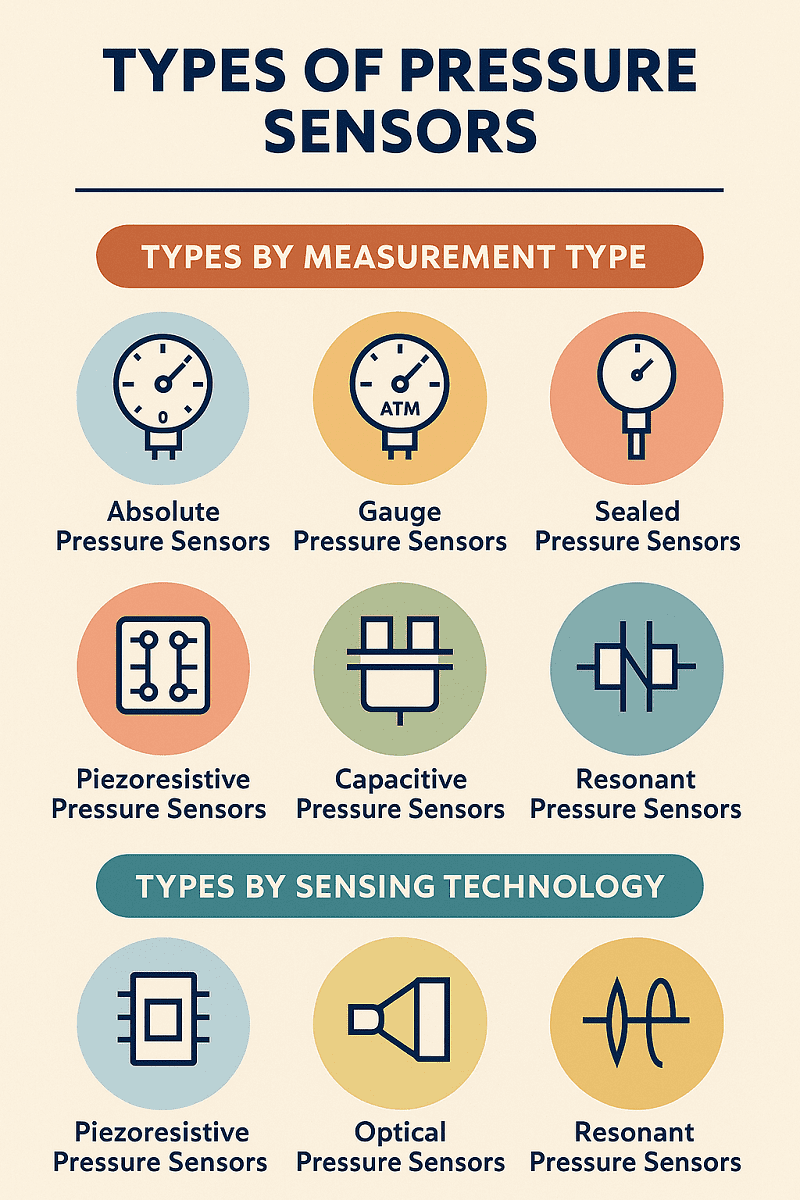
3. Types of Pressure Sensors by Measurement Type
3.1 Types of Pressure Sensors: Absolute Pressure Sensors
Definition:
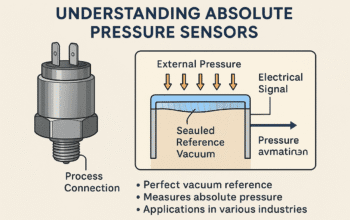
Measure pressure relative to a perfect vacuum (0 psi or 0 bar).
Working Principle:
These sensors use a sealed reference vacuum chamber against which the external pressure is measured.
Applications:
- Altitude measurement
- Vacuum systems
- Aerospace and meteorology
Advantages:
- High accuracy
- Stable reference
Limitations:
- Costlier than gauge sensors
3.2 Types of Pressure Sensors: Gauge Pressure Sensors
Definition:
Measure pressure relative to atmospheric pressure.
Working Principle:
Gauge sensors use a vented chamber that allows atmospheric pressure to act as a reference.
Applications:
- Tire pressure monitoring
- Blood pressure measurement
- Hydraulic systems
Advantages:
- Common and cost-effective
- Ideal for general applications
Limitations:
- Affected by changes in atmospheric pressure
3.3 Types of Pressure Sensors: Differential Pressure Sensors
Definition:
Measure the difference between two pressure sources.
Working Principle:
These sensors have two input ports to measure the pressure difference.
Applications:
- Filter monitoring
- HVAC systems
- Flow measurement
Advantages:
- Ideal for process control
- Can detect clogs or leaks
Limitations:
- Requires two pressure ports
3.4 Types of Pressure Sensors: Sealed Pressure Sensors
Definition:
Measure pressure relative to a sealed reference pressure, often 1 atm.
Applications:
- High-pressure industrial applications
- Subsea equipment
Advantages:
- Resistant to atmospheric fluctuations
Limitations:
- Not suitable for applications requiring real-time atmospheric correction
4. Types of Pressure Sensors by Sensing Technology
Now let’s explore pressure sensors based on the sensing element or technology used:
4.1 Piezoresistive Pressure Sensors
Working Principle:
Use piezoresistive materials (such as silicon) whose resistance changes with pressure-induced deformation.
Applications:
- Medical devices
- Automotive systems
Advantages:
- High sensitivity
- Cost-effective for high-volume applications
Limitations:
- Temperature-sensitive
- Requires compensation
4.2 Capacitive Pressure Sensors
Working Principle:
Use the change in capacitance between two plates caused by diaphragm deflection under pressure.
Applications:
- Industrial process control
- HVAC systems
Advantages:
- High resolution
- Good stability
Limitations:
- Sensitive to humidity and temperature
4.3 Optical Pressure Sensors
Working Principle:
Use fiber optics or light modulation to measure pressure changes.
Applications:
- High-voltage or explosive environments
- Biomedical instrumentation
Advantages:
- Immune to electromagnetic interference
- Excellent for harsh environments
Limitations:
- Expensive and complex
4.4 Resonant Pressure Sensors
Working Principle:
Utilize resonating elements whose frequency shifts under pressure.
Applications:
- Aerospace
- Scientific instrumentation
Advantages:
- Extremely accurate
- Stable over time
Limitations:
- Costly and application-specific
4.5 Strain Gauge Pressure Sensors
Working Principle:
Measure strain in a diaphragm using bonded strain gauges.
Applications:
- Hydraulic and pneumatic systems
- Load measurement
Advantages:
- Accurate and reliable
- Widely used
Limitations:
- May need external amplification

5. How to Choose the Right Types of Pressure Sensors
When selecting a pressure sensor for your application, consider the following factors:
- Type of pressure: Absolute, gauge, differential, or sealed
- Operating pressure range
- Required accuracy
- Environmental conditions: Temperature, humidity, electromagnetic interference
- Output type: Analog (voltage/current) or digital (I2C/SPI)
- Size and mounting constraints
- Material compatibility with the medium (especially for corrosive fluids)
6. Common Applications of Types of Pressure Sensors
Automotive
- Tire pressure monitoring systems (TPMS)
- Engine and fuel system diagnostics
Medical
- Blood pressure monitors
- Respiratory equipment
Industrial
- Process control
- Leak detection
- Hydraulic systems
Aerospace
- Altitude measurement
- Cabin pressure control
Consumer Electronics
- Smartphones (barometers)
- Smartwatches (altimeters)
7. Future Trends in Pressure Sensing Technology
- Miniaturization: Smaller sensors for wearable and mobile devices
- Integration: Combined with temperature and humidity sensors for environmental monitoring
- Wireless communication: IoT-based pressure monitoring systems
- AI and machine learning: For predictive maintenance and real-time analytics
Conclusion
Understanding the various types of pressure sensors is essential for selecting the right one for your application. Whether you’re working in automotive systems, industrial automation, or biomedical devices, choosing the appropriate sensor type ensures efficiency, safety, and accuracy.
As technology evolves, pressure sensors continue to become more intelligent, compact, and integrated—offering even greater value across industries.
For more technical insights and product guides, visit Abi Royen – https://abiroyen.com.