Thyristors are essential components in the realm of power electronics. Known for their ability to handle high voltages and currents, these semiconductor devices play a crucial role in controlling electrical power. Whether in industrial motor controls, light dimmers, or inverter circuits, thyristors serve as the backbone for efficient switching and regulation of electrical energy.
This comprehensive guide will walk you through everything you need to know about thyristors — including their working principle, construction, different types, and wide range of applications.
What is a Thyristors?
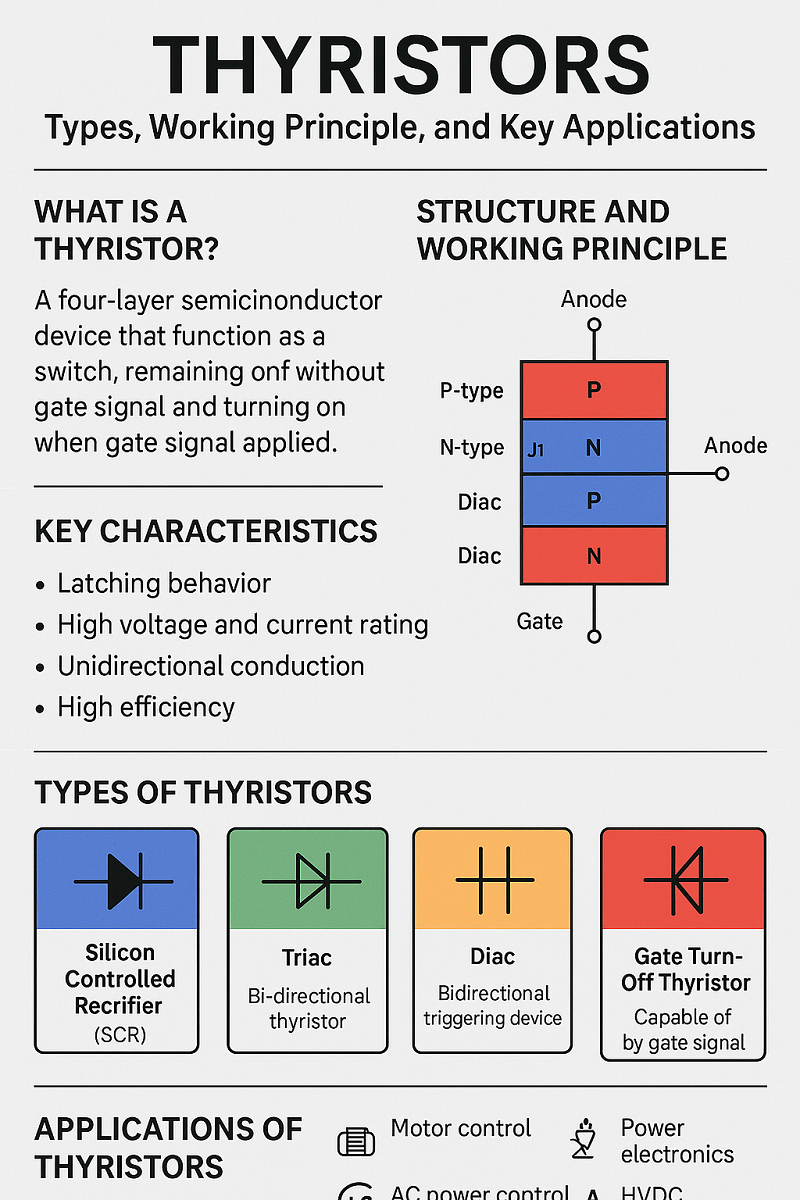
A thyristor is a four-layer, three-junction semiconductor device that functions as a switch. It remains off (non-conducting) until a gate signal is applied, at which point it turns on and continues conducting as long as current flows in the forward direction.
Unlike a transistor, which can turn on and off based on continuous signals, a thyristor is latching — once it turns on, it stays on until the current drops below a specific threshold, known as the holding current.
Thyristors are typically used in high-power applications, including AC/DC conversion, voltage regulation, and motor speed control.
Structure and Working Principle of a Thyristors
A basic thyristor consists of four alternate P-type and N-type layers forming a PNPN structure, resulting in three junctions (J1, J2, and J3). It has three terminals:
- Anode (A) – Connected to the outer P-layer
- Cathode (K) – Connected to the outer N-layer
- Gate (G) – Connected to the inner P-layer
Working Principle:
- When a positive voltage is applied to the anode with respect to the cathode and no gate signal is applied, the thyristor remains in off state (forward blocking).
- When a trigger pulse is applied to the gate, the device enters the conducting state (forward conduction).
- Once turned on, the gate loses control, and the thyristor remains on until the anode current drops below the holding current.
Key Characteristics of Thyristors
- Latching behavior: They stay on even after the gate signal is removed.
- High voltage and current rating: Suitable for industrial power applications.
- Unidirectional conduction: Basic thyristors only conduct in one direction.
- High efficiency: Minimal power loss when in conducting state.
Types of Thyristors
There are several variations of thyristors, each tailored for specific uses:
1. Silicon Controlled Rectifier (SCR)
The most common type of thyristor. SCRs conduct current only in one direction and are used for rectification and power control.
Applications: Motor control, battery chargers, light dimmers.
2. Triac (Triode for Alternating Current)
A bi-directional thyristor that can control current flow in both directions. Commonly used in AC power applications.
Applications: AC dimmer switches, fan speed control, heating systems.
3. Diac (Diode for Alternating Current)
A triggering device often used to fire triacs. It is bidirectional and conducts current only after a specific breakdown voltage.
Applications: Light dimmers, triggering circuits for triacs.
4. Gate Turn-Off Thyristor (GTO)
Can be turned off by applying a negative gate signal. Offers more control compared to regular SCRs.
Applications: Traction systems, industrial drives, power inverters.
5. Light-Activated SCR (LASCR)
Triggered using a light signal instead of an electrical gate signal.
Applications: High-voltage DC transmission, isolated triggering environments.
Applications of Thyristors in Real-World Systems
Thyristors are versatile and are employed in various sectors, including:
1. Industrial Motor Control
SCRs and GTOs are extensively used for variable speed motor drives and industrial automation.
2. Power Electronics and Inverters
Used in DC-to-AC inverters, voltage regulators, and power conditioning systems for renewable energy.
3. AC Power Control
Triacs are used in household appliances like fan regulators, lamp dimmers, and heater controllers.
4. HVDC Transmission
Thyristors are key components in High Voltage Direct Current (HVDC) systems, enabling long-distance electricity transmission.
5. Welding Equipment
Used to control the timing and amount of current delivered to the electrodes.
6. Battery Charging Systems
SCR-based chargers are common in automotive and industrial battery systems for controlled rectification.

Advantages of Using Thyristors
- Efficient switching of high power
- Low power consumption in on-state
- High durability and long life
- Cost-effective solution for power control
- Compatibility with both AC and DC systems
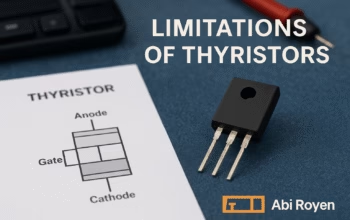
Limitations of Thyristors
Despite their advantages, thyristors come with certain limitations:
- Cannot be turned off via gate (except GTO)
- Require additional circuitry for protection
- Not ideal for high-frequency applications
- Susceptible to overvoltage and thermal runaway
Thyristors vs Transistors
| Feature | Thyristor | Transistor |
|---|---|---|
| Switching | Latching (on until current stops) | Continuous control via base/gate |
| Application | Power control, AC circuits | Signal amplification, switching |
| Directionality | Typically unidirectional | Bi-directional |
| Control Signal | Pulse trigger at gate | Continuous current/voltage |
How to Test a Thyristor
A multimeter with a diode-check function can be used to test thyristors:
- Connect the anode and cathode — it should not conduct without gate signal.
- Apply a small gate signal — the device should conduct.
- Remove gate signal — it should still conduct.
- Stop the anode current — device turns off.
Conclusion
Thyristors are foundational components in the world of power electronics. Their ability to handle high voltages and currents while offering controlled switching makes them indispensable in both industrial and consumer electronics. With evolving technologies and smarter control techniques, modern thyristor variants continue to find innovative applications — from electric vehicles to power grids.
Whether you’re an electronics hobbyist, an electrical engineer, or a tech writer, understanding thyristors is a key step toward mastering the field of power electronics.
Suggested Visual Add-ons for Website:
- Infographic showing thyristor structure (PNPN layers + terminals)
- Diagram: SCR and TRIAC operation cycle
- Comparison chart: Thyristors vs Transistors
- Application schematic: Thyristor in AC dimmer