Introduction Surface-Mount Resistors (SMD)
In the world of electronics, the demand for compact, efficient, and reliable components has driven the development of Surface-Mount Technology (SMT). Among the most widely used SMT components are Surface-Mount Resistors (SMD). These tiny yet powerful components are essential in nearly every modern electronic device, from smartphones and laptops to medical equipment and automotive electronics.
This article provides a comprehensive overview of surface-mount resistors, including their structure, types, advantages, disadvantages, and practical applications in today’s technology-driven world.
What Are Surface-Mount Resistors (SMD)?
A Surface-Mount Resistor (SMD resistor) is a type of resistor designed to be mounted directly onto the surface of a printed circuit board (PCB) rather than through drilled holes, as with traditional through-hole resistors.
Unlike older resistor technologies, SMD resistors are manufactured in compact rectangular packages, often measured in metric or imperial units (such as 0603, 0805, 1206, etc.). These packages allow for miniaturization, which is essential in the design of modern portable and high-density electronics.
Structure of Surface-Mount Resistors
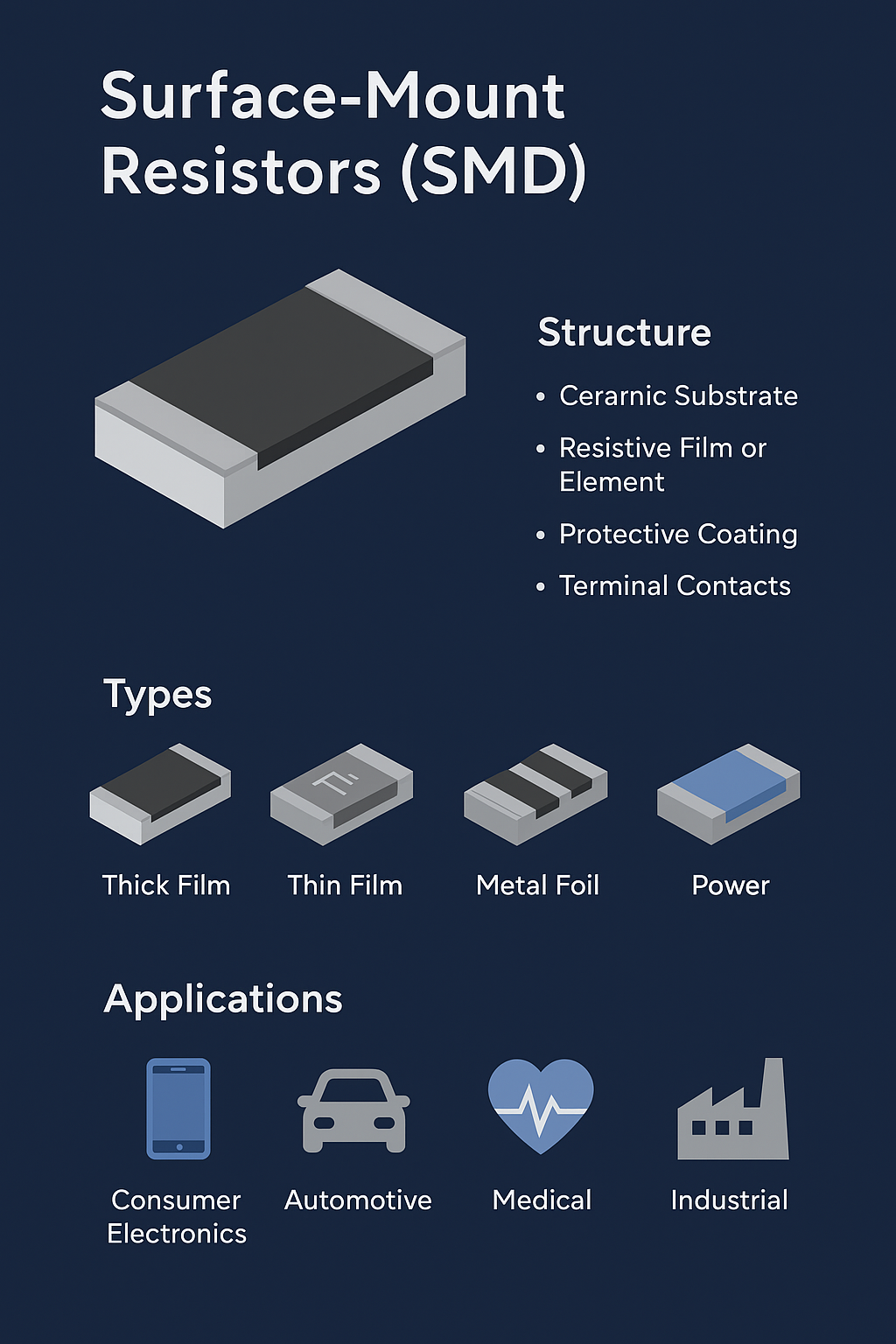
The structure of an SMD resistor typically consists of the following layers:
- Ceramic Substrate – Provides mechanical strength and thermal stability.
- Resistive Film or Element – Determines the resistance value (commonly made of metal oxide or thick/thin film materials).
- Protective Coating – Shields the resistor from environmental influences such as moisture, dust, and chemicals.
- Terminal Contacts – Metalized ends allow soldering directly onto the PCB pads.
This multilayer construction ensures durability and precise resistance performance, even under challenging conditions.
Common Package Sizes of Surface-Mount Resistors (SMD)
SMD resistors come in standardized package sizes. Some of the most common include:
- 0201 (0.6 × 0.3 mm) – Extremely small, used in ultra-compact devices.
- 0402 (1.0 × 0.5 mm) – Popular in smartphones and small gadgets.
- 0603 (1.6 × 0.8 mm) – Widely used for general-purpose circuits.
- 0805 (2.0 × 1.25 mm) – Balanced size for manual soldering and automation.
- 1206 (3.2 × 1.6 mm) – Larger, suitable for higher power dissipation.
The smaller the package, the greater the component density that can be achieved on a PCB.
Types of Surface-Mount Resistors
SMD resistors are available in various types, each designed for specific applications:
- Thick Film SMD Resistors
- Most commonly used type.
- Made by printing resistive film onto a ceramic base.
- Cost-effective and reliable for general applications.
- Thin Film SMD Resistors
- Manufactured using a precise sputtering process.
- Offers high accuracy, low noise, and tight tolerance.
- Ideal for medical, aerospace, and measurement devices.
- Metal Foil SMD Resistors
- Provide the highest precision and stability.
- Used in critical applications requiring minimal temperature coefficient.
- Power SMD Resistors
- Designed to handle higher wattage.
- Often larger in size and used in power supply circuits.
- Specialty SMD Resistors
- Include fusible resistors, moisture-resistant resistors, and high-frequency resistors.
- Tailored for niche applications where standard resistors may fail.
Advantages of Surface-Mount Resistors (SMD)
Surface-mount resistors have several benefits compared to through-hole resistors:
- Compact Size – Enables miniaturization of devices.
- High Reliability – Lower risk of lead damage and strong PCB adhesion.
- Efficient Manufacturing – Compatible with automated assembly lines.
- Improved Electrical Performance – Shorter leads reduce parasitic inductance and capacitance.
- Versatility – Available in a wide range of values, tolerances, and power ratings.
Disadvantages of SMD Resistors
Despite their many advantages, SMD resistors also have limitations:
- Difficult Manual Handling – Their small size makes manual soldering and replacement challenging.
- Lower Power Rating – Generally handle less power than larger through-hole resistors.
- Fragility – Can be more easily damaged by overheating during soldering.
- Cost for Precision Types – High-accuracy thin-film or metal foil resistors can be expensive.
Applications of Surface-Mount Resistors (SMD)
SMD resistors are used in virtually all areas of electronics, including:
- Consumer Electronics – Smartphones, tablets, laptops, and wearable devices.
- Automotive Systems – Engine control units, infotainment, and safety electronics.
- Medical Equipment – Diagnostic devices and patient monitoring systems.
- Industrial Electronics – Motor drives, sensors, and automation controllers.
- Communication Systems – Routers, modems, and wireless base stations.
- Aerospace and Defense – High-reliability circuits requiring precision components.
Their versatility and compactness make them indispensable in modern circuit design.

How to Read SMD Resistor Codes
SMD resistors typically do not have color bands like traditional resistors. Instead, they use a numeric code system:
- Three-Digit Code (e.g., 472 = 47 × 10² = 4700 Ω)
- Four-Digit Code (e.g., 1001 = 100 × 10¹ = 1000 Ω)
- EIA-96 Code (used for precision resistors, combining numbers and letters).
This coding system allows quick identification of resistance values despite their small size.
Future of Surface-Mount Resistors (SMD)
As electronics continue to evolve, the demand for smaller, more efficient, and more reliable resistors will grow. The future trends include:
- Miniaturization – Even smaller packages like 01005 for ultra-dense circuits.
- Higher Precision – Expanding use of thin-film and metal foil resistors.
- Improved Thermal Management – Development of high-power SMD resistors.
- Integration with Smart Devices – Embedded resistors in multilayer PCBs.
These advancements ensure that SMD resistors will remain a cornerstone of electronic innovation.
Conclusion
Surface-Mount Resistors (SMD) play a vital role in the advancement of modern electronics. Their compact design, precision, and versatility have made them the preferred choice for engineers and manufacturers across industries.
Whether in consumer gadgets, industrial automation, or aerospace technology, SMD resistors provide the reliability and efficiency that today’s high-performance circuits demand. As technology advances, these components will continue to evolve, ensuring smaller, faster, and more efficient electronic systems.