Introduction Silicon Controlled Rectifier (SCR)
In the world of power electronics, the Silicon Controlled Rectifier (SCR) is a vital semiconductor device that plays a significant role in controlling high-voltage and high-power applications. As a member of the thyristor family, SCRs are widely used in industrial automation, motor control, power regulation, and switching systems.
Their ability to handle large currents and voltages, combined with controllable switching capabilities, makes them an essential component in modern electronics. This article will explore the working principle, types, applications, advantages, and limitations of SCRs in detail.
What is a Silicon Controlled Rectifier (SCR)?
A Silicon Controlled Rectifier (SCR) is a four-layer, three-junction semiconductor device that acts as a switch to control the flow of electrical current. It is designed to conduct current only when a small control signal (gate signal) is applied and continues conducting until the current drops below a certain threshold.
An SCR is made from silicon material due to its high voltage handling and thermal stability, and it operates similarly to a diode but with an additional control terminal—the gate.
Structure of an Silicon Controlled Rectifier (SCR)
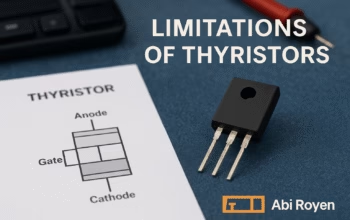
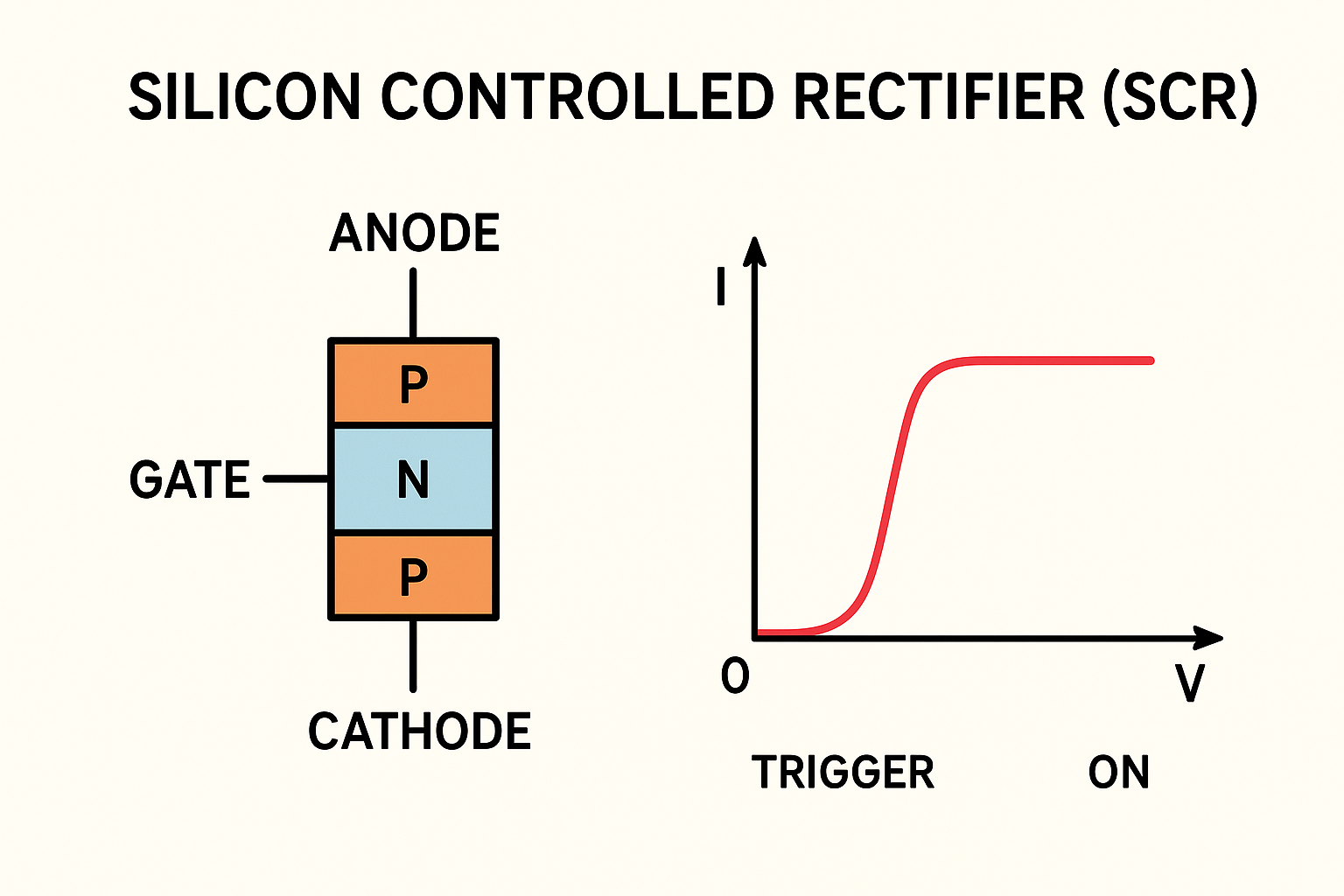
An SCR consists of four alternating layers of P-type and N-type semiconductor materials, forming a PNPN structure. It has three main terminals:
- Anode (A) – Positive terminal where the main current enters.
- Cathode (K) – Negative terminal where the main current exits.
- Gate (G) – Control terminal used to trigger conduction.
When a gate pulse is applied, the SCR switches from a non-conducting (OFF) state to a conducting (ON) state.
Working Principle of Silicon Controlled Rectifier (SCR)
The working of an SCR is based on controlling the current flow using the gate signal:
- Forward Blocking State (OFF State)
- Anode is positive with respect to cathode.
- No gate signal is applied, so the device remains OFF.
- Only a small leakage current flows.
- Forward Conduction State (ON State)
- A positive gate pulse is applied.
- The device starts conducting heavily, allowing current to flow from anode to cathode.
- Reverse Blocking State
- Anode is negative with respect to cathode.
- The SCR blocks current flow like a reverse-biased diode.
Once the SCR starts conducting, it remains ON even if the gate signal is removed, until the main current falls below the holding current.
Types of Silicon Controlled Rectifier (SCR)
SCRs come in several types, each suited for different applications:
- Phase-Controlled SCRs – Used for controlling AC power by varying the firing angle.
- Fast Switching SCRs – Designed for high-frequency applications.
- Light-Activated SCRs (LASCRs) – Triggered by light instead of an electrical signal.
- Reverse Blocking SCRs – Can block voltage in both forward and reverse directions.
Applications of Silicon Controlled Rectifier (SCR) in Industrial Electronics
SCRs are widely used in power control and automation systems, such as:
- Motor Speed Control
- Used in DC motor drives to control speed smoothly.
- Power Regulation
- In heaters, furnaces, and lighting systems for energy efficiency.
- Rectification
- In converting AC to DC for industrial power supplies.
- Overvoltage Protection
- Used in crowbar circuits to protect equipment from voltage surges.
- Phase Control in AC Circuits
- For dimming lights and controlling AC loads.
- Industrial Automation
- In PLC-based control panels for switching high-power loads.

Advantages of Silicon Controlled Rectifier (SCR)
- High Voltage and Current Handling – Can handle thousands of volts and high current loads.
- Low Power Consumption – Minimal gate signal power required.
- Compact and Reliable – Suitable for industrial environments.
- Fast Switching Capability – Allows quick control in automation systems.
- Cost-Effective – Affordable compared to mechanical switches for high-power control.
Limitations of SCR
- Unidirectional Conduction – Works only in one direction for current flow.
- Requires Continuous Current Flow – Once turned ON, needs load current to remain above holding current.
- Triggering Complexity – Requires precise firing control.
- Sensitive to Overvoltage – Can be damaged by voltage spikes without protection.
Future Trends in SCR Technology
With advancements in power electronics and smart automation, SCR technology is evolving towards:
- Hybrid Power Control Modules combining SCRs with IGBTs or MOSFETs.
- Smart SCRs with built-in diagnostics for predictive maintenance.
- Improved Heat Management for higher efficiency in compact devices.
- Integration in Renewable Energy Systems for solar inverters and wind turbine controls.
Conclusion
The Silicon Controlled Rectifier (SCR) remains a cornerstone of industrial power electronics, offering efficient and reliable control of high-power applications. From motor speed control to overvoltage protection, SCRs continue to play a critical role in automation, manufacturing, and energy systems.
As industries move towards Industry 4.0 and smart manufacturing, SCR technology will evolve further, providing even more precise, efficient, and intelligent control solutions.