

Resistors are fundamental components in every electronic circuit, controlling current flow and ensuring proper voltage distribution. While individual resistors are common, certain applications require multiple resistors working together in a compact and organized form. This is where resistor networks and arrays come into play.
Resistor networks and arrays offer a more efficient and space-saving alternative to using discrete resistors. They are widely used in both analog and digital systems, from consumer electronics to industrial automation. This article explores their structure, types, applications, and benefits in modern electronics.
1. What Are Resistor Networks and Arrays?
Resistor Networks and Resistor Arrays are groups of resistors packaged into a single component.
- Resistor Network: Contains multiple resistors connected in a specific internal configuration (e.g., series, parallel, or a combination) within one package.
- Resistor Array: Typically consists of several independent resistors in one package, without internal connections, allowing flexible use.
These configurations reduce component count on printed circuit boards (PCBs), simplify assembly, and improve reliability.
2. Structure and Packaging of Resistor Networks and Arrays
Resistor networks and arrays can be manufactured in different forms:
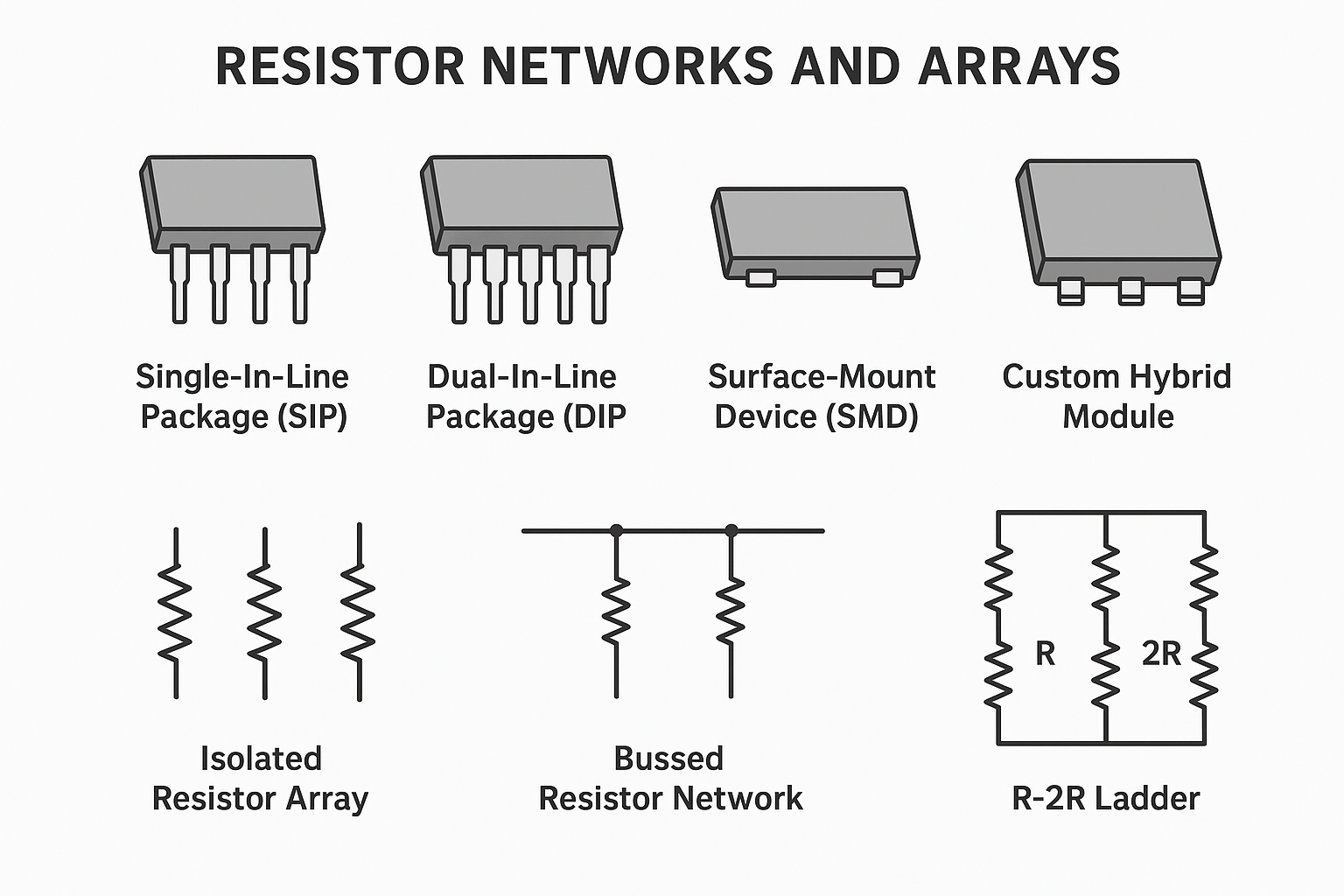
- Single-In-Line Package (SIP): Resistors are arranged in a line with a single row of pins.
- Dual-In-Line Package (DIP): Resistors are placed in two parallel rows of pins.
- Surface-Mount Device (SMD) Arrays: Compact designs suitable for modern high-density PCBs.
- Custom Hybrid Modules: Specialized designs for industrial or military-grade equipment.
These components are often marked with resistance values and tolerance codes, similar to discrete resistors.
3. Types of Resistor Networks and Arrays
3.1. Isolated Resistor Array
Contains multiple independent resistors with no internal connections. Each resistor operates separately and can be used in different parts of the circuit.
3.2. Bussed Resistor Network
All resistors share a common pin connected internally, useful in pull-up or pull-down applications for digital logic circuits.
3.3. Dual Terminator Network
Used in high-speed data transmission to reduce signal reflections and improve integrity.
3.4. Ladder Network (R-2R)
Special arrangement used in digital-to-analog converters (DACs) and analog-to-digital converters (ADCs).
4. Key Specifications to Consider of Resistor Networks and Arrays
When selecting resistor networks or arrays, engineers evaluate:
- Resistance Value: Measured in ohms (Ω).
- Tolerance: Precision level (±1%, ±5%, etc.).
- Temperature Coefficient: Stability of resistance under temperature changes.
- Power Rating: Maximum power each resistor can dissipate.
- Number of Resistors: Depending on circuit requirements.
5. Applications of Resistor Networks and Arrays
Resistor networks and arrays are widely used in:
- Pull-up and Pull-down Resistors: Common in microcontrollers and digital logic circuits.
- Voltage Dividers: For sensor interfaces and signal conditioning.
- Digital Termination: To match impedance in communication lines.
- Audio Equipment: For tone control and equalization circuits.
- Measurement Systems: For balanced and precise resistance networks.
- Data Converters: Ladder networks in DACs and ADCs.
6. Advantages of Using Resistor Networks and Arrays
6.1. Space Efficiency
Replacing several discrete resistors with one package reduces PCB size.
6.2. Improved Reliability
Fewer solder joints mean lower risk of failure due to mechanical stress or thermal cycling.
6.3. Better Matching
Resistors in the same package are manufactured under identical conditions, resulting in better tolerance matching.
6.4. Simplified Assembly
Only one component needs to be placed instead of multiple discrete parts, saving manufacturing time.
6.5. Cost Savings
Reduces labor and component handling costs in high-volume production.

7. Challenges and Limitations
While resistor networks and arrays offer many benefits, they also have some drawbacks:
- Limited Customization: Predefined values and configurations may not fit all designs.
- Heat Dissipation Limits: Compact packages can struggle with high power loads.
- Repair Difficulty: If one resistor fails, the entire package may need replacement.
8. Trends and Innovations
Modern electronics increasingly use Surface-Mount Technology (SMT) resistor arrays to achieve higher density and lower costs. Manufacturers are also developing thin-film resistor networks with ultra-tight tolerances for precision measurement equipment.
In automotive electronics, resistor networks are used for sensor calibration and ECU signal processing. Meanwhile, IoT devices benefit from their compact size and reliability.
9. Conclusion
Resistor networks and arrays play an essential role in modern electronics by offering compact, reliable, and cost-effective solutions for handling multiple resistors in one package. From simple pull-up applications to precision signal processing, these components help engineers design efficient and high-performance circuits.
Whether in consumer devices, industrial control systems, or advanced instrumentation, resistor networks and arrays continue to evolve, meeting the demands of ever-smaller and more complex electronic designs.