Introduction of Powering an Operational Amplifier
Powering an Operational Amplifier ~ Operational amplifiers, or op-amps, are the backbone of modern analog electronics. From audio circuits to instrumentation systems, op-amps are everywhere, performing tasks such as amplification, filtering, integration, and signal conditioning. However, one of the most critical—and often overlooked—aspects of using op-amps is how to power them correctly.
Supplying the wrong voltage, using an unstable source, or failing to consider the input/output swing limitations can lead to malfunction, noise issues, or even permanent damage. This article provides a comprehensive guide to powering operational amplifiers, covering voltage requirements, single vs. dual supply setups, grounding techniques, and real-world design tips.
1. Understanding Power Supply Requirements of Op-Amps
Every op-amp requires a power source to function. The supply voltage is typically denoted as V+ (positive rail) and V− (negative rail or ground).
- Supply Voltage Range:
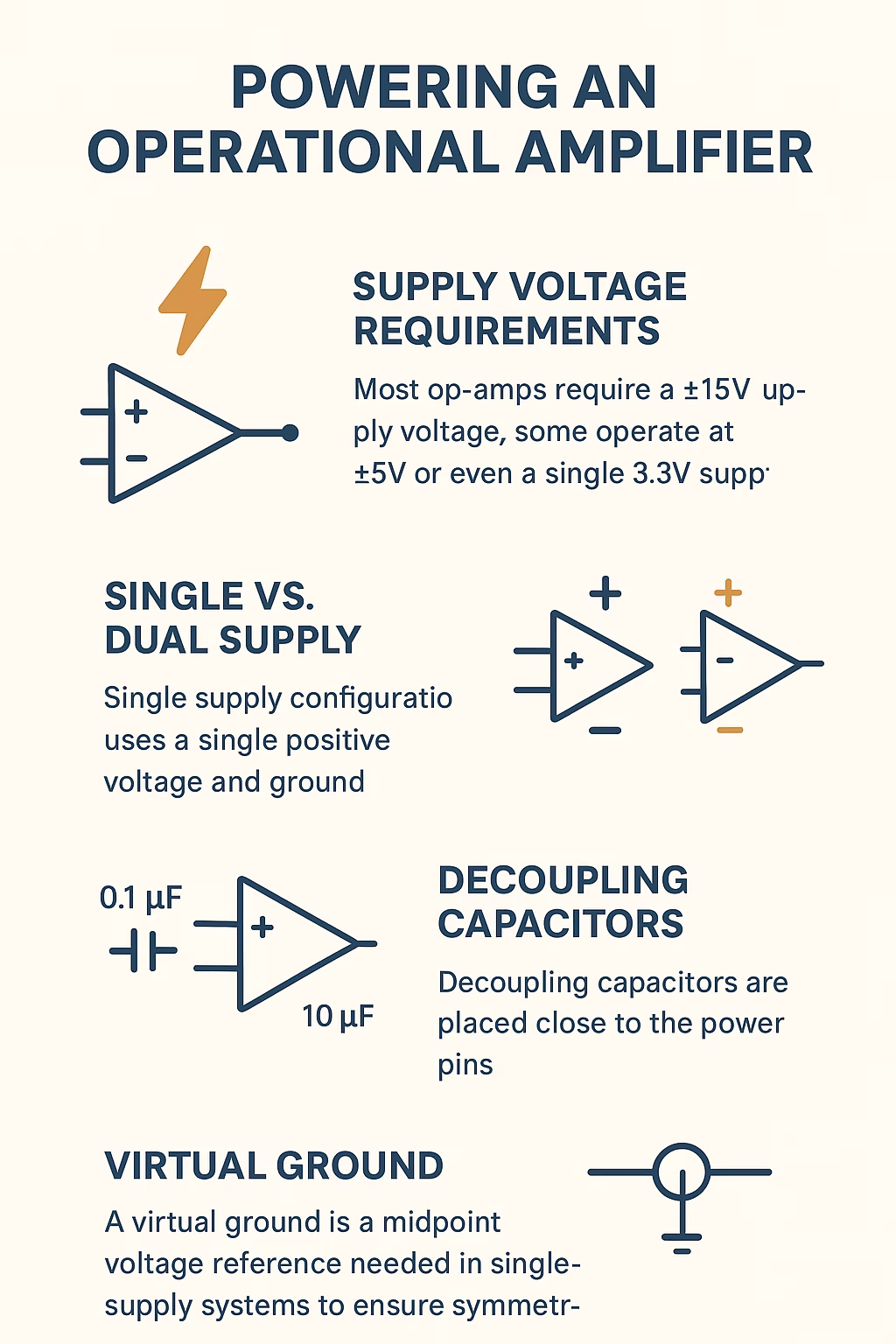
Most general-purpose op-amps, such as the LM741, require ±15 V for optimal performance. Modern low-voltage op-amps can operate at ±5 V or even a single 3.3 V supply, making them suitable for battery-powered and portable systems. - Absolute Maximum Ratings:
Exceeding the maximum supply voltage can permanently damage the op-amp. For example, the TL081 has a maximum supply of ±18 V, while some rail-to-rail op-amps are limited to 6 V. - Current Consumption:
Op-amps draw only a small amount of quiescent current (typically in the microampere to milliampere range), but high-speed and high-power op-amps can require more.
2. Single Supply vs. Dual Supply Configurations
One of the most important design choices when powering an op-amp is whether to use a single supply or a dual supply.
2.1 Dual Supply (±V)
- Typical Configuration: +15 V and -15 V
- Advantages:
- Allows input and output to swing around 0 V (ground).
- Simplifies AC signal amplification without biasing.
- Ideal for audio, instrumentation, and analog computation.
- Example Applications: Audio amplifiers, analog filters, sensor interfaces.
2.2 Single Supply (+V and Ground)
- Typical Configuration: +5 V or +12 V with ground as the negative rail.
- Challenges: Input signals must be shifted (biased) to stay within the op-amp’s input range.
- Advantages:
- Lower power requirements.
- Easier for battery-operated and microcontroller-based systems.
- Example Applications: Embedded systems, battery-powered devices, low-voltage portable equipment.
3. Rail-to-Rail Operational Amplifiers
Traditional op-amps cannot swing their output all the way to the supply rails. This means that with a single 5 V supply, the output may only swing between 0.5 V and 4.5 V.
Rail-to-rail op-amps solve this issue:
- Rail-to-Rail Input (RRI): Can accept input voltages from ground to supply.
- Rail-to-Rail Output (RRO): Can swing output voltages nearly equal to supply rails.
- Use Case: Essential in low-voltage systems (3.3 V or below) and precision applications.
4. Powering an Operational Amplifier in Real Circuits
When powering operational amplifiers, several practical considerations ensure stable and noise-free operation.
4.1 Decoupling Capacitors
- Place a 0.1 µF ceramic capacitor as close as possible to the power pins.
- Use an additional 10 µF electrolytic capacitor per supply rail for stability.
- Helps reduce high-frequency noise and prevent oscillations.
4.2 Virtual Ground in Single-Supply Systems
In single-supply designs, a virtual ground (midpoint voltage reference) is often required.
- Example: In a 5 V system, a voltage divider or dedicated IC can create a 2.5 V reference point.
- Ensures symmetrical signal swing around a midpoint rather than ground.
4.3 Power Supply Rejection Ratio (PSRR)
- A measure of how well the op-amp rejects supply voltage variations.
- High PSRR values (above 80 dB) ensure stable operation even with slightly noisy supplies.
4.4 Grounding Techniques
- Use star grounding to prevent ground loops.
- Keep analog and digital grounds separate in mixed-signal circuits.
5. Common Power Supply Sources for Op-Amps
Depending on the application, op-amps can be powered in several ways:
- Linear Power Supplies
- Provide clean, stable voltage.
- Best for high-precision analog systems (audio, instrumentation).
- Switching Power Supplies
- More efficient than linear regulators.
- Require proper filtering to minimize switching noise.
- Battery Power
- Ideal for portable systems.
- Ensure battery voltage stays within op-amp operating range.
- Voltage Regulators
- Commonly used ICs like LM7805 (5 V regulator) or LM317 (adjustable regulator) provide stable supply rails.
- For dual supply, designers often use charge pump inverters to generate negative rails.
6. Case Studies: Practical Examples
6.1 Powering a Sensor Interface Circuit
- Application: Amplifying a thermocouple signal.
- Power Setup: Dual ±12 V supply.
- Reason: Allows input signals close to 0 V without distortion.
6.2 Powering an Audio Amplifier
- Application: Portable audio device.
- Power Setup: Single 5 V USB supply with rail-to-rail op-amp.
- Reason: Saves power, fits consumer electronics standards.
6.3 Powering an Embedded System
- Application: Microcontroller-based instrumentation.
- Power Setup: Single 3.3 V supply with virtual ground at 1.65 V.
- Reason: Compatibility with digital logic and low-power design.

7. Common Mistakes When Powering an Operational Amplifier
- Exceeding Voltage Ratings – Leads to permanent damage.
- Poor Decoupling – Causes oscillation and instability.
- Improper Biasing in Single Supply – Output signal gets clipped.
- Ignoring Power Sequencing – Can cause latch-up in some CMOS op-amps.
- Mixing Analog and Digital Grounds – Creates noise issues.
8. Best Practices for Powering an Operational Amplifier
- Always check the datasheet for supply voltage limits and typical operating ranges.
- Use low-noise regulators for precision circuits.
- Place decoupling capacitors close to the op-amp pins.
- Choose rail-to-rail op-amps when working with low supply voltages.
- For battery-powered systems, ensure that the op-amp maintains proper operation across the entire battery discharge range.
Conclusion of Powering an Operational Amplifier
Powering operational amplifiers may seem simple, but in practice, it requires careful consideration of voltage ranges, supply types, decoupling, and grounding techniques. Whether using a dual ±15 V setup for high-performance audio, a single 5 V supply for portable devices, or a 3.3 V rail-to-rail op-amp for embedded systems, understanding the fundamentals ensures reliable, noise-free performance.
By applying the principles discussed in this guide, engineers and hobbyists alike can design circuits that fully harness the power of operational amplifiers.