

Popular Programmable Unijunction Transistors (PUT) ~ The Programmable Unijunction Transistor (PUT) is a unique type of four-layer thyristor known for its programmable characteristics and versatility in electronic circuits. Unlike the conventional Unijunction Transistor (UJT), PUTs offer more control over their triggering parameters, making them a preferred choice in precision timing, triggering, and oscillator applications.
In this article, we will explore some of the most popular PUT models, highlight their electrical characteristics, and examine where and how they are commonly used.
What is a Programmable Unijunction Transistor (PUT)?
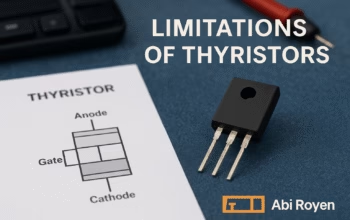
A PUT is a type of thyristor with three terminals: anode, cathode, and gate. Internally, it comprises four layers of alternating P and N-type materials, much like an SCR. The device is “programmable” because the gate terminal allows the user to set the intrinsic stand-off ratio by connecting external resistors, thus defining the voltage level at which the PUT turns on.
PUTs operate as switching devices and are commonly used in:
- Relaxation oscillators
- Timer circuits
- Triggering for SCRs or TRIACs
- Sawtooth waveform generators
Top Popular Programmable Unijunction Transistors (PUT) Models in the Market
Several PUT models have stood out in the market for their reliability, performance, and ease of use in various applications. Here are some of the most widely used:
1. Popular Programmable Unijunction Transistors (PUT): 2N6027 (by ON Semiconductor, formerly Motorola)
Key Features:
- Gate trigger voltage: Programmable
- Peak gate current: 0.2 A
- Repetitive peak off-state voltage: 40V
- Low power consumption
Applications:
- Timer circuits
- Light dimmers
- Simple oscillator designs
The 2N6027 is one of the most commonly referenced PUTs and is widely available in TO-92 packaging. It’s a solid choice for educational and low-power commercial applications.
2. Popular Programmable Unijunction Transistors (PUT): 2N6028 (ON Semiconductor)
Key Features:
- Improved version of 2N6027
- Better stability at high temperatures
- Higher gate current capability
Applications:
- Analog signal processing
- SCR triggering
- Voltage-controlled oscillator circuits
The 2N6028 is a favorite for designers who need enhanced thermal stability and more robust current characteristics compared to its predecessor.
3. Popular Programmable Unijunction Transistors (PUT): NTE6404 (NTE Electronics)
Key Features:
- Programmable gate triggering voltage
- Fast switching
- Available in TO-92 case
Applications:
- Time-delay circuits
- SCR triggering
- Low-power pulse generation
NTE6404 is an equivalent to 2N6027 and 2N6028, but produced by NTE Electronics. It’s often used as a drop-in replacement and known for good availability.
4. Popular Programmable Unijunction Transistors (PUT): ECG6404 (Philips / ECG)
Key Features:
- Legacy model, still popular in legacy equipment
- Electrically equivalent to 2N6027
- Durable in vintage or industrial devices
Applications:
- Maintenance and repair of older equipment
- Educational kits
- Light-control devices
While this model is no longer in mass production, it remains important in legacy designs.


Key Electrical Characteristics to Compare
When selecting a PUT, the following characteristics are essential to consider:
| Parameter | Typical Range |
|---|---|
| Gate trigger voltage (V_GT) | 1V to 10V |
| Gate trigger current (I_GT) | 50 µA to 200 µA |
| Peak anode current (I_A) | 100 mA to 200 mA |
| Holding current (I_H) | 1 mA to 10 mA |
| Off-state voltage (V_OFF) | Up to 40V |
| Package type | TO-92 (most common) |
PUT vs UJT: What’s the Difference?
While PUTs are functionally similar to UJTs, there are some notable differences:
| Feature | PUT | UJT |
|---|---|---|
| Structure | Four-layer PNPN device | Three-layer NPN device |
| Gate Configuration | Programmable with external resistors | Fixed internal configuration |
| Availability | More available and replaceable | Becoming obsolete |
| Triggering Voltage | Adjustable | Fixed |
| Manufacturing | Easier with standard processes | More complex for foundries |
As a result of their flexibility and availability, PUTs have largely replaced UJTs in modern electronic designs.
Common Applications of PUTs
Here are several ways in which PUTs are utilized in practical circuits:
1. Relaxation Oscillators
PUTs can generate repeating waveforms by charging and discharging a capacitor through a resistor. This setup is ideal for tone generation and pulse circuits.
2. Triggering SCRs and TRIACs
In power control applications, PUTs can be used to precisely trigger other thyristors, offering better control over the firing angle.
3. Timing Circuits
Due to their predictable firing characteristics, PUTs are used in simple timer circuits such as delay switches and soft-start mechanisms.
4. Ramp and Sawtooth Generators
PUTs are effective in generating non-sinusoidal waveforms, useful in waveform synthesizers and analog sweep circuits.
Design Tips for Working with PUTs
- Use External Resistors for Programming: To define the firing voltage, place a voltage divider at the gate.
- Capacitor Selection Matters: For oscillators, the capacitor value determines frequency. Choose based on timing needs.
- Observe Voltage Ratings: Exceeding V_OFF can permanently damage the PUT.
- Avoid Noise on the Gate: Shielding or filtering may be necessary in high-EMI environments.
PUT Availability and Selection Criteria
When choosing a PUT, consider:
- Application voltage and current requirements
- Desired firing characteristics
- Package and pin configuration
- Manufacturer support and datasheet availability
Suppliers like Digi-Key, Mouser, and Newark offer PUTs such as 2N6027 and 2N6028 with detailed datasheets and package options.
Conclusion of Popular Programmable Unijunction Transistors (PUT)
Programmable Unijunction Transistors (PUTs) continue to be a valuable component in modern and legacy electronic circuits. Their programmable nature, availability, and simplicity make them ideal for various low-power triggering and timing applications. Among the most popular models, 2N6027, 2N6028, and NTE6404 stand out for their robust performance and ease of integration.
As UJTs fade into obsolescence, PUTs remain a reliable and accessible alternative for engineers, educators, and hobbyists alike.
📌 Need More on PUT Circuits?
Visit AbiRoyen.com for tutorials, application notes, and downloadable schematics featuring PUTs and other essential electronic components.