In the world of electronics and automation, sensing devices play a vital role in making systems smarter and more responsive to their environment. One such essential component is the photoresistor, also known as an LDR (Light-Dependent Resistor). These small yet powerful devices have found their way into countless applications, from simple light-sensitive switches to advanced robotic vision systems.
This article will cover the definition, working principle, types, applications, and advantages of photo-resistors, providing a complete understanding for students, hobbyists, and engineers.
1. What is a Photoresistor?
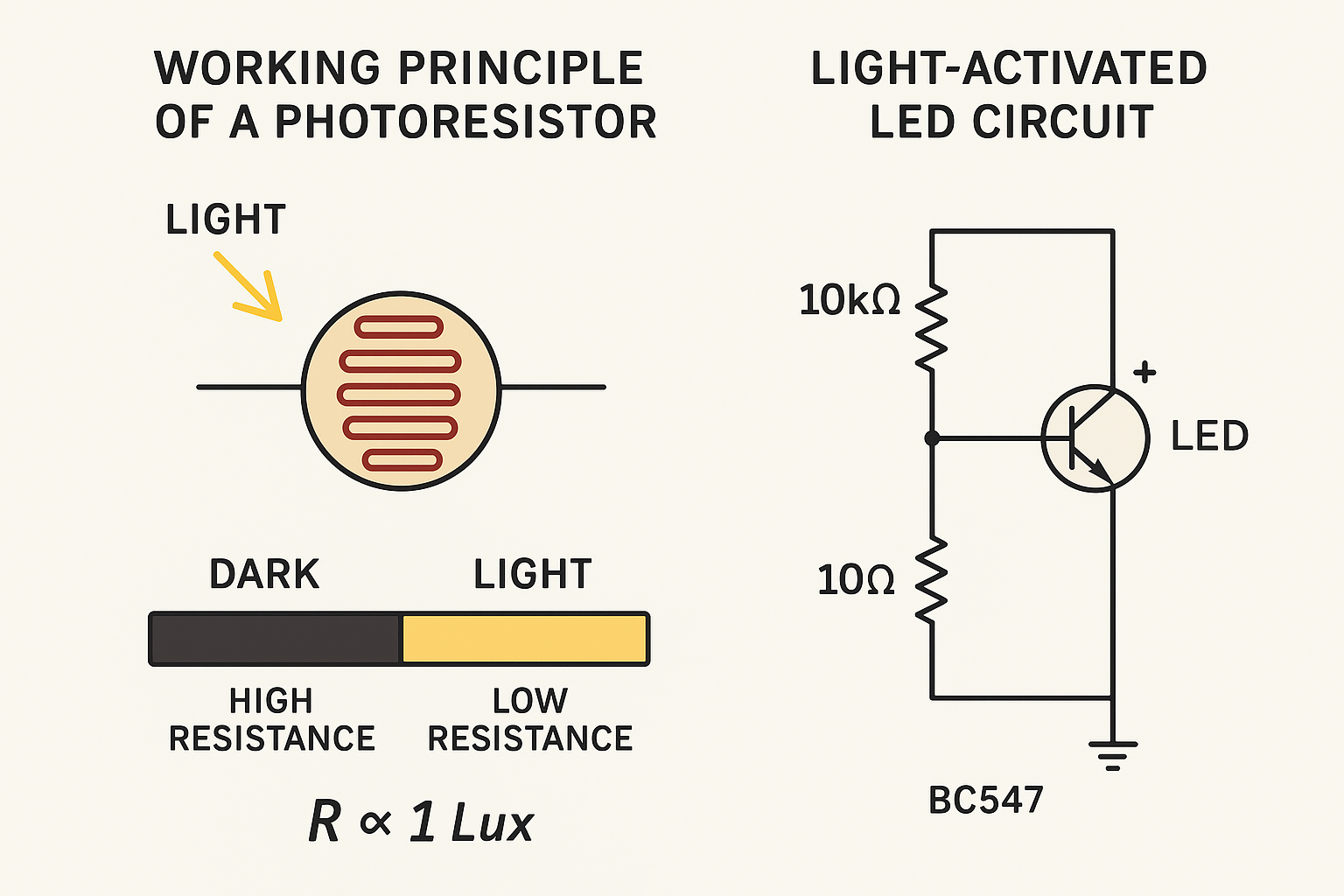
A photoresistor is an electronic component whose resistance changes depending on the amount of light falling on it. When the intensity of light increases, its resistance decreases; conversely, when light intensity decreases, its resistance increases.
Photo-resistors are passive components, meaning they cannot generate electrical energy; instead, they only modify the electrical signal passing through them based on light intensity.
Other names for a photoresistor include:
- Light-Dependent Resistor (LDR)
- Photoconductive Cell
- Light Sensor
2. Working Principle of a Photoresistor
The functioning of a photo-resistor is based on the photoconductivity effect. This phenomenon occurs when a material’s electrical conductivity increases upon exposure to light.
Inside a photoresistor, a semiconductor material (commonly cadmium sulfide, CdS) is used. In darkness, very few free electrons are available, resulting in high resistance. When light photons strike the semiconductor surface, they transfer energy to the electrons, freeing them from their atomic bonds. This increases the number of charge carriers, reducing the resistance.
Key points:
- Dark condition → High resistance (up to several megaohms)
- Bright light → Low resistance (a few hundred ohms)
Basic equation for resistance change:
nginxSalinEditR ∝ 1 / Lux
Where:
- R = Resistance
- Lux = Light intensity
3. Types of Photoresistor
Photoresistors can be classified based on the material and spectral response.
a. Cadmium Sulfide (CdS) LDR
- Most common type.
- Sensitive to visible light.
- Inexpensive and widely available.
b. Lead Sulfide (PbS) LDR
- Sensitive to infrared light.
- Suitable for thermal imaging and IR detection.
c. Cadmium Selenide (CdSe) LDR
- Responsive to light in the red to near-infrared spectrum.
- Used in flame detectors and certain optical sensors.
4. Characteristics of Photoresistor
Before using a photoresistor in a circuit, it is important to understand its key characteristics:
- Spectral Response – Wavelength range where the device is sensitive.
- Light Resistance – Resistance value under specific light intensity.
- Dark Resistance – Resistance value in complete darkness.
- Response Time – How quickly it reacts to changes in light.
- Maximum Voltage and Power Rating – Limits for safe operation.
5. Applications of Photoresistor
Photoresistors are versatile and used in various applications:
a. Light-Sensitive Switches
- Used in street lighting systems to turn lights on at night and off in the morning automatically.
b. Camera Light Meters
- Helps adjust exposure based on ambient lighting.
c. Solar Trackers
- Guides solar panels to face the sun for maximum energy absorption.
d. Alarm Systems
- Detects changes in light when an object passes in front of a sensor.
e. Consumer Electronics
- Used in mobile phones for auto-brightness adjustment.
f. Toys and Gadgets
- Enables interactive lighting effects.
6. Advantages of Photoresistor
- Low Cost – Affordable and easy to integrate into circuits.
- Simple Operation – No complex circuitry required.
- Durability – Long lifespan when used within specifications.
- Wide Range of Applications – Suitable for industrial, commercial, and hobbyist projects.

7. Limitations of Photoresistor
- Slow Response – Not ideal for high-speed light detection.
- Temperature Sensitivity – Performance can vary with temperature changes.
- Spectral Limitations – Some materials only detect specific wavelengths.
8. How to Use a Photoresistor in a Circuit
A photoresistor is often used in combination with a voltage divider circuit.
Example:
- Connect the photoresistor in series with a fixed resistor.
- Apply voltage across the series combination.
- Measure voltage across one of the resistors to determine light level.
In microcontroller applications (Arduino, Raspberry Pi), the voltage from the divider is read by an analog input pin.
9. Practical Example: Light-Activated LED Circuit
Components needed:
- 1 × Photo-resistor (LDR)
- 1 × Fixed resistor (10kΩ)
- 1 × NPN transistor (e.g., BC547)
- 1 × LED
- 1 × Power supply (5V or 9V)
How it works:
- The LDR and fixed resistor form a voltage divider.
- As light decreases, the voltage at the divider changes.
- When it reaches a certain threshold, the transistor turns on, lighting the LED.
10. Future Trends in Photoresistor Technology
While semiconductor photodiodes and phototransistors are replacing photo-resistors in some high-speed applications, LDRs remain popular due to their low cost, simplicity, and robustness.
Future developments may focus on:
- Eco-friendly materials (replacing cadmium-based compounds)
- Integration with IoT devices
- Flexible sensor designs for wearable technology
Conclusion
The photoresistor (LDR) is an essential and affordable light-sensing device in electronics. Its ability to change resistance with light makes it invaluable in automation, control systems, and consumer devices. Although it has some limitations in speed and temperature sensitivity, its advantages ensure it remains widely used in both professional and DIY electronics projects.
If you are designing a system that needs to detect light levels, the photo-resistor is a simple and cost-effective solution worth considering.