Material of Ferrite Beads ~ In the world of electronics, controlling electromagnetic interference (EMI) is essential to ensure optimal performance and compliance with regulatory standards. One of the most effective and widely used components for EMI suppression is the ferrite bead. Though these components appear simple, their internal material composition is a critical factor that determines their performance characteristics. In this article, we’ll delve into the materials used to manufacture ferrite beads, explore how these materials influence functionality, and provide guidance on choosing the right type for specific applications.
What Are Ferrite Beads?
Ferrite beads, sometimes referred to as ferrite chokes or ferrite cores, are passive electronic components designed to suppress high-frequency noise in electronic circuits. They work by providing high impedance to high-frequency signals while allowing low-frequency currents (like DC or low-frequency AC) to pass through with minimal resistance.
The core of this noise-suppressing ability lies in the ferrite material itself—a type of ceramic compound made from iron oxide mixed with other metals. But not all ferrites are created equal. The specific material composition directly affects how the ferrite bead behaves in different frequencies and electrical conditions.
Types of Ferrite Materials Used in Ferrite Beads
There are two primary classes of ferrite materials used in ferrite bead manufacturing:
- Manganese-Zinc Ferrite (MnZn)
- Nickel-Zinc Ferrite (NiZn)
Each of these materials has distinct electrical and magnetic properties that make them suitable for specific applications.
1. Manganese-Zinc Ferrite (MnZn)
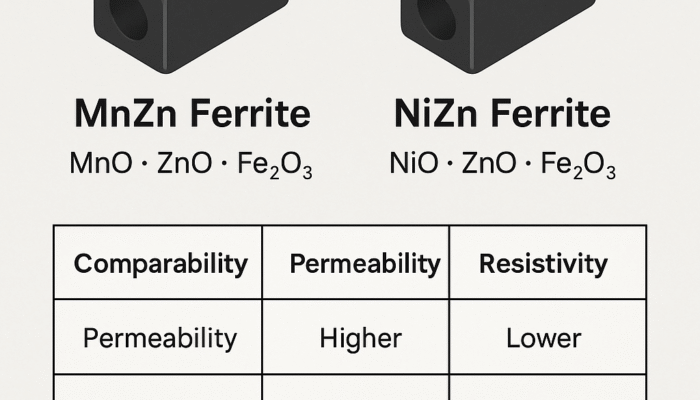
MnZn ferrite is made from manganese oxide (MnO) and zinc oxide (ZnO) mixed with iron oxide (Fe₂O₃). This type of ferrite exhibits:
- High permeability
- Lower resistivity compared to NiZn
- Effective performance in lower frequency ranges (typically below 10 MHz)
- Better impedance characteristics at power line frequencies
Key Properties of MnZn Ferrite:
- Relative permeability (µr): 1500 to 15000
- Resistivity: ~10² Ω·cm
- Frequency range: < 10 MHz
- Applications: Power lines, AC power filtering, DC power supply lines
Advantages of MnZn Ferrite:
- Superior suppression of low-frequency EMI
- Ideal for applications requiring high current handling
- Excellent for power electronics, including switching regulators and power converters
2. Nickel-Zinc Ferrite (NiZn)
NiZn ferrite is composed of nickel oxide (NiO) and zinc oxide (ZnO) with iron oxide. It offers different characteristics:
- Higher resistivity than MnZn ferrites
- Lower permeability
- Ideal for high-frequency applications (10 MHz to several hundred MHz)
- Lower core loss at high frequencies
Key Properties of NiZn Ferrite:
- Relative permeability (µr): 10 to 1000
- Resistivity: ~10⁶ Ω·cm
- Frequency range: > 10 MHz
- Applications: Signal lines, USB cables, HDMI, RF circuits
Advantages of NiZn Ferrite:
- Better performance in high-frequency noise suppression
- Less risk of creating ground loops or interference in signal integrity
- Suitable for digital electronics and communication systems

Comparing MnZn and NiZn Ferrites
| Property | MnZn Ferrite | NiZn Ferrite |
|---|---|---|
| Frequency Range | < 10 MHz | > 10 MHz |
| Permeability | Higher | Lower |
| Resistivity | Lower (~10² Ω·cm) | Higher (~10⁶ Ω·cm) |
| Applications | Power circuits | Signal/data lines |
| Current Handling | Better | Moderate |
How Material of Ferrite Beads Affects Performance
The material composition directly affects the following ferrite bead parameters:
- Impedance vs Frequency Curve
MnZn materials exhibit higher impedance at lower frequencies, while NiZn is optimized for higher frequencies. - DC Bias Characteristics
MnZn ferrites typically handle higher DC currents without significant saturation, making them better for power applications. - Thermal Performance
The composition influences heat dissipation and stability at elevated temperatures. - Insertion Loss
A bead’s ability to filter unwanted signals depends largely on the material’s response to specific frequencies.
Selecting the Right Material of Ferrite Beads for Your Application
To choose the proper ferrite bead material, engineers should consider:
- Operating Frequency Range:
Is the noise you’re targeting in the low MHz or high MHz range? - Current Requirements:
Will the bead carry high current loads? MnZn is generally preferable for power lines. - Circuit Type:
Signal integrity is crucial in communication lines, which makes NiZn a better fit. - Thermal Environment:
High-power applications may require MnZn due to better current and heat handling.
Emerging Materials and Innovations
Beyond MnZn and NiZn, researchers are exploring advanced composite materials and nano-structured ferrites for improved EMI suppression and miniaturization. Some ferrite beads now include additives like cobalt or rare earth metals to tweak specific properties like frequency response or thermal stability.
Additionally, multilayer ferrite bead (MLFB) technology has introduced compact SMD beads suitable for high-density circuit boards, relying on optimized NiZn mixtures.
Applications of Ferrite Beads Based on Material
- MnZn Ferrite Beads:
- AC power lines
- Power supply filters
- Switch-mode power supplies (SMPS)
- Motor driver circuits
- NiZn Ferrite Beads:
- USB lines
- HDMI/video signal cables
- RF communication circuits
- Microcontroller input/output lines
Conclusion of Material of Ferrite Beads
The Material of Ferrite Beads plays a decisive role in its EMI suppression capabilities. Whether you’re dealing with power electronics or high-speed digital circuits, understanding the differences between MnZn and NiZn ferrite materials will help you make informed design choices and improve the reliability of your systems.
When selecting ferrite beads, consider frequency, current, and circuit sensitivity, and consult material-specific impedance curves for optimal performance. As the demand for better EMI suppression grows, material science innovations will continue to evolve, offering even more effective solutions for tomorrow’s electronics.
If you’re looking for practical tips, product recommendations, or circuit design guides involving ferrite beads and other passive components, explore more articles on Abi Royen.