Maintenance Safety Considerations Transformers ~ Power transformers are among the most critical assets in any electrical power system. They ensure voltage transformation, efficiency, and stability of electricity transmission and distribution. However, due to their importance and high cost, transformers require a robust maintenance and safety program to guarantee long-term reliability, efficiency, and operational safety.
This article explores the essential maintenance and safety considerations of transformers, covering inspection routines, protection measures, common risks, and best practices for improving service life.

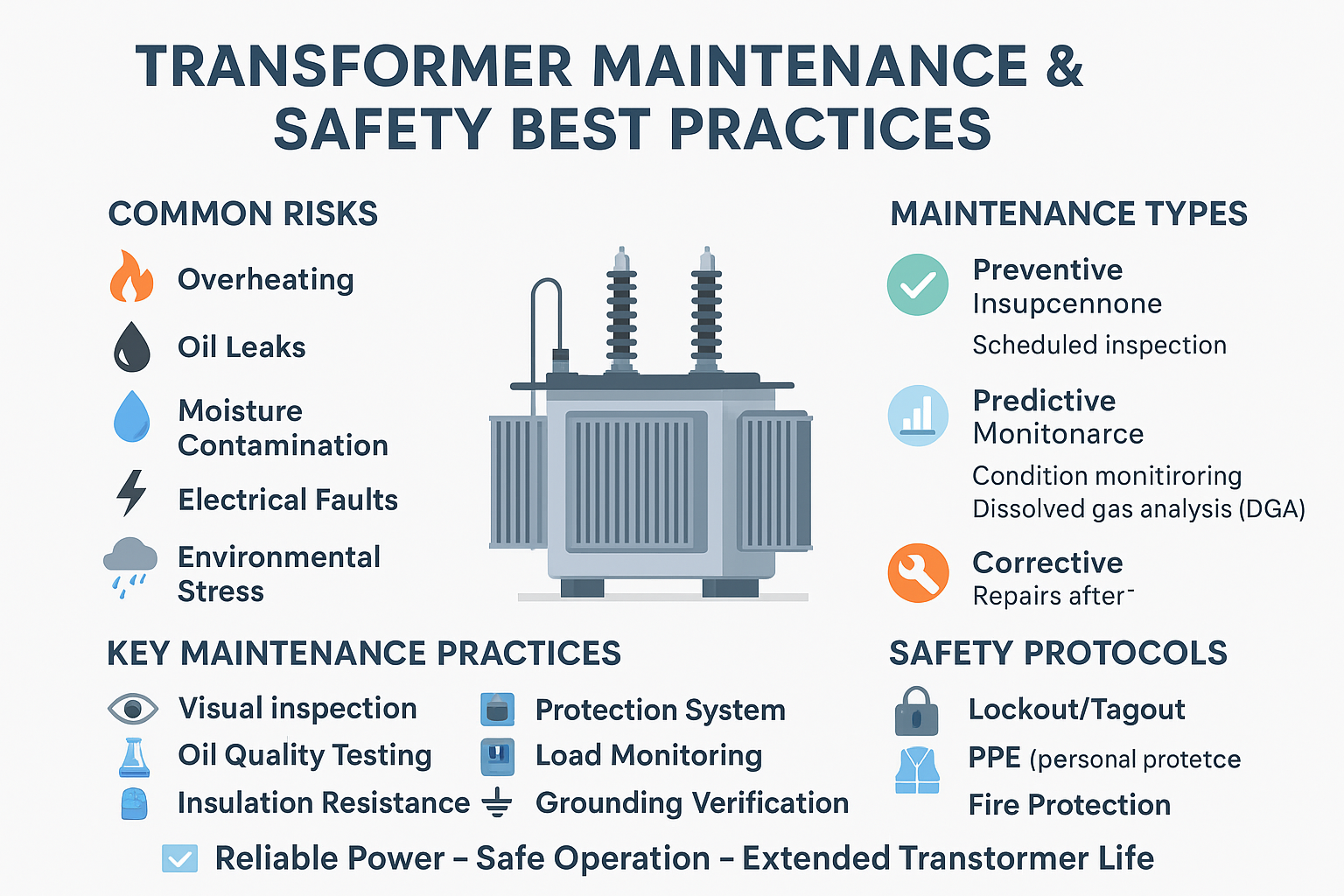
1. Why Maintenance Safety Considerations Transformers Are Critical
Transformers are subject to electrical, mechanical, thermal, and environmental stress throughout their operational life. Neglecting maintenance and safety can lead to:
- Equipment failure causing costly downtime.
- Fire hazards due to insulation breakdown or oil leakage.
- Energy losses reducing system efficiency.
- Safety risks for operators and technicians.
- Unexpected costs for repairs or replacements.
A comprehensive maintenance strategy not only reduces risks but also ensures the reliability of the power grid or industrial system.
2. Common Risks and Hazards in Transformer Operation
Before diving into maintenance practices, it’s important to understand the major risks associated with transformer operation:
- Overheating – Often caused by overloading, poor ventilation, or deteriorating insulation.
- Oil Leaks – Insulating oil leakage reduces dielectric strength and can lead to fire hazards.
- Moisture Contamination – Water entering the oil or windings reduces insulation resistance.
- Electrical Faults – Short circuits, arcing, or partial discharges can damage windings.
- Mechanical Stress – Vibration and mechanical shocks can damage structural components.
- Environmental Hazards – Dust, humidity, corrosive environments, and extreme temperatures accelerate wear.
Each of these risks highlights the need for preventive maintenance and safety measures.
3. Types of Maintenance Safety Considerations Transformers
Transformer maintenance is generally divided into three categories:
a. Preventive Maintenance
- Regular inspection and servicing to prevent failures.
- Examples: Oil testing, thermographic scanning, bushing inspection.
b. Predictive Maintenance
- Uses condition monitoring tools to predict potential issues.
- Examples: Dissolved Gas Analysis (DGA), vibration monitoring, partial discharge detection.
c. Corrective Maintenance
- Repair or replacement after a fault occurs.
- Least desirable approach due to downtime and cost.
Preventive and predictive approaches are most effective for long-term reliability.
4. Key Maintenance Safety Considerations Transformers Practices
a. Regular Visual Inspection
Check for oil leaks, corrosion, physical damage, unusual noise, and overheating signs.
b. Oil Quality Testing
- Measure dielectric strength, moisture content, and acidity.
- Perform Dissolved Gas Analysis (DGA) to detect fault gases such as hydrogen, methane, or acetylene.
c. Insulation Resistance Testing
Ensure insulation materials maintain their dielectric properties over time.
d. Bushing and Terminal Maintenance
Inspect bushings for cracks, contamination, and tracking to prevent flashovers.
e. Cooling System Check
- Inspect radiators, fans, and pumps for proper operation.
- Monitor oil temperature regularly.
f. Protection System Testing
Relays, circuit breakers, and Buchholz relays must be tested to ensure fast fault detection.
g. Load Monitoring
Avoid overloading to prevent thermal stress and reduced lifespan.
h. Grounding System Verification
Proper grounding prevents dangerous potential build-up and ensures operator safety.
5. Maintenance Safety Considerations Transformers
Working around transformers involves significant electrical hazards. Safety protocols must always be followed.
a. Lockout/Tagout (LOTO) Procedures
Always de-energize and lockout power before performing maintenance.
b. Personal Protective Equipment (PPE)
Technicians should wear arc-flash suits, insulated gloves, helmets, and safety boots.
c. Fire Protection
Install fire detection systems, automatic extinguishers, and provide fire-resistant oil alternatives when possible.
d. Handling Transformer Oil
- Prevent spillage during oil sampling or refilling.
- Store oil in sealed, dry environments to avoid contamination.
e. High Voltage Awareness
Maintain safe distances from energized parts and use insulated tools.
f. Training and Competence
Only qualified personnel should perform inspections, tests, and repairs.
6. Role of Technology in Maintenance Safety Considerations Transformers
Modern technologies improve accuracy and efficiency in transformer maintenance.
- IoT Sensors: Real-time monitoring of temperature, load, and oil quality.
- Drones: Visual inspection of transformers in remote or hazardous areas.
- Infrared Thermography: Detecting hot spots before failures occur.
- AI and Predictive Analytics: Predicting failures based on historical data trends.
Integrating technology reduces human error and allows data-driven maintenance strategies.
7. Best Practices for Reliable and Safe Operation
To maximize transformer lifespan and safety:
- Implement a maintenance schedule (monthly, quarterly, yearly checks).
- Conduct DGA testing annually or more frequently in critical systems.
- Keep records of all inspections, test results, and repairs.
- Use condition monitoring tools for predictive maintenance.
- Train staff on the latest safety standards (e.g., IEEE, IEC).
- Replace aging components before they fail.
- Ensure the transformer environment is clean, dry, and well-ventilated.
8. Conclusion of Maintenance Safety Considerations Transformers
Transformers are high-value assets that demand careful maintenance and safety considerations. By adopting preventive and predictive maintenance strategies, implementing modern monitoring technologies, and ensuring strict safety protocols, organizations can:
- Extend transformer lifespan.
- Prevent costly unplanned outages.
- Improve operational efficiency.
- Protect both personnel and infrastructure from risks.
Ultimately, transformer maintenance is not just about preserving equipment but also about ensuring the safety, reliability, and sustainability of the entire power system.

Reference Article: Maintenance Safety Considerations Transformers