

Limitations of inductors ~ Inductors are fundamental passive components widely used in electronics for energy storage, filtering, and managing electromagnetic interference (EMI). Despite their usefulness, inductors are not without their limitations. Understanding the drawbacks of inductors is crucial for electronic engineers and designers to avoid inefficiencies, errors, or failures in their circuits.
This article explores the main limitations of inductors, how they affect circuit performance, and what design considerations are necessary to mitigate these issues.
1. Limitations of Inductors Size and Bulkiness
One of the most common limitations of inductors is their physical size. Compared to resistors and capacitors, inductors—especially those with high inductance or current-handling capabilities—are significantly larger and heavier.
Why Size Matters:
- Space Constraints: In compact electronic devices like smartphones or wearables, large inductors are impractical.
- Weight Considerations: In aerospace or mobile applications, weight must be minimized, making heavy inductors unsuitable.
2. Limitations of Inductors Core Saturation
Most inductors use a ferromagnetic core (like ferrite or iron) to increase inductance. However, these cores can saturate if the magnetic field becomes too strong.
What is Core Saturation?
Core saturation occurs when the core material cannot magnetize further, leading to a dramatic drop in inductance.
Consequences:
- Loss of energy storage capability.
- Distortion in signals or failure in filtering.
- Thermal issues due to increased current flow.
3. Limitations of Inductors Frequency Response
Inductors are not ideal for high-frequency applications due to parasitic capacitance and resistance that become more pronounced at higher frequencies.
High-Frequency Limitations:
- Skin Effect: AC current tends to flow on the surface of conductors at high frequencies, increasing effective resistance.
- Parasitic Capacitance: Windings in the coil behave like a capacitor, leading to self-resonance.
- Self-Resonant Frequency (SRF): Beyond this point, the inductor starts behaving like a capacitor.
Design Impact:
- Inductors lose their inductive behavior at high frequencies.
- RF engineers must choose specially designed high-frequency inductors.
4. Energy Losses and Heat Dissipation
Inductors are known for resistive losses due to the wire used in the winding. These losses manifest as heat, which can impact the efficiency and reliability of the component.
Sources of Loss:
- DC Resistance (DCR): Resistance of the wire.
- Core Losses: Hysteresis and eddy currents in the core.
- AC Resistance: Increases with frequency due to the skin effect.
Problems Caused:
- Need for heat sinks or ventilation.
- Reduced power efficiency in power supply circuits.
- Potential damage or drift in characteristics.
5. Cost and Manufacturing Complexity
Compared to resistors and capacitors, inductors are generally more expensive and harder to manufacture due to the winding process, core materials, and insulation requirements.
Challenges Include:
- Precision winding for small tolerance values.
- Core material selection for specific frequency ranges.
- Quality control to minimize parasitics and ensure reliability.
6. Limitations of Inductors Magnetic Interference
Inductors can emit magnetic fields, which may interfere with nearby components or circuits.
Interference Issues:
- Cross-Talk: Adjacent inductors or signal lines may pick up unintended signals.
- EMI (Electromagnetic Interference): Poor shielding can lead to compliance issues with EMC standards.
Mitigation Techniques:
- Use of magnetic shielding or placement away from sensitive components.
- Use of toroidal cores to minimize EMI.

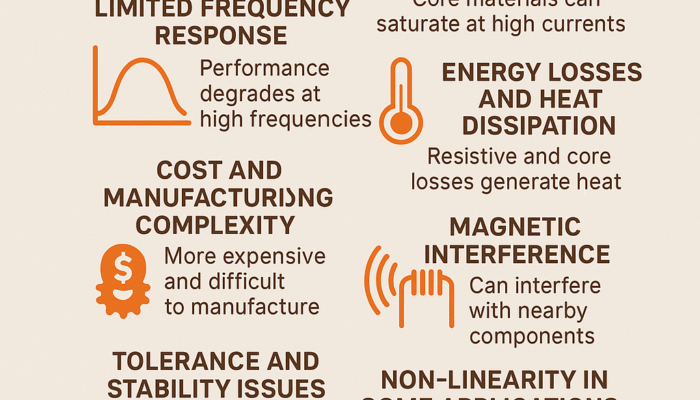
7. Limitations of Inductors Tolerance and Stability Issues
Inductors have wider tolerance ranges (often ±10% or more) compared to resistors or capacitors.
Impacts of Tolerance:
- May lead to inconsistent filter behavior.
- Affect resonance in tuned circuits.
- Require more precise circuit tuning or calibration.
Moreover, inductance can vary with temperature, especially in air-core or ferrite-based inductors, which can destabilize sensitive analog circuits or oscillators.
8. Non-Linearity in Some Applications
Inductors are not always linear devices, especially when dealing with variable currents that push the magnetic core into saturation or when operating near the self-resonance frequency.
Effects:
- Harmonic distortion in audio applications.
- Inaccurate signal processing.
- Difficulty in modeling and simulation.
Design Considerations to Mitigate Limitations of Inductors
Even with their limitations, inductors remain essential. Smart engineering choices can help reduce their downsides:
- Choose Core Material Wisely: Ferrite for high frequency, iron powder for high current.
- Stay Below Core Saturation Limits: Consider peak currents.
- Use Shielded Inductors: To minimize EMI.
- Consider Thermal Ratings: Add heat sinks if necessary.
- Use Air-Core Inductors: Where high linearity or EMI immunity is needed.
- Account for Parasitics in High-Frequency Design: Model SRF and parasitic elements.
Conclusion of Limitations of Inductors
Inductors are indispensable components in many electronic applications—from power supplies and radio circuits to EMI filters and audio systems. However, they do come with notable limitations, including size, cost, frequency behavior, core saturation, and thermal issues.
A deep understanding of these drawbacks, combined with proper design practices, can ensure that inductors work effectively within a circuit without compromising performance or reliability. By respecting their constraints and leveraging modern inductor technologies, engineers can maximize both functionality and efficiency in electronic designs.
If you’re looking for more in-depth articles on passive components and practical electronics design, visit Abi Royen – abiroyen.com regularly for the latest insights and guides.