Introduction of Key Functions of Transformers
Key Functions of Transformers ~ Transformers are one of the most important devices in electrical and industrial engineering. They play a critical role in regulating voltage, ensuring safety, and enabling efficient power transmission across vast distances. Without transformers, modern power grids and industrial systems would be inefficient, unsafe, and unsustainable.
This article explores the key functions of transformers, highlighting their importance in everyday applications—from electricity distribution in cities to powering specialized industrial equipment.
What is a Transformer?
A transformer is an electrical device that transfers energy between two or more circuits through electromagnetic induction. Its primary purpose is to change voltage levels while maintaining power consistency. By adjusting voltage up or down, transformers make electricity usable for different applications.
Transformers are built with two sets of coils, known as the primary winding and the secondary winding, wrapped around a magnetic core. Depending on the winding configuration, a transformer can either increase (step-up) or decrease (step-down) voltage.
Key Functions of Transformers
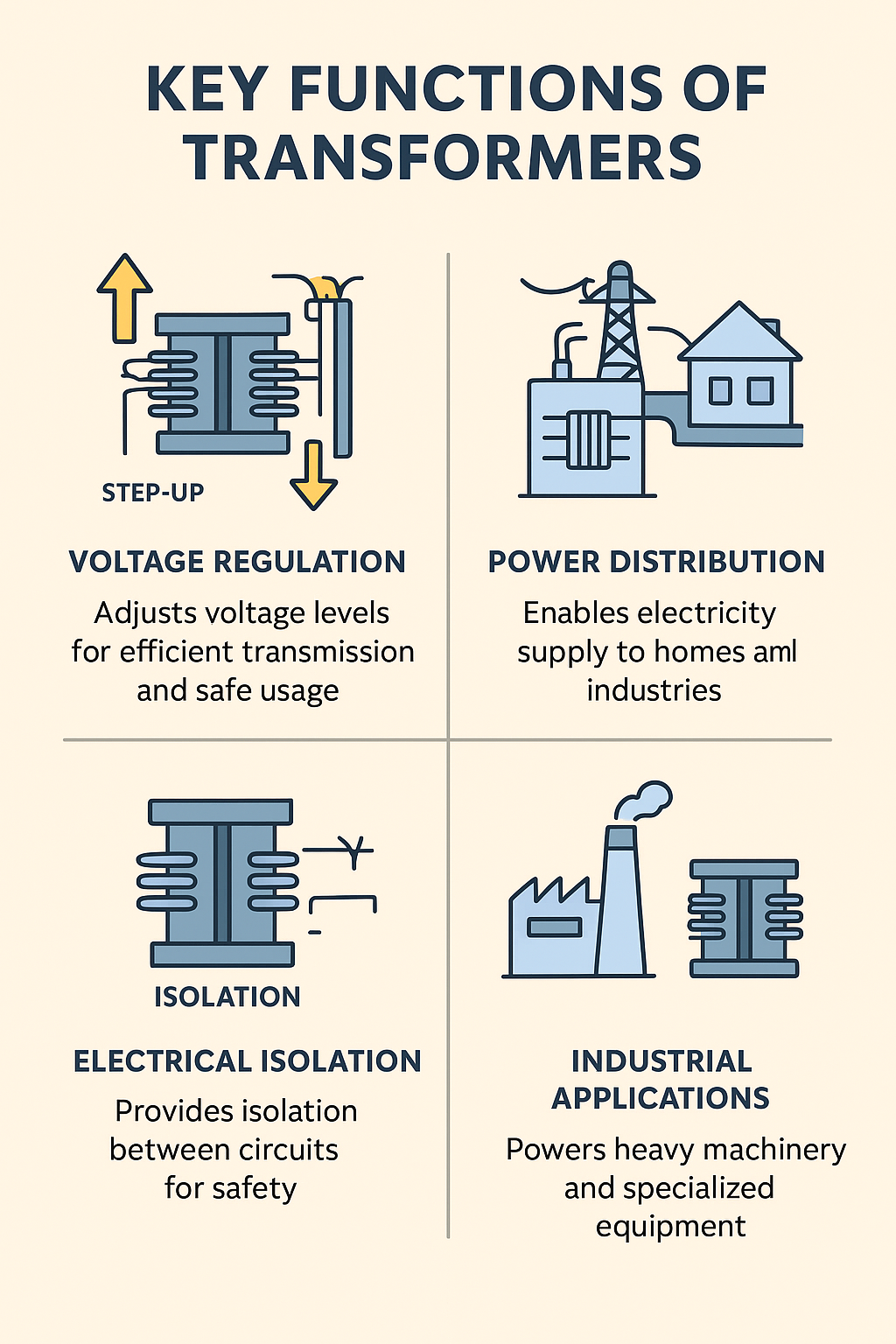
1. Key Functions of Transformers: Voltage Regulation
One of the primary functions of transformers is voltage regulation.
- Step-up transformers increase voltage for efficient long-distance transmission.
- Step-down transformers decrease voltage to safe levels for household and industrial use.
Without voltage regulation, electricity would be lost as heat during transmission, resulting in inefficiency and higher energy costs.
2. Key Functions of Transformers: Power Distribution
Transformers are the backbone of power distribution systems. They ensure that electricity generated at power plants can be delivered across cities and industries.
- Large distribution transformers reduce transmission voltage to usable levels.
- Local pole-mounted transformers supply electricity to homes and small businesses.
This ensures a smooth and consistent energy supply for consumers.
3. Key Functions of Transformers: Electrical Isolation for Safety
Transformers provide isolation between circuits, which is crucial for safety. Isolation transformers protect sensitive devices and users from electrical shocks. They are widely used in:
- Medical equipment
- Industrial control panels
- Laboratory instruments
By separating the input and output circuits, they minimize the risk of short circuits and electrical accidents.
4. Efficient Power Transmission
High-voltage transmission is necessary for moving electricity over long distances. Step-up transformers at power plants raise voltage, while step-down transformers at substations lower it for end use. This process reduces transmission losses and ensures that electricity reaches consumers reliably.
5. Matching Impedance
Transformers also serve an important role in impedance matching, especially in electronic circuits and audio systems. Proper impedance matching:
- Maximizes power transfer
- Minimizes signal loss
- Ensures stable device performance
This function is vital in communication systems, audio amplifiers, and other sensitive electronics.
6. Supporting Renewable Energy Integration
With the rise of renewable energy sources such as solar and wind, transformers are critical in integrating these systems into the main grid. They regulate voltage from renewable sources, ensuring compatibility with the distribution network.
For example:
- Solar inverters with transformers stabilize output voltage.
- Wind farm transformers step up voltage for grid transmission.
7. Industrial Applications
Transformers are used in various industries to power heavy machinery and specialized equipment. Examples include:
- Welding transformers for controlled voltage in metal fabrication.
- Furnace transformers in steel manufacturing.
- Rectifier transformers in chemical processing.
These applications demonstrate how transformers go beyond household electricity to serve critical roles in industrial productivity.

Advantages of Using Transformers
- Energy Efficiency – Reduces transmission losses.
- Safety – Provides isolation and prevents electrical hazards.
- Scalability – Easily adaptable for various voltage requirements.
- Reliability – Durable with low maintenance needs.
- Flexibility – Supports both traditional and renewable energy systems.
Future of Transformers
As global demand for energy increases, transformers will continue to evolve. Smart transformers, equipped with digital monitoring systems, are becoming integral in smart grids. They enable real-time data collection, predictive maintenance, and more efficient energy use.
Moreover, the push toward renewable energy and electric vehicles (EVs) will further expand transformer applications in the coming decades.
Conclusion of Key Functions of Transformers
Transformers are the unsung heroes of electrical engineering, ensuring safe, efficient, and reliable electricity supply worldwide. From voltage regulation and power distribution to safety and industrial use, their functions are indispensable.
As industries grow and new energy solutions emerge, transformers will remain a cornerstone of electrical infrastructure—continuing to power homes, businesses, and technologies that define modern life.