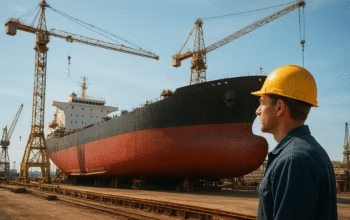


History and Evolution Shipyards ~ Shipyards are the backbone of the maritime industry, serving as the birthplace of vessels that connect the world. From the earliest wooden boats to today’s massive container ships and naval warships, shipyards have undergone tremendous evolution. This article explores the rich history and progressive transformation of shipyards, tracing their development across civilizations and technological eras.
1. The History and Evolution Shipyards Origins of Shipbuilding: Ancient Shipyards
The story of shipyards dates back thousands of years. Early shipbuilding began when humans first crafted rafts and canoes to traverse rivers and lakes. However, organized shipyards as places dedicated to vessel construction began appearing around 2500 BCE.
Egyptian Shipyards
Ancient Egyptians are among the earliest known civilizations to have built structured shipyards. Along the Nile River, they constructed wooden ships used for transport, trade, and even naval purposes. Excavations at Wadi al-Jarf, a Red Sea port, revealed large wooden planks and tools that suggest organized shipbuilding activity.
Phoenician and Greek Contributions
The Phoenicians (1500–300 BCE) advanced shipbuilding by constructing sea-worthy vessels for Mediterranean trade. They developed dry docks and primitive cranes. Later, the Greeks built triremes and galleys in shipyards located in strategic ports like Piraeus, near Athens.
2. History and Evolution Shipyards: Roman Era Shipyards
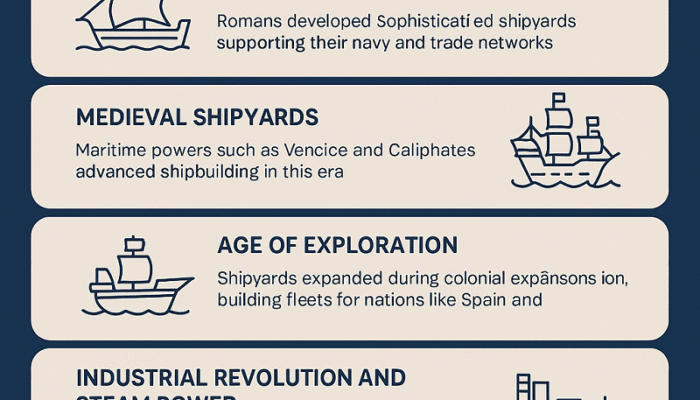
The Roman Empire saw a major leap in maritime infrastructure. The Romans developed sophisticated shipyards to support their navy and trade networks. One of the most notable shipyards was located at Portus, a man-made harbor near Rome, which served as a hub for constructing and maintaining large merchant ships and war galleys.
Roman shipyards featured:
- Timber stockpiles
- Ship slipways
- Ropewalks
- Sails and rigging workshops
They combined naval engineering with logistics to support their expansive empire.
3. History and Evolution Shipyards: Medieval Shipyards and the Rise of Maritime Powers
During the Middle Ages, shipbuilding flourished across Europe and the Islamic world. As maritime trade and naval warfare became more prominent, shipyards evolved in complexity and scale.
Islamic Golden Age
Between the 8th and 13th centuries, the Islamic Caliphates built advanced shipyards in cities like Basra, Cairo, and Cordoba. These yards produced dhows and other vessels used in Indian Ocean trade routes.
European Shipyards
In Venice, the Arsenale di Venezia, established in the 12th century, is considered one of the first industrial-scale shipyards in history. It employed over 16,000 workers and could produce a ship a day during its peak. The Arsenale featured:
- Assembly-line production techniques
- Standardized parts
- Specialized labor divisions
This set the stage for the future of shipbuilding as a mass production industry.
4. History and Evolution Shipyards: The Age of Exploration and Colonial Expansion
The 15th to 17th centuries marked the Age of Exploration, when nations like Spain, Portugal, the Netherlands, and England expanded their maritime reach. Shipyards became strategic assets in building fleets for exploration, colonization, and naval dominance.
Key Developments
- Dry docks introduced in England and the Netherlands
- Introduction of larger sailing ships like carracks and galleons
- Use of mathematical principles in ship design (via treatises like those by Matthew Baker)
Shipyards in Lisbon, Seville, and Plymouth grew rapidly, supplying ships for world-changing voyages by Columbus, Vasco da Gama, and Magellan.
5. Industrial Revolution and Steam Power
The 18th and 19th centuries brought transformative changes in shipbuilding due to the Industrial Revolution.
Material Shift
- Transition from wood to iron, then steel
- Introduction of steam engines replaced sails
- Riveting and welding replaced wooden joinery
Major Shipyards
- Harland and Wolff in Belfast (builder of the Titanic)
- Chantiers de l’Atlantique in France
- Newport News Shipbuilding in the USA
These facilities featured mechanized cranes, floating dry docks, and rail systems, allowing faster and larger ship construction.

6. 20th Century: War, Innovation, and Global Expansion
World Wars I and II greatly accelerated shipyard development. Nations invested heavily in naval and cargo ship construction, leading to:
- Modular construction methods
- Prefabricated sections
- Mass production techniques (notably by the U.S. Liberty Ships program)
Post-war reconstruction and globalization fueled commercial shipbuilding across Europe, Asia, and North America.
7. History and Evolution Shipyards: The Rise of Asia and the Modern Megayards
In the late 20th century, Asia emerged as the new epicenter of shipbuilding. South Korea, Japan, and China built massive shipyards that dominate the global market today.
Notable Shipyards
- Hyundai Heavy Industries (South Korea)
- Mitsubishi Heavy Industries (Japan)
- CSSC and CSIC (China)
Modern shipyards now use:
- Computer-aided design (CAD) and simulation tools
- Robotic welding arms
- Autonomous transportation for ship components
- 3D printing for small parts
These advancements allow for the construction of supertankers, LNG carriers, cruise ships, and even offshore platforms.
8. Environmental Concerns and Sustainable Shipyards
In recent decades, environmental awareness has prompted shipyards to innovate greener technologies and practices:
- Cleaner fuels and emissions control
- Recycling and waste management
- Green ship certifications
- Energy-efficient hull designs
Future shipyards aim to be smart, sustainable, and digitally integrated, aligned with Industry 4.0 standards.
Conclusion of History and Evolution Shipyards
The history and evolution of shipyards mirror the progress of human civilization — from primitive wooden docks to sprawling industrial giants that birth some of the most complex machines on Earth. Understanding this evolution is crucial not only for maritime enthusiasts but also for those involved in engineering, global trade, and defense. As technology advances, shipyards will continue to innovate, building the vessels that carry humanity into the future.