

Introduction of History and Development Transistor
The transistor is one of the most influential inventions in modern history, serving as the foundation of nearly every electronic device used today. From computers and smartphones to medical equipment and satellites, transistors power the digital age. Understanding the History and Development Transistor not only highlights its significance but also illustrates how it transformed human civilization.
This article will explore the origins of the transistor, the key milestones in its development, and how it continues to evolve in modern technologies.
The Birth of the Transistor
Before the invention of the transistor, electronics relied heavily on vacuum tubes. While effective, vacuum tubes were bulky, consumed high amounts of power, and were prone to frequent failures. The demand for smaller, more efficient, and reliable components grew rapidly during the early 20th century.
In December 1947, three scientists at Bell Labs—John Bardeen, Walter Brattain, and William Shockley—successfully demonstrated the first working transistor. This invention marked the beginning of a new era in electronics.
- Bardeen and Brattain built the first point-contact transistor.
- Shockley later invented the more practical bipolar junction transistor (BJT) in 1948, making mass production possible.
This breakthrough earned them the 1956 Nobel Prize in Physics, recognizing the transistor as a pivotal discovery in science and technology.
Early Development and Adoption (1950s–1960s)
During the 1950s, transistors began replacing vacuum tubes in many applications. The early versions were made of germanium, but later, silicon became the preferred material due to its abundance, stability, and superior performance.
Key milestones during this era included:
- Miniaturization of Electronics – Radios, hearing aids, and early computers began adopting transistors.
- Military and Aerospace Use – The U.S. military funded research for transistors to improve communication and navigation systems.
- Commercial Growth – The first transistor radios, introduced in the mid-1950s, became widely popular, showcasing the transistor’s potential for consumer electronics.
By the 1960s, the transistor had firmly established itself as a replacement for vacuum tubes.
The Rise of Integrated Circuits (1960s–1970s)
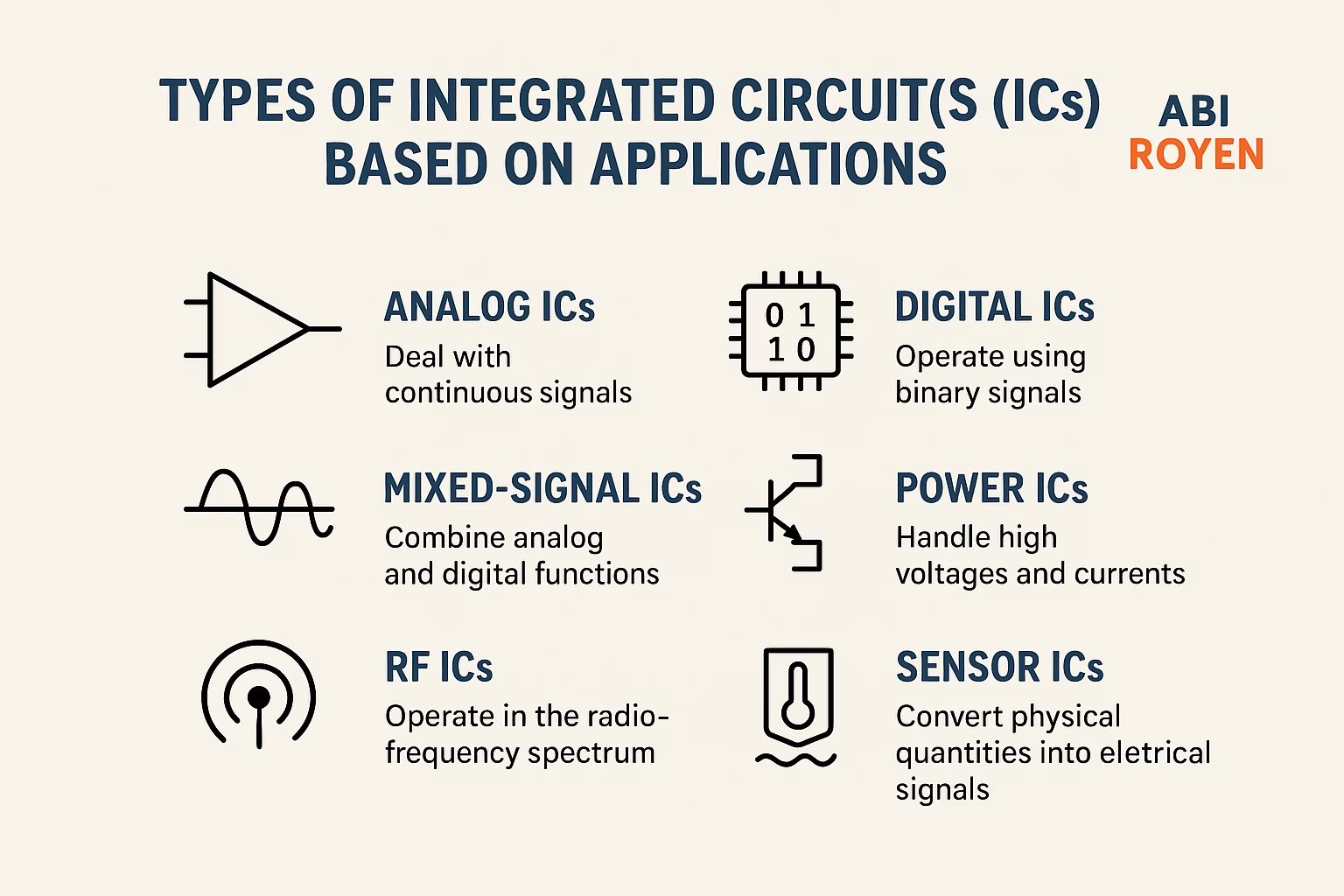
While individual transistors were revolutionary, wiring thousands of them together remained complex and impractical. This challenge led to the development of the integrated circuit (IC).
In 1958, Jack Kilby at Texas Instruments and Robert Noyce at Fairchild Semiconductor independently invented the IC, which combined multiple transistors on a single silicon chip. This innovation paved the way for:
- Smaller and more powerful computers
- Affordable consumer electronics
- The foundation of the microprocessor
By the 1970s, the microprocessor, a single chip containing millions of transistors, was introduced. This invention revolutionized computing, enabling the rise of personal computers.
Transistor Scaling and Moore’s Law (1970s–1990s)
In 1965, Gordon Moore, co-founder of Intel, predicted that the number of transistors on a chip would double approximately every two years. This prediction, known as Moore’s Law, guided the semiconductor industry for decades.
Between the 1970s and 1990s, transistor sizes shrank dramatically, allowing chips to pack millions and later billions of transistors. This scaling brought:
- Faster processing speeds
- Reduced power consumption
- Cheaper and more accessible electronics
The rise of personal computers, mobile phones, and the internet during this period was made possible by continuous transistor miniaturization.
Modern Transistors and Nanotechnology (2000s–Present)
Today, transistors are smaller than ever, with sizes measured in nanometers (nm). Advanced processors now contain tens of billions of transistors, pushing the boundaries of what was once thought impossible.
Recent developments include:
- CMOS Technology – Complementary metal-oxide-semiconductor (CMOS) transistors dominate modern integrated circuits, offering high efficiency.
- FinFET and 3D Transistors – Introduced in the 2010s, these designs improved performance by stacking transistors vertically, enabling even smaller and faster chips.
- Quantum and Nanoelectronics – Researchers are exploring quantum transistors and carbon nanotube transistors as potential successors to traditional silicon technology.
- AI and Advanced Computing – High-performance chips with billions of transistors now power artificial intelligence, machine learning, and big data applications.


Impact of the Transistor on Society
The transistor’s invention sparked the Information Age, transforming nearly every aspect of human life. Some major impacts include:
- Computing – From room-sized mainframes to handheld smartphones, transistors enabled exponential growth in computing power.
- Communication – Transistors power satellites, mobile networks, and the internet, connecting billions worldwide.
- Medicine – Medical imaging, monitoring devices, and life-support systems rely on transistor technology.
- Industry and Automation – Robotics, manufacturing, and control systems depend heavily on transistors for precision and efficiency.
- Everyday Life – Household appliances, entertainment systems, and even cars are powered by millions of tiny transistors.
The Future of Transistor Development
As transistor scaling reaches physical limits, researchers are exploring alternatives to continue advancing electronics:
- Quantum Transistors – Leveraging quantum mechanics for computing beyond classical limits.
- Optical Transistors – Using light instead of electrons to transmit signals faster.
- Neuromorphic Computing – Designing transistors that mimic the human brain for artificial intelligence.
While Moore’s Law may be slowing, innovation in transistor design ensures continued progress in technology.
Conclusion of History and Development Transistor
The history and development transistor is a story of innovation, perseverance, and transformation. From its humble beginnings in 1947 to its role in powering today’s supercomputers and smartphones, the transistor has shaped modern civilization.
As new technologies such as quantum computing and nanotechnology emerge, the transistor will remain at the heart of progress, continuing to drive humanity forward into the digital future.