Introduction of Future Sensor Technology Trends
Future Sensor Technology Trends ~ In the fast-paced digital era, sensors have become the backbone of modern technology. They are the invisible yet essential components that allow devices to perceive, measure, and respond to their environments. From smartphones and industrial automation to healthcare and environmental monitoring, sensor technology enables smarter systems and decision-making processes.
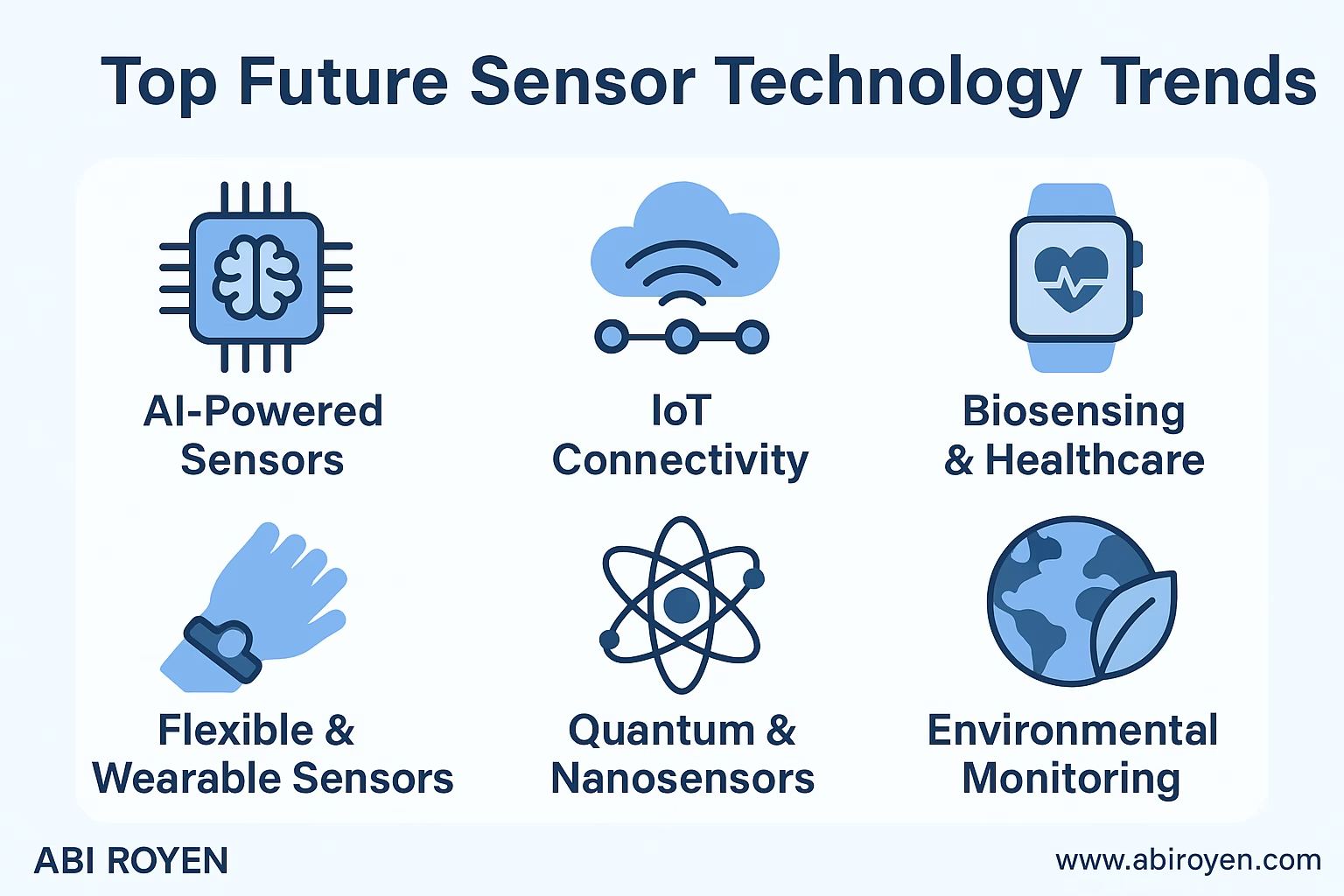
As we look toward the future, sensor technology trends are evolving at a remarkable pace. Emerging fields such as the Internet of Things (IoT), artificial intelligence (AI), and quantum computing are reshaping what sensors can do — making them smaller, more accurate, energy-efficient, and intelligent. This article explores the future trends in sensor technology that are set to transform industries and daily life.
1. Future Sensor Technology Trends: The Evolution of Sensor Technology
Over the past few decades, sensors have evolved from basic mechanical systems to complex, integrated digital devices. Early sensors were bulky, single-function components, while today’s smart sensors combine sensing, processing, and communication in one compact module.
This evolution has been driven by:
- Miniaturization through semiconductor advances.
- Wireless communication enabling real-time data exchange.
- Integration with AI for self-learning and predictive analytics.
- Increased reliability and sensitivity for critical applications like healthcare and aerospace.
As industries demand more intelligent and connected systems, sensors are becoming the nervous system of modern technology — detecting and transmitting information that powers automation, analytics, and decision-making.
2. Future Sensor Technology Trends: The Rise of Smart and Connected Sensors
The next generation of sensors is characterized by connectivity and intelligence. Unlike traditional sensors that only collect data, smart sensors can analyze and transmit information autonomously.
Key Features of Smart Sensors:
- Built-in microcontrollers and signal processors
- Real-time communication via Wi-Fi, Bluetooth, or 5G
- AI-powered data analysis
- Self-calibration and fault detection
Smart sensors play a crucial role in IoT ecosystems, where billions of devices exchange data seamlessly. For instance, in smart homes, sensors monitor temperature, motion, and air quality, while in smart cities, they manage traffic flow, lighting, and waste systems.
Industries Adopting Smart Sensors:
- Automotive: for autonomous driving and advanced driver-assistance systems (ADAS)
- Healthcare: for wearable health monitoring and diagnostics
- Agriculture: for precision farming and soil monitoring
- Manufacturing: for predictive maintenance and process optimization
Smart sensors are the foundation of Industry 4.0, enabling more efficient, adaptive, and sustainable operations.
3. Future Sensor Technology Trends: AI-Powered Sensor Systems
Artificial Intelligence is revolutionizing sensor technology. Traditional sensors capture raw data, but AI-enabled sensors can interpret patterns and make decisions without human intervention.
Applications of AI Sensors:
- Predictive Maintenance: Machine sensors detect anomalies before equipment fails.
- Autonomous Vehicles: Lidar, radar, and vision sensors use AI for navigation and obstacle detection.
- Healthcare Diagnostics: Biosensors combined with AI help identify diseases at an early stage.
- Environmental Monitoring: AI interprets sensor data to predict pollution levels or weather anomalies.
AI integration not only enhances sensor functionality but also reduces energy consumption and data bandwidth by processing information locally — a concept known as edge computing.
As AI models continue to evolve, the line between sensors and intelligent computing devices will blur, giving rise to self-learning sensors capable of continuous improvement.
4. Internet of Things (IoT) and Sensor Networks
The Internet of Things is one of the biggest driving forces behind future sensor development. In an IoT ecosystem, sensors collect real-time data from physical environments and transmit it to cloud-based systems for analysis.
IoT Sensor Trends:
- Energy Harvesting: Sensors powered by ambient energy (solar, vibration, RF).
- Low-Power Wide-Area Networks (LPWAN): for long-range communication with minimal energy use.
- Edge Intelligence: combining sensor data with local processing to reduce latency.
IoT sensors are critical in various sectors:
- Smart Homes: monitoring security, lighting, and appliances.
- Industrial IoT (IIoT): optimizing manufacturing and logistics.
- Smart Agriculture: enabling automated irrigation and crop monitoring.
- Healthcare IoT: tracking patient vitals through connected devices.
As the number of IoT devices surpasses 75 billion by 2030, future sensors will need to balance power efficiency, security, and data integrity.
5. Future Sensor Technology Trends: Biosensors and Health Monitoring
One of the most promising areas of future sensor technology is biosensing. Biosensors combine biological elements (like enzymes or antibodies) with electronic systems to detect physiological or chemical changes.
Emerging Biosensor Technologies:
- Wearable sensors: integrated into smartwatches or patches to monitor heart rate, glucose, or oxygen levels.
- Implantable sensors: for real-time tracking of organ function or drug delivery.
- Lab-on-a-chip devices: miniaturized systems performing complex analyses within seconds.
With the global push toward personalized medicine and telehealth, biosensors are becoming indispensable. AI-enhanced biosensors can detect diseases early and provide continuous health insights, empowering both patients and medical professionals.
Future developments may lead to non-invasive diagnostic sensors, capable of analyzing biomarkers through sweat, saliva, or breath — making healthcare more accessible and preventive.
6. Future Sensor Technology Trends: Flexible and Wearable Sensors
Another significant innovation is flexible and stretchable sensors, designed for wearable or embedded applications. These sensors are made using materials like graphene, nanowires, and conductive polymers.
Applications:
- Smart clothing for fitness and health tracking
- Prosthetics and robotic skin for tactile feedback
- Human-machine interfaces for augmented reality (AR) systems
Flexible sensors are essential for next-generation electronics that blend seamlessly with human activity. They provide comfort, durability, and adaptability — crucial for medical, sports, and consumer applications.

7. Future Sensor Technology Trends: Quantum and Nanoscale Sensors
At the cutting edge of research, quantum sensors and nanosensors promise unprecedented accuracy and sensitivity.
Quantum Sensors:
Operate based on quantum phenomena like entanglement and superposition, enabling ultra-precise measurements of gravity, magnetic fields, and time. They’re expected to revolutionize navigation, materials research, and even space exploration.
Nanosensors:
Built at the nanometer scale, these sensors detect atomic-level changes, useful in fields like environmental monitoring and biomedical diagnostics. For example, nanosensors can identify a single virus particle or toxic molecule in a sample.
As fabrication techniques improve, these sensors will move from research labs into mainstream industrial and commercial use.
8. Environmental and Sustainability Sensors
Future technology must also address global challenges like climate change and resource scarcity. Environmental sensors are vital tools for sustainable development, monitoring everything from air quality to water contamination.
Future Innovations:
- Self-powered sensors using solar or kinetic energy
- Remote sensing networks for large-scale environmental data
- AI-driven climate modeling based on sensor feedback
Smart environmental sensors will be essential in creating eco-friendly cities, improving disaster preparedness, and managing renewable energy systems more efficiently.
9. Challenges and Future Outlook
While the potential of future sensor technology is immense, several challenges must be addressed:
Key Challenges:
- Data Security & Privacy: As sensors collect sensitive data, protection against cyber threats is critical.
- Power Consumption: The demand for ultra-low-power or self-powered sensors is growing.
- Standardization: Lack of common communication protocols limits cross-device compatibility.
- Scalability & Cost: High manufacturing costs for advanced materials can slow adoption.
However, ongoing research in materials science, nanotechnology, and AI integration continues to push boundaries. The future outlook is optimistic — with innovations paving the way for autonomous systems, smarter cities, and personalized healthcare.
10. Conclusion of Future Sensor Technology Trends
The future of sensor technology is bright, interconnected, and intelligent. As sensors become smaller, more adaptive, and integrated with AI and IoT, they will redefine how humans interact with machines and their environment.
From quantum sensing to biosensors, flexible electronics, and environmental monitors, the evolution of sensor technology will power the next era of innovation. For industries, governments, and consumers alike, understanding these trends is vital to harnessing the full potential of a smarter, data-driven future.