Introduction: Why the Future of Transistors Matters
Future of Transistors ~ Transistors are the heart of every electronic device we use today, from smartphones and laptops to satellites and medical equipment. These tiny semiconductor components act as switches or amplifiers, making modern computing possible. Since their invention in 1947, transistors have shrunk dramatically in size while multiplying in performance, driving the exponential growth described by Moore’s Law.
But as we approach the physical limits of silicon-based transistors, the industry is now exploring new materials, architectures, and even quantum solutions. The future of transistors is not only about making them smaller but also about making them smarter, more energy-efficient, and suitable for the demands of artificial intelligence (AI), the Internet of Things (IoT), and quantum computing.
This article explores the future of transistors, their technological evolution, challenges, and how they will shape the next era of electronics.
The Current State of Transistor Technology
Today, transistors are measured in nanometers (nm), with modern processors using technology nodes as small as 3 nm. A smaller transistor means more can be packed into a chip, enabling faster performance and lower power consumption.
- Modern processors contain tens of billions of transistors.
- FinFET (Fin Field-Effect Transistor) technology has dominated in recent years, replacing traditional planar designs.
- Gate-All-Around (GAAFET) transistors are the next step, offering improved control of current leakage and power efficiency.
These innovations ensure that Moore’s Law continues, but experts agree that traditional silicon scaling is nearing its end. This is where the future of transistors becomes even more exciting.
Key Innovations Shaping the Future of Transistors
1. Future of Transistors: Beyond Silicon: New Materials
Silicon has been the foundation of the semiconductor industry for decades, but it faces physical and thermal limitations. Researchers are exploring:
- Graphene and Carbon Nanotubes (CNTs): Ultra-thin materials that allow faster electron mobility.
- Gallium Nitride (GaN): Widely used in power electronics, offering higher efficiency at high voltages.
- Molybdenum Disulfide (MoS₂): Promising for ultra-thin, flexible transistors.
These materials could overcome the bottlenecks of silicon while supporting smaller and faster devices.
2. Future of Transistors: Quantum Transistors
Traditional transistors manipulate electrons in predictable ways, but quantum transistors leverage quantum states. This allows for processing power far beyond classical computers.
- Spintronics: Uses the spin of electrons instead of their charge.
- Single-electron transistors: Enable extreme miniaturization at atomic scales.
- Quantum dots: Offer unique ways to control electronic behavior at nanoscale levels.
Quantum transistors could become the backbone of quantum computers, revolutionizing industries such as cryptography, medicine, and materials science.
3. Future of Transistors: Neuromorphic Transistors
Inspired by the human brain, neuromorphic transistors are designed to mimic neural networks, enabling advanced artificial intelligence hardware.
- They consume less energy compared to traditional architectures.
- They allow real-time learning and adaptation.
- They could be critical for AI, robotics, and autonomous systems.
4. Future of Transistors: Flexible and Wearable Electronics
The future of transistors is not only about raw computing power but also adaptability. Flexible transistors are being developed for:
- Wearable health devices (smart patches, biosensors).
- Smart clothing with integrated electronics.
- Foldable displays in next-generation smartphones.
By using organic semiconductors and thin-film technologies, transistors can now bend, stretch, and integrate into everyday objects.
5. Future of Transistors: 3D Stacking and Heterogeneous Integration
Instead of shrinking transistors indefinitely, engineers are now exploring vertical stacking and heterogeneous integration.
- 3D transistor stacking increases density without requiring smaller nodes.
- Chiplet architecture allows different specialized chips to be combined into one system.
- This approach boosts performance while reducing cost and design complexity.
Challenges Ahead
Despite the breakthroughs, several challenges remain for the future of transistors:
- Heat Dissipation: Smaller transistors generate more heat, requiring advanced cooling solutions.
- Manufacturing Costs: Cutting-edge fabrication plants cost tens of billions of dollars.
- Quantum Uncertainty: At atomic scales, electron behavior becomes unpredictable.
- Sustainability: Semiconductor manufacturing consumes large amounts of energy and water.
Overcoming these obstacles is crucial for keeping up with the growing demand for faster and more efficient electronics.
Applications of Future Transistor Technology
Artificial Intelligence (AI) and Machine Learning
Future transistors will accelerate neural networks, making AI more powerful and energy-efficient.
Internet of Things (IoT)
Tiny, ultra-low-power transistors will make it possible to embed sensors into everyday devices, from smart homes to industrial automation.
Quantum Computing
Quantum transistors will power next-generation computing, unlocking new possibilities in fields like cryptography and drug discovery.
Healthcare
Wearable electronics powered by flexible transistors will revolutionize patient monitoring and personalized medicine.
Space and Defense
Radiation-hardened transistors will enhance the reliability of satellites, spacecraft, and defense systems.

The Road Ahead: What to Expect in the Next Decade
Experts predict several key milestones for transistors over the next 10 years:
- Sub-1 nm transistors becoming a reality with new materials.
- Mass production of GAAFETs replacing FinFETs in mainstream processors.
- Commercial adoption of neuromorphic and quantum transistors.
- Integration of flexible transistors into consumer products.
These advancements will not only redefine electronics but also shape entire industries, from healthcare and energy to transportation and communication.
Conclusion of Future of Transistors
The future of transistors is more exciting than ever. While silicon has carried us through decades of technological progress, the next era will be driven by new materials, quantum phenomena, neuromorphic designs, and flexible electronics.
Transistors will not only get smaller but also smarter, more adaptable, and more efficient. They will power the growth of AI, IoT, quantum computing, and beyond, ensuring that innovation continues for decades to come.
As we stand on the edge of this new frontier, one thing is clear: the transistor will remain the beating heart of technology, shaping the future of our digital world.
Timeline Future of Transistors
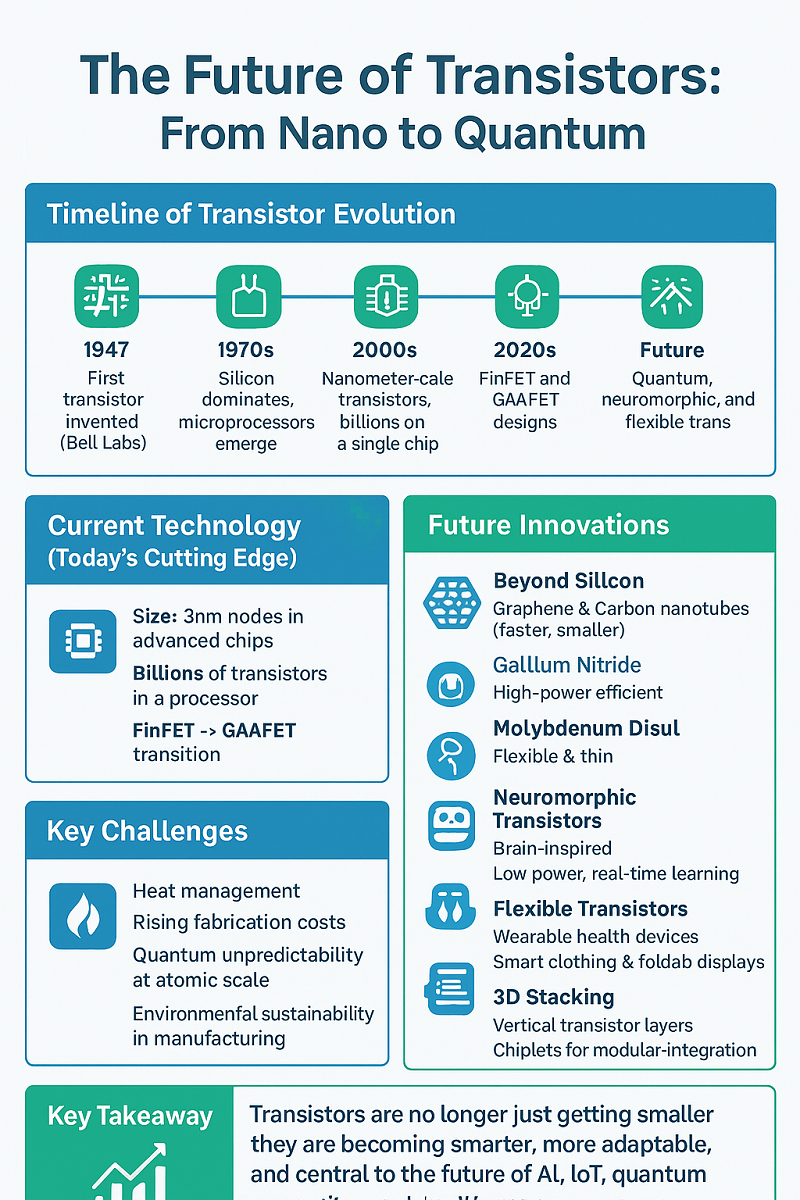
1. Timeline of Transistor Evolution
- 1947 – First transistor invented (Bell Labs).
- 1970s – Silicon dominates, microprocessors emerge.
- 2000s – Nanometer-scale transistors, billions on a single chip.
- 2020s – FinFET and GAAFET designs.
- Future – Quantum, neuromorphic, and flexible transistors.
2. Current Technology (Today’s Cutting Edge)
- Size: 3nm nodes in advanced chips.
- Billions of transistors in a processor.
- FinFET → GAAFET transition.
- Focus: Efficiency, performance, power saving.
3. Future Innovations
🔬 Beyond Silicon
- Graphene & Carbon Nanotubes (faster, smaller).
- Gallium Nitride (high-power efficiency).
- Molybdenum Disulfide (flexible & thin).
⚛️ Quantum Transistors
- Spintronics.
- Single-electron transistors.
- Quantum dots → foundation of quantum computers.
🧠 Neuromorphic Transistors
- Brain-inspired.
- Low power, real-time learning.
- Ideal for AI & robotics.
📱 Flexible Transistors
- Wearable health devices.
- Smart clothing & foldable displays.
🏗 3D Stacking
- Vertical transistor layers.
- Chiplets for modular integration.
4. Key Challenges
- Heat management.
- Rising fabrication costs.
- Quantum unpredictability at atomic scale.
- Environmental sustainability in manufacturing.
5. Applications of Future Transistors
- 🚀 AI & Machine Learning → smarter, faster AI.
- 🌐 IoT Devices → ultra-low power sensors everywhere.
- ⚛️ Quantum Computing → secure cryptography & advanced simulations.
- 🩺 Healthcare → wearable monitors & personalized medicine.
- 🛰 Space & Defense → radiation-hardened chips.
6. What’s Next? (Next 10 Years)
- Sub-1nm transistors.
- GAAFET mass adoption.
- Neuromorphic & quantum devices hit the market.
- Flexible electronics in daily life.