

Introduction
E-Ink Display, also known as Electronic Paper Displays (EPDs), are revolutionizing the way we interact with digital content. These displays offer a paper-like reading experience, exceptional visibility in sunlight, and ultra-low power consumption—making them a popular choice for devices like e-readers, electronic shelf labels, and digital signage.
In this article, we’ll dive deep into the working principles of E-Ink technology, its advantages, its wide range of applications, and how it compares to traditional display technologies such as LCDs and OLEDs.
What is an E-Ink Display?
An E-Ink display is a type of reflective display that mimics the appearance of ink on paper. Unlike traditional backlit screens, E-Ink displays do not emit light directly. Instead, they reflect ambient light, just like printed paper, which reduces eye strain and increases readability in bright environments.
The term E-Ink is derived from “electronic ink,” and the technology was originally developed by E Ink Corporation. EPDs are bistable, meaning they require power only when updating the content on the screen, not to maintain it. This unique feature allows E-Ink devices to run for weeks or even months on a single battery charge.
How E-Ink Display Technology Works
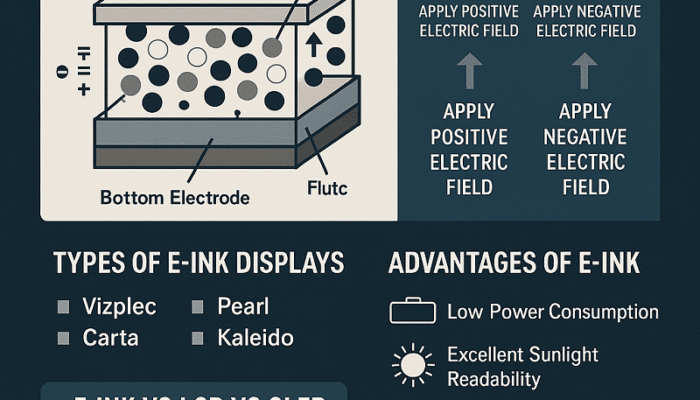
At the core of E-Ink technology lies microcapsule electrophoretic display principles. Here’s how it works:
- Microcapsules filled with positively charged white particles and negatively charged black particles are suspended in a clear fluid.
- These microcapsules are sandwiched between two layers of electrodes.
- When a positive or negative electric field is applied to the electrodes, the particles move to the top of the capsule, making the surface appear black or white depending on the charge.
- The arrangement of these particles creates grayscale images or text, and once in place, they stay static without needing power—unless the image changes.
Types of E-Ink Display
There are several types of E-Ink displays developed over time, each designed for different applications:
1. E Ink Vizplex
- First commercial EPD.
- Used in early Kindle e-readers.
2. E Ink Pearl
- Improved contrast ratio and faster refresh rate.
- Widely used in Amazon Kindle and Sony e-readers.
3. E Ink Carta
- High resolution (up to 300 PPI).
- Great contrast for high-quality text rendering.
4. E Ink Kaleido (Color E-Ink)
- Adds color filter layer to grayscale E-Ink.
- Suitable for children’s books, magazines, and comics.
5. E Ink Gallery & Advanced Color EPD (ACeP)
- Capable of displaying full-color images without a filter layer.
- Targeted for signage and retail applications.
Advantages of E-Ink Display
E-Ink displays offer several key advantages over traditional display types:
✅ Low Power Consumption
- Power is only used during screen updates.
- Ideal for battery-powered devices like e-readers or smartwatches.
✅ Excellent Sunlight Readability
- Reflective nature makes them readable even in direct sunlight.
✅ Eye-Friendly
- No blue light emission.
- Easier on the eyes for prolonged reading sessions.
✅ Thin and Lightweight
- Contributes to the overall portability of devices.
✅ Flexible and Rugged
- Some models use plastic substrates that are bendable and more durable than glass-based displays.
Limitations of E-Ink Display
Despite their many strengths, E-Ink displays also come with a few drawbacks:
- ❌ Limited Refresh Rate: Not suitable for fast-moving images or video playback.
- ❌ Limited Color Options: While color E-Ink is improving, it’s not as vivid as OLED or LCD.
- ❌ Higher Cost: Generally more expensive to manufacture than basic LCDs.
Common Applications of E-Ink Display
1. E-Readers
- Amazon Kindle, Kobo, and others use E-Ink due to its readability and long battery life.
2. Digital Signage
- Used in bus stops, airports, and train stations for static schedules and information displays.
3. Electronic Shelf Labels (ESL)
- Retail stores use E-Ink labels to display prices and product details that can be updated remotely.
4. Smart Watches and Fitness Bands
- Some low-power wearables use E-Ink to extend battery life.
5. Smart Cards and Badges
- ID cards with changing display information.
6. Note-Taking Devices
- Tablets like the reMarkable use E-Ink to provide a digital paper writing experience.

E-Ink Display vs LCD vs OLED
| Feature | E-Ink | LCD | OLED |
|---|---|---|---|
| Power Consumption | Very Low | Moderate | High |
| Sunlight Readability | Excellent | Poor | Moderate |
| Color Capability | Limited | Full Color | Full Color |
| Video Playback | Not Suitable | Excellent | Excellent |
| Eye Comfort | High | Moderate | Low |
E-Ink excels where readability, battery efficiency, and eye comfort are prioritized, while LCD and OLED are superior for multimedia and color-rich applications.
Future of E-Ink Display Technology
The future of E-Ink is bright and evolving rapidly. Upcoming innovations include:
- Flexible E-Ink panels for foldable or rollable displays.
- Color E-Ink improvements that could compete with LCDs in visual quality.
- E-Ink smartphones that blend performance with eye comfort and energy efficiency.
- Integration into IoT ecosystems for smart homes, wearables, and logistics.
As industries push for more sustainable and low-power solutions, E-Ink is likely to expand its reach into areas like education, healthcare, and smart cities.
Conclusion of E-Ink Display
E-Ink displays offer a unique combination of readability, energy efficiency, and user comfort that makes them ideal for specific applications. From e-readers and signage to smart labels and digital notebooks, their role in modern technology is continually expanding.
As demand for environmentally-friendly and battery-conscious devices grows, electronic paper display technology stands at the forefront of innovation—bringing the paper experience into the digital world.
Whether you’re a tech enthusiast, product designer, or consumer exploring new gadgets, understanding E-Ink technology can help you make better decisions for your projects or purchases.