

Diodes in Modern Electronics ~ In the world of modern electronics, few components are as fundamental and versatile as the diode. From the simplest rectifier circuits to advanced communication systems, diodes play an essential role in controlling the flow of electricity. Their ability to allow current to pass in one direction while blocking it in the other makes them the backbone of many technologies we rely on daily.
This article explores what diodes are, their working principle, the various types of diodes, and their wide-ranging applications in modern electronics.
What is a Diode?
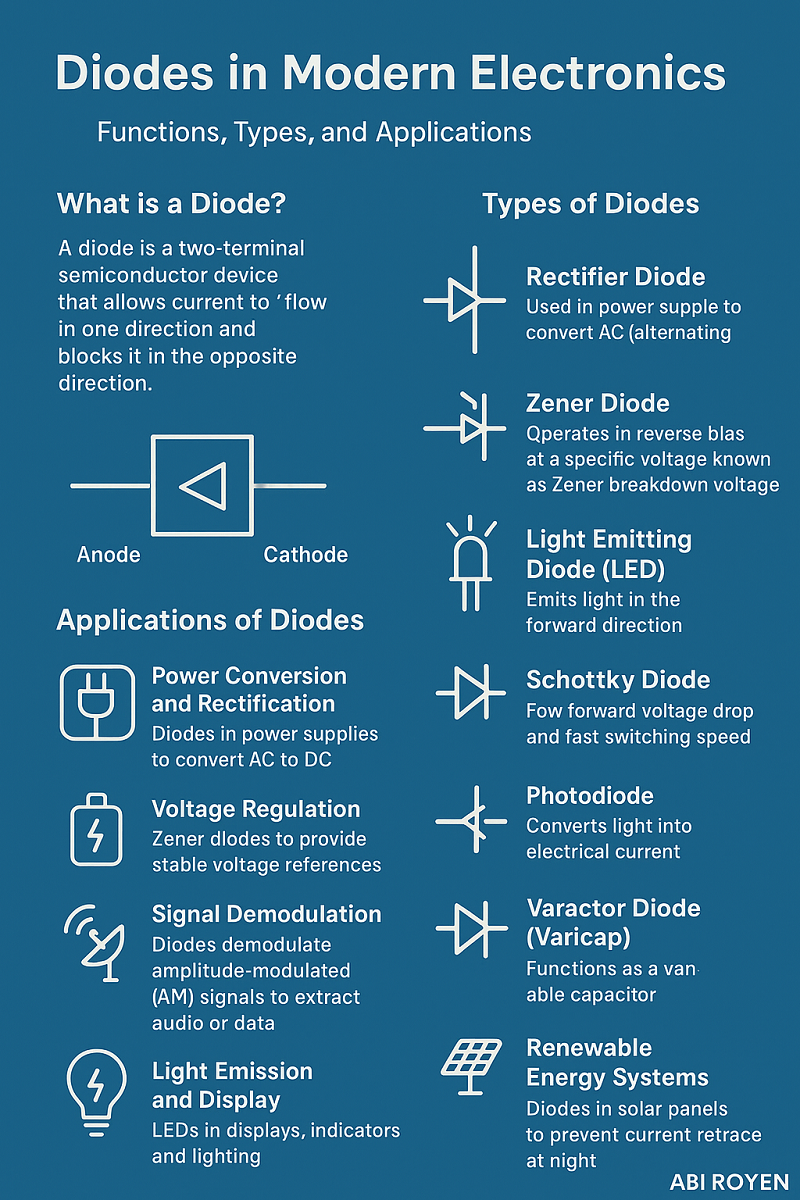
A diode is a two-terminal semiconductor device that primarily allows current to flow in one direction while preventing it in the opposite direction. It is made of a p-n junction, where one side is doped with positive charges (p-type semiconductor) and the other with negative charges (n-type semiconductor).
When connected correctly in a circuit, a diode acts as an electrical one-way valve, enabling current to pass forward (forward bias) and blocking it in reverse (reverse bias). This unique property makes it indispensable in power supplies, signal processing, and many other electronic systems.

How Does a Diode Work?
The working principle of a diode relies on the p-n junction:
- Forward Bias:
- When the positive terminal of a power source is connected to the p-side and the negative terminal to the n-side, electrons and holes move towards the junction.
- This reduces the depletion region and allows current to flow freely.
- Reverse Bias:
- When the connections are reversed, the depletion region widens, preventing current flow.
- Only a very small leakage current may pass, but essentially, the diode blocks current in this state.
This simple yet powerful function is the foundation of countless electronic applications.
Types of Diodes
Modern electronics use a wide variety of diodes, each designed for specific purposes:
- Rectifier Diode
- Used in power supplies to convert AC (alternating current) into DC (direct current).
- Essential in chargers, adapters, and power circuits.
- Zener Diode
- Operates in reverse bias at a specific voltage known as the Zener breakdown voltage.
- Widely used in voltage regulation and circuit protection.
- Light Emitting Diode (LED)
- Emits light when current flows through it in the forward direction.
- Used in displays, indicators, lighting, and automotive systems.
- Schottky Diode
- Known for its low forward voltage drop and fast switching speed.
- Commonly used in RF (radio frequency) applications and power rectification.
- Photodiode
- Converts light into electrical current.
- Used in sensors, solar cells, and optical communication systems.
- Varactor Diode (Varicap)
- Functions as a variable capacitor when reverse biased.
- Used in frequency tuning circuits like radios and televisions.
- Laser Diode
- Similar to LEDs but emits coherent light.
- Widely used in barcode scanners, fiber-optic communication, and laser pointers.
Applications of Diodes in Modern Electronics
Diodes have become integral to modern technology, enabling devices we use daily. Some common applications include:
1. Diodes in Modern Electronics: Power Conversion and Rectification
- Diodes are key components in power supplies, converting AC from the wall outlet into DC used by electronics like smartphones, computers, and televisions.
2. Voltage Regulation
- Zener diodes provide stable voltage references, ensuring circuits operate safely and reliably.
- They protect sensitive components from voltage spikes.
3. Diodes in Modern Electronics: Signal Demodulation
- In communication systems, diodes demodulate amplitude-modulated (AM) signals, allowing the extraction of audio or data.
4. Light Emission and Display
- LEDs are now the standard in lighting, from household bulbs to high-resolution television displays.
- They are energy-efficient and long-lasting compared to traditional bulbs.
5. Diodes in Modern Electronics: Protection Circuits
- Diodes protect circuits against reverse polarity, electrostatic discharge (ESD), and voltage surges.
- Schottky and TVS (transient voltage suppression) diodes are widely used for this purpose.
6. Renewable Energy Systems
- In solar panels, diodes prevent current from flowing backward at night, enhancing efficiency and safety.
7. Diodes in Modern Electronics: Sensors and Detectors
- Photodiodes detect light levels and convert them into electrical signals.
- They are critical in cameras, automatic lighting systems, and industrial automation.
Why Diodes are Essential in Modern Electronics
Without diodes, the electronic world would be drastically different. They:
- Enable the safe operation of devices by managing current direction.
- Provide efficient energy conversion, crucial for modern energy-saving technologies.
- Support high-speed communication systems through signal modulation and detection.
- Drive innovation in lighting and display technologies with LEDs and laser diodes.
As technology evolves, diodes continue to be at the heart of innovation, powering everything from consumer electronics to industrial automation and renewable energy systems.
The Future of Diodes in Electronics
With the advancement of nanotechnology and semiconductor materials, future diodes are expected to:
- Operate faster with lower power consumption.
- Integrate into flexible and wearable electronics.
- Enhance optoelectronic devices for 5G and beyond.
- Improve renewable energy harvesting and storage systems.
Diodes are not just passive components; they are enablers of technological progress.
Conclusion of Diodes in Modern Electronics
Diodes in modern electronics serve as the silent heroes that ensure circuits work efficiently, safely, and effectively. From simple rectifiers to sophisticated photodiodes and laser diodes, their applications span across nearly every industry.
Understanding diodes not only helps electronics enthusiasts and engineers design better systems but also highlights their importance in shaping the technology-driven world we live in today.