

Construction of NTC thermistors ~ NTC (Negative Temperature Coefficient) thermistors are widely used in electronics for temperature sensing and control applications. Their functionality is directly linked to their construction, which determines their accuracy, stability, and response time. Understanding how NTC thermistors are built can help engineers, technicians, and electronics enthusiasts choose the right component for their projects and ensure reliable operation.
This article will explore the materials, structural design, and manufacturing processes involved in constructing NTC thermistors, as well as the factors that influence their performance.
1. Overview of NTC Thermistors
An NTC thermistor is a type of resistor whose resistance decreases as temperature increases. This negative temperature coefficient behavior makes it ideal for applications such as:
- Temperature measurement
- Inrush current limiting
- Temperature compensation in circuits
- Thermal protection in electronics
The construction of an NTC thermistor ensures that it reacts predictably to temperature changes, making its design critical for performance.
2. Core Components of Construction of NTC Thermistors
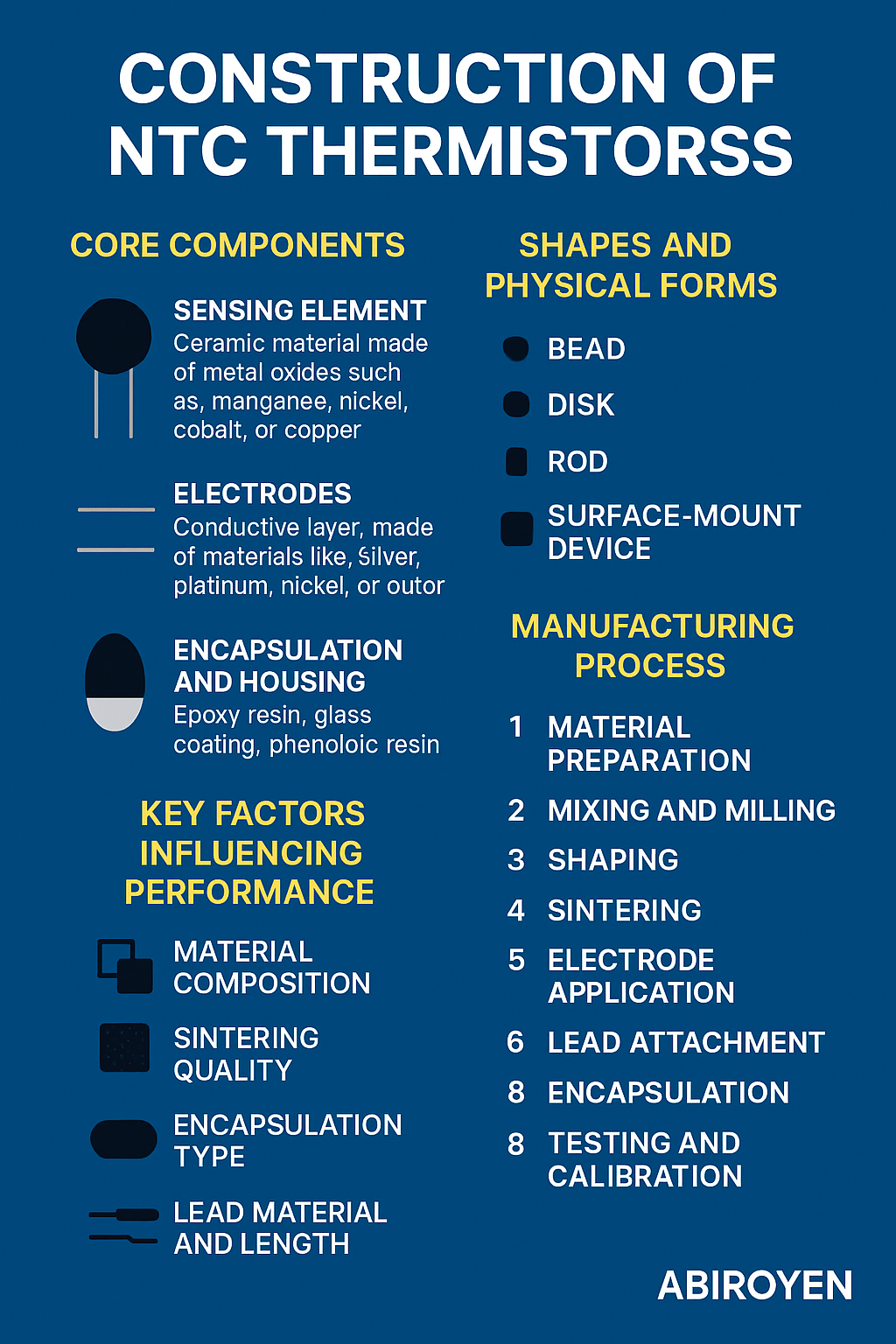
The construction of an NTC thermistor generally involves three essential components:
2.1 Construction of NTC Thermistors: Sensing Element
The sensing element is the heart of the thermistor. It is usually made from a ceramic material composed of metal oxides such as:
- Manganese oxide (MnO)
- Nickel oxide (NiO)
- Cobalt oxide (CoO)
- Copper oxide (CuO)
These materials are chosen for their high temperature sensitivity and stable resistance-temperature characteristics.
2.2 Construction of NTC Thermistors: Electrodes
Electrodes are conductive layers applied to both sides of the sensing element to allow electrical connection. These electrodes are often made from:
- Silver
- Platinum
- Nickel
- Copper
The choice of electrode material depends on the application, required conductivity, and environmental resistance.
2.3 Construction of NTC Thermistors: Encapsulation and Housing
The encapsulation protects the sensing element from moisture, mechanical stress, and contamination. Common encapsulation materials include:
- Epoxy resin
- Glass coating
- Phenolic resin
For applications requiring high durability and heat resistance, glass-encapsulated NTC thermistors are preferred.
3. Shapes and Physical Forms of NTC Thermistors
The physical construction of NTC thermistors varies depending on their intended application:
- Bead Thermistors – Tiny bead-shaped sensing elements coated with glass or epoxy.
- Disk and Chip Thermistors – Flat designs made from pressed ceramic powder.
- Rod Thermistors – Cylindrical thermistors for specialized industrial uses.
- Surface-Mount Device (SMD) Thermistors – Compact thermistors for printed circuit boards (PCBs).
Each shape offers different mechanical and thermal properties, which influence heat transfer and response time.
4. Step-by-Step Manufacturing Process of Construction of NTC Thermistors
The construction of NTC thermistors involves several precise manufacturing steps:
4.1 Material Preparation
Metal oxides are measured in specific ratios to achieve the desired resistance-temperature characteristics.
4.2 Mixing and Milling
The powdered oxides are mixed with a binder and milled to create a homogeneous material.
4.3 Shaping
The prepared ceramic material is shaped into beads, disks, rods, or chips depending on the design requirements.
4.4 Sintering
The shaped material is sintered at high temperatures (up to 1400°C) to create a dense, stable ceramic structure. This process enhances the mechanical strength and electrical properties of the thermistor.
4.5 Electrode Application
A thin layer of metal is applied to form electrodes. This is typically done using screen printing, sputtering, or electroplating.
4.6 Lead Attachment
For leaded thermistors, fine metal wires are attached to the electrodes using soldering or welding.
4.7 Encapsulation
The sensing element is coated with protective material (epoxy or glass) to safeguard it from environmental damage.
4.8 Testing and Calibration
Each thermistor is tested to ensure it meets specifications for resistance, tolerance, and temperature coefficient.

5. Key Factors Influencing NTC Thermistor Performance
The construction details greatly affect the performance of NTC thermistors:
- Material Composition – Determines sensitivity and operating temperature range.
- Sintering Quality – Impacts stability and resistance drift over time.
- Encapsulation Type – Influences durability and thermal response speed.
- Lead Material and Length – Affects electrical resistance and installation flexibility.
6. Advantages of Well-Constructed NTC Thermistors
- High Accuracy in temperature sensing
- Fast Response Time due to efficient heat transfer
- Long-Term Stability with minimal drift
- Wide Operating Temperature Range
- Cost-Effectiveness in mass production
7. Applications Linked to Construction of NTC Thermistors
Because their construction is adaptable, NTC thermistors are found in:
- Consumer Electronics – Temperature control in refrigerators, air conditioners, and ovens.
- Automotive Systems – Engine temperature monitoring and battery management.
- Medical Equipment – Patient temperature measurement devices.
- Industrial Equipment – Overheat protection in motors and transformers.
8. Conclusion of Construction of NTC Thermistors
The construction of NTC thermistors is a blend of material science, precision manufacturing, and application-specific design. By understanding their structure—sensing element, electrodes, and encapsulation—you can better appreciate how these small components deliver such precise temperature measurements.
Whether you are designing a consumer gadget, automotive system, or industrial control device, knowing the construction details will help you choose the right NTC thermistor for the job, ensuring accuracy, stability, and reliability.