

Characteristics of Active Components ~ In the vast world of electronics, components are classified into two main categories: active and passive. While passive components such as resistors, capacitors, and inductors simply absorb or store energy, active components take it a step further by actively controlling and amplifying electrical signals. This unique capability allows them to be the driving force behind complex functionalities in everything from smartphones to industrial control systems.
In this article, we will explore the key characteristics of active components, their functions, and their critical role in modern electronic design. By understanding these characteristics, engineers, students, and hobbyists can make more informed decisions when designing or troubleshooting circuits.
What Are Active Electronic Components?
Active components are devices that can control the flow of electricity, often requiring an external power source to function. These components are capable of amplifying signals, switching current flow, and modulating energy. They typically include semiconductor devices such as:
- Transistors
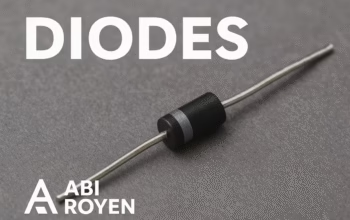
- Diodes
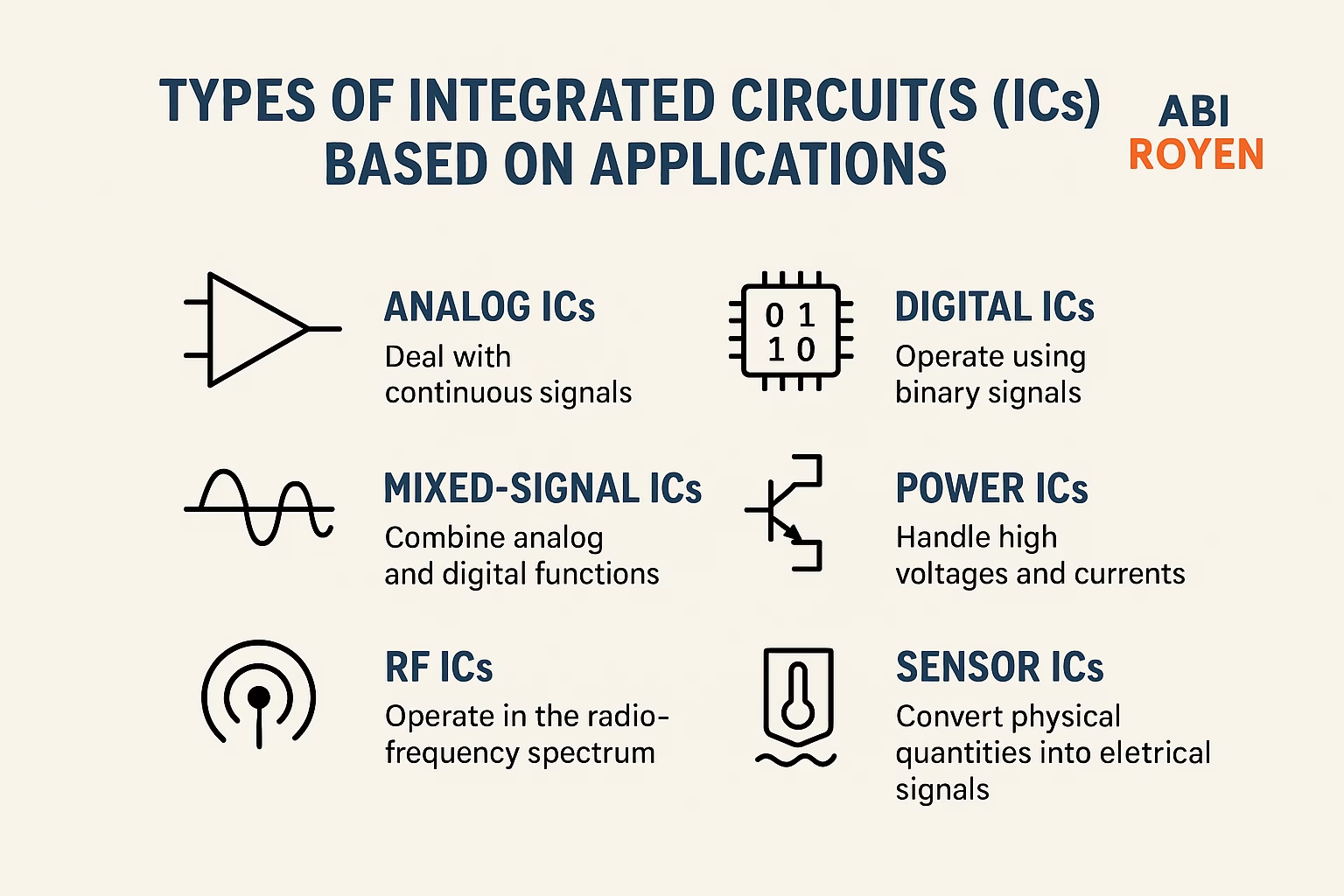
- Integrated Circuits (ICs)
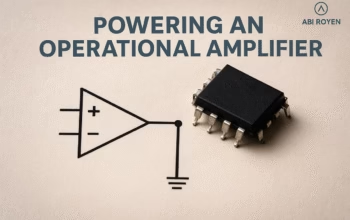
- Operational Amplifiers (Op-Amps)
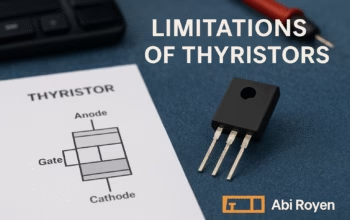
- Silicon Controlled Rectifiers (SCRs)
Each of these components serves different purposes but shares several common characteristics that distinguish them from passive components.
Key Characteristics of Active Components
1. Signal Amplification
One of the most defining traits of active components is their ability to amplify signals. This means they can take a small input signal and produce a much larger output signal.
For example:
- Transistors are used in amplifiers to increase the strength of weak audio or radio signals.
- Op-Amps are designed to provide very high gain in analog circuits.
Amplification is essential in communication systems, sound equipment, and any application where signal strength must be increased.
2. Power Dependency
Unlike passive components, active components require a separate power source to operate. This external power allows them to modify or enhance the signal.
Example:
- A transistor needs a bias voltage applied to its base or gate to control current flow between other terminals.
This dependency on an external power source is a fundamental characteristic that allows active components to perform tasks beyond the scope of passive components.
3. Control Functionality
Active components can control the behavior of electrical signals. They can:
- Turn signals on or off (switching)
- Regulate voltage or current
- Modify waveforms
A good example is the MOSFET, a type of transistor used in digital electronics as a switch. With just a small input voltage, it can control a large current, making it essential for logic gates and power regulation.
4. Characteristics of Active Components Directionality
Active components are directional, meaning they allow current to flow in a specific direction only. This is a crucial feature when designing rectifiers or digital logic systems.
Examples:
- Diodes conduct current in only one direction.
- Transistors have emitter, base, and collector terminals, each with a specific function.
This unidirectional behavior enables the creation of logic-based systems, waveform rectification, and signal modulation.
5. Signal Modulation and Switching
Active components play a vital role in modulating and switching signals. Modulation refers to altering a signal’s amplitude, frequency, or phase to transmit data, especially in wireless communication.
- Transistors can be used in oscillators and modulators.
- ICs often contain logic gates and flip-flops for digital signal switching.
Their fast switching capabilities make them ideal for modern microprocessors, memory devices, and communication systems.


6. Gain Control and Feedback Characteristics of Active Components
Active components offer gain control and can be used in feedback loops, making them integral in systems like:
- Automatic gain control (AGC) circuits
- Proportional-integral-derivative (PID) controllers
- Audio compressors and limiters
Op-Amps are widely used in feedback circuits to stabilize gain and improve linearity.
7. Non-Linearity and Responsiveness
Most active components exhibit non-linear characteristics, meaning their output does not always increase proportionally with the input.
Example:
A transistor’s collector current does not increase linearly with base current. This non-linearity can be exploited for specific functionalities like mixing signals or building oscillators.
Additionally, active components are highly responsive to input changes, making them suitable for high-speed and high-frequency applications.
8. Miniaturization and Integration
Modern active components have enabled the miniaturization of electronic devices. With Integrated Circuits (ICs), it is possible to embed thousands or even millions of transistors onto a single chip.
This characteristic is responsible for the rapid advancement of:
- Smartphones
- Computers
- Wearable electronics
- Internet of Things (IoT) devices
Miniaturized active components consume less power and space while offering superior performance.
Comparison: Active vs Passive Components
| Feature | Active Components | Passive Components |
|---|---|---|
| Power Requirement | Requires external power | Does not require power |
| Signal Amplification | Yes | No |
| Directionality | Yes | No (generally bidirectional) |
| Control Capability | Can control current/voltage | Cannot control flow |
| Common Examples | Transistors, ICs, Diodes | Resistors, Capacitors, Inductors |
| Complexity | Higher | Lower |
Applications of Active Components
Understanding the characteristics of active components helps in recognizing their applications, such as:
- Audio and Video Amplifiers
- Power Supply Regulation
- Digital Logic Systems
- Signal Processing
- Microprocessors and Controllers
- Radio and Telecommunication Circuits
They are at the heart of every electronic device, from consumer electronics to industrial automation systems.
Conclusion of Characteristics of Active Components
The characteristics of active electronic components—such as signal amplification, power dependency, directional current control, and high responsiveness—make them indispensable in modern electronics. Whether you’re designing a simple audio amplifier or a complex microprocessor, understanding these characteristics helps you select the right component for your application.
By mastering the roles and behaviors of active components, electronics enthusiasts and professionals can build more efficient, reliable, and innovative electronic systems.
For more in-depth guides, component tutorials, and electronics resources, visit Abi Royen – your trusted platform for mastering electronics fundamentals.