Introduction of Capacitors as Energy Storage
In the ever-evolving world of electronics and renewable energy, energy storage technologies play a crucial role in ensuring efficiency and reliability. While batteries have long dominated this space, capacitors are emerging as equally important components in specific applications. Capacitors are widely recognized for their ability to store and release electrical energy quickly, making them essential in circuits, renewable energy systems, and even futuristic energy storage solutions. This article will explore capacitors as energy storage devices, their working principles, types, benefits, applications, and the potential future they hold.
What is a Capacitor?
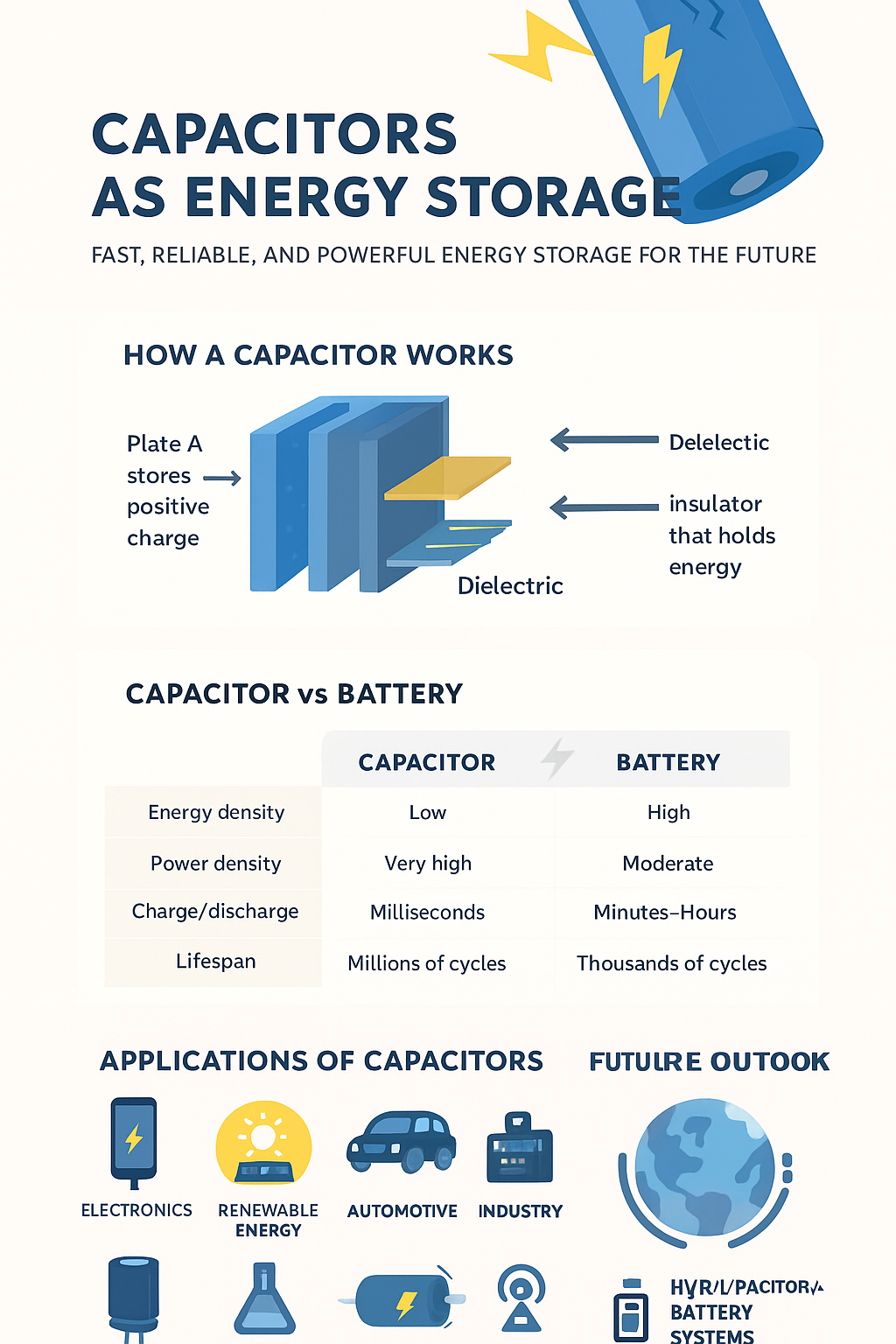
A capacitor is a passive electronic component that stores electrical energy in an electric field. It consists of two conductive plates separated by a dielectric material (insulator). When a voltage is applied across the plates, an electric field forms, storing energy until the capacitor is discharged.
Key characteristics of capacitors include:
- Capacitance (Farads): The ability to store charge.
- Voltage Rating: The maximum voltage a capacitor can handle.
- Energy Storage: The energy (E) stored is given by the formula:
E=12CV2E = \frac{1}{2} C V^2E=21CV2
Where:
- C is the capacitance in farads
- V is the applied voltage
Why Use Capacitors as Energy Storage?
Unlike batteries, capacitors can charge and discharge rapidly, making them ideal for applications that require high power in short bursts. Here are some of the main benefits:
- Fast Charging and Discharging
Capacitors can release energy almost instantly, which is essential in devices requiring quick energy bursts. - High Power Density
Although capacitors typically have lower energy density than batteries, their power density is significantly higher, enabling rapid energy delivery. - Long Lifespan
Capacitors can endure millions of charge-discharge cycles, far outlasting batteries that degrade over time. - Wide Temperature Tolerance
Capacitors remain effective in extreme conditions where batteries may fail. - Maintenance-Free Operation
Since capacitors do not rely on chemical reactions, they require minimal maintenance and are highly reliable.
Types of Capacitors as Energy Storage
Capacitors come in various types, each with unique applications:
- Electrolytic Capacitors
- Provide high capacitance in a small package.
- Commonly used in power supply circuits.
- Ceramic Capacitors
- Stable and reliable.
- Often used in high-frequency applications.
- Film Capacitors
- Known for durability and stability.
- Useful in high-voltage applications.
- Supercapacitors (Ultracapacitors)
- Specialized capacitors designed for high energy storage.
- Bridge the gap between traditional capacitors and batteries.
- Capable of storing significant energy and releasing it rapidly.
Applications of Capacitors as Energy Storage
Capacitors play a critical role in both small-scale electronics and large-scale energy systems.
1. Electronics and Consumer Devices
- Capacitors stabilize voltage and power supply in devices like smartphones, laptops, and televisions.
- They act as backup energy sources during sudden power drops, ensuring uninterrupted operation.
2. Renewable Energy Systems
- In solar and wind energy applications, capacitors smooth out fluctuations in power supply.
- They store excess energy and release it when demand spikes, improving grid stability.
3. Automotive Industry
- Supercapacitors are used in electric vehicles (EVs) for regenerative braking, where energy is captured and reused.
- They provide quick bursts of power for acceleration and starting systems.
4. Industrial Applications
- Capacitors are employed in heavy machinery for starting motors, stabilizing energy, and improving efficiency.
- In power factor correction systems, capacitors reduce energy losses and improve the reliability of power grids.
5. Emergency Power Systems
- In data centers and hospitals, capacitors provide short-term backup power until generators or secondary systems take over.

Capacitors vs. Batteries: A Comparison
While both capacitors and batteries are used for energy storage, their characteristics differ significantly:
| Feature | Capacitors | Batteries |
|---|---|---|
| Energy Density | Low | High |
| Power Density | Very High | Moderate |
| Charge/Discharge Speed | Seconds to milliseconds | Minutes to hours |
| Lifespan | Millions of cycles | Thousands of cycles |
| Maintenance | Low | Higher |
In practice, capacitors and batteries are often used together to complement each other’s strengths. For example, in electric vehicles, capacitors handle quick bursts of energy while batteries provide long-term storage.
The Future of Capacitors as Energy Storage
As technology evolves, capacitors—particularly supercapacitors—are expected to play a bigger role in global energy solutions. Emerging innovations include:
- Hybrid Capacitor-Battery Systems: Combining the high energy density of batteries with the fast discharge rates of capacitors.
- Nanotechnology: Enhancing capacitor performance through advanced materials, increasing energy density.
- Grid-Level Storage: Supercapacitors could support renewable energy integration by stabilizing power fluctuations.
- Wearable and IoT Devices: Capacitors offer lightweight, durable energy storage for small devices.
The continuous research and development in this field indicate that capacitors may soon become indispensable in the transition to clean, reliable, and efficient energy systems.
Conclusion of Capacitors as Energy Storage
Capacitors are more than just small components in electronic circuits—they are powerful energy storage devices with wide-ranging applications. Their ability to store and release energy rapidly, combined with their long lifespan and reliability, make them a vital complement to batteries in modern technology. As innovations like supercapacitors and hybrid systems advance, capacitors are poised to play a central role in the future of energy storage, from consumer electronics to renewable power grids.
By understanding capacitors as energy storage devices, engineers, researchers, and technology enthusiasts can unlock new possibilities for efficient and sustainable energy solutions.