

Introduction of Big Three Asia Megayards
Big Three Asia Megayards ~ Asia has firmly established itself as the heart of the global shipbuilding industry. At the center of this dominance are three colossal players often referred to as the “Big Three” megayards: Hyundai Heavy Industries (HHI), Daewoo Shipbuilding & Marine Engineering (DSME), and Samsung Heavy Industries (SHI). These shipbuilding giants are headquartered in South Korea and represent the pinnacle of modern industrial and maritime engineering capability. This article explores their origins, technological innovations, competitive edge, and impact on global maritime commerce.
1. Big Three Asia Megayards: Hyundai Heavy Industries (HHI)
Overview
Founded in 1972, Hyundai Heavy Industries is not only the largest shipbuilder in South Korea but also the largest shipyard in the world. Located in Ulsan, this megayard spans over 1,500 acres, employing more than 25,000 workers at its peak.
Technological Edge
- Smart Shipyards: HHI integrates AI, IoT, and digital twin technologies to manage ship design and production lines efficiently.
- Eco-Friendly Solutions: Leading in LNG carrier construction, HHI focuses on environmental compliance with dual-fuel engines and scrubber systems.
- Autonomous Navigation: In collaboration with Avikus, HHI is testing autonomous navigation systems for large vessels.
Production Capacity
- Annual capacity of over 10 million GT (Gross Tonnage)
- Specializes in VLCCs (Very Large Crude Carriers), LNG carriers, container ships, and offshore platforms
Global Recognition
HHI is consistently ranked No. 1 globally for ship orders, maintaining a strong portfolio of clients including Maersk, Shell, and BP.
2. Big Three Asia Megayards: Daewoo Shipbuilding & Marine Engineering (DSME)
Overview
DSME was founded in 1973 and is based in Okpo Bay, Geoje Island. The shipyard is renowned for its specialization in advanced and high-value ships.
Core Strengths
- LNG & LPG Expertise: DSME is known for its cutting-edge LNG and LPG carriers, often featuring advanced re-liquefaction and fuel gas supply systems.
- Defense Contracts: Builds submarines, naval destroyers, and other defense-related vessels for the South Korean Navy and foreign clients.
- Offshore Engineering: DSME is a leader in floating production storage and offloading units (FPSOs) and drilling rigs.
Innovations
- Shipbuilding Automation: Heavy use of robotic welding, digital inspection tools, and automated painting systems.
- Green Technology: DSME integrates energy-saving devices and low-emission technologies in its ship designs.
Production Capacity
- Produces over 70 ships annually, totaling approximately 7 million GT
- Employs over 10,000 skilled workers
3. Big Three Asia Megayards: Samsung Heavy Industries (SHI)
Overview
Samsung Heavy Industries began shipbuilding in 1974 and operates out of Geoje Island as well. It is a core company under the Samsung Group umbrella and focuses on technologically advanced ship types.
Focus Areas
- LNG & FLNG Units: SHI has pioneered Floating Liquefied Natural Gas (FLNG) technology.
- Cruise Ships & Mega Container Ships: Competes with European yards in complex cruise and post-Panamax container ship construction.
- Digital Shipyard Concept: Implements full digitalization of design, scheduling, and project management using AI and big data.
Global Projects
- Built Prelude FLNG, the world’s largest floating structure.
- Supplies high-end vessels to companies like ExxonMobil, NYK, MOL, and Teekay.
Production Highlights
- Shipyard area spans 3.3 million square meters
- Annual delivery of over 40 ships, including offshore drilling units

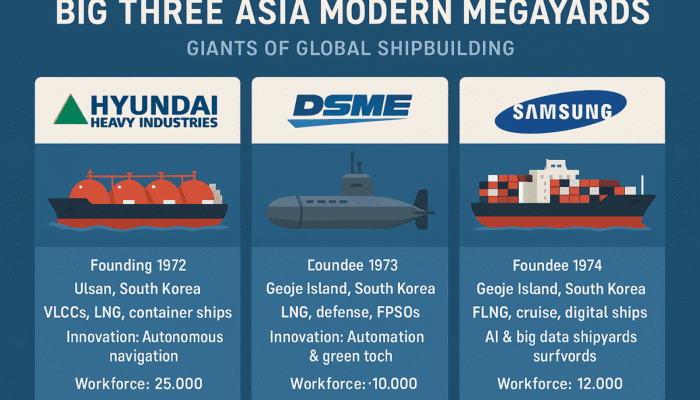
Big Three Asia Megayards Comparison: Strengths at a Glance
| Feature/Company | HHI | DSME | SHI |
|---|---|---|---|
| Founded | 1972 | 1973 | 1974 |
| Location | Ulsan, South Korea | Geoje Island, South Korea | Geoje Island, South Korea |
| Specialties | VLCCs, LNG, container ships | LNG, defense, FPSOs | FLNG, cruise, digital ships |
| Innovation | Autonomous navigation | Automation & green tech | AI & big data shipyards |
| Workforce | ~25,000 | ~10,000 | ~12,000 |
Why South Korea?
South Korea’s dominance in shipbuilding is no accident. Several factors contribute to the success of the Big Three:
- Government Support: The South Korean government offers subsidies and R&D incentives.
- Skilled Workforce: A large talent pool of marine engineers, technicians, and designers.
- Infrastructure: Deep harbors, advanced cranes, and logistics tailored for mega-ship construction.
- Export Orientation: Strong global trade relations and aggressive marketing strategies.
Global Impact of the Big Three Asia Megayards
The Big Three are responsible for over 40% of the world’s shipbuilding output. Their contributions enable:
- Lower cost logistics in global trade
- Cleaner marine energy through LNG adoption
- Safety and innovation in naval defense systems
- Strategic energy production with offshore platforms
They are also helping reshape the industry with Green Shipbuilding, Digital Twin Ship Design, and Autonomous Shipping, aligning with IMO’s goals for sustainable maritime practices.
Future Outlook
The shipbuilding market is undergoing transformation with increased demand for:
- Zero-emission ships
- Hybrid-electric propulsion systems
- Floating wind farms
- AI-assisted navigation
The Big Three are actively investing in R&D, digital transformation, and sustainability. As a result, they are expected to remain global leaders in the transition to next-generation shipping.
Conclusion of Big Three Asia Megayards
The Big Three—Hyundai Heavy Industries, Daewoo Shipbuilding & Marine Engineering, and Samsung Heavy Industries—are not just manufacturing giants; they are the architects of the future maritime world. Their megayards represent the cutting edge of shipbuilding, and their innovations will continue to steer the direction of global trade, energy, and technology.
For maritime professionals, investors, and observers, these Asian megayards are worth watching closely as they redefine the scale and ambition of what modern shipbuilding can achieve.