

Integrated Circuits (ICs) are the unsung heroes of modern technology. These miniature marvels of engineering have become the backbone of countless electronic devices, from the smartphone in your pocket to the systems guiding spacecraft in orbit. This article explores the vast and varied applications of integrated circuits, illustrating why they are indispensable in today’s electronic and digital world.
What Are Integrated Circuits?
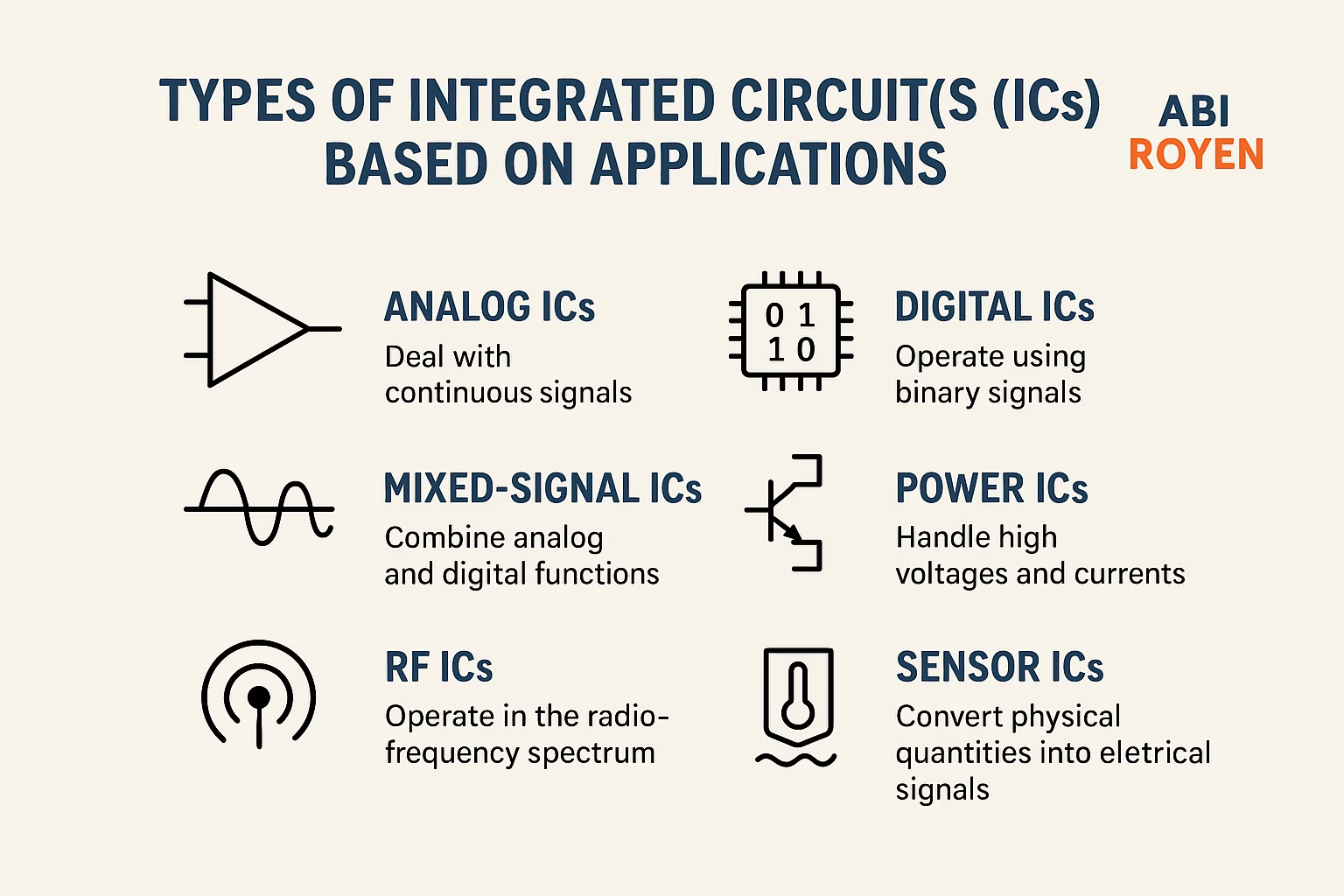
An Integrated Circuit (IC) is a set of electronic circuits on a small, flat piece of semiconductor material, usually silicon. ICs can contain thousands to billions of transistors, resistors, diodes, and capacitors, all interconnected to perform complex functions. They are categorized by function into analog ICs, digital ICs, or mixed-signal ICs.
Major Applications of Integrated Circuits
1. Consumer Electronics
Perhaps the most visible application of integrated circuits is in consumer electronics. Devices such as:
- Smartphones
- Tablets
- Smart TVs
- Gaming consoles
- Digital cameras
All rely on ICs for processing, memory, connectivity, and user interface functionalities. The development of highly efficient microprocessors and system-on-chips (SoCs) has enabled sleeker, faster, and smarter gadgets.
2. Computers and Data Storage
Computing devices are fundamentally powered by integrated circuits. Key components include:
- Central Processing Units (CPUs)
- Graphics Processing Units (GPUs)
- Random Access Memory (RAM)
- Solid-State Drives (SSDs)
Each of these components consists of millions or billions of transistors etched into ICs. As Moore’s Law predicted, the transistor density continues to increase, allowing for higher computing power in smaller form factors.
3. Telecommunications
The telecommunications industry has undergone a massive transformation due to ICs. From 5G infrastructure to satellite communication, ICs handle:
- Signal processing
- Data encoding and decoding
- Modulation and demodulation
- Network switching and routing
Modern communication devices depend on RF ICs, Power Amplifiers, and Baseband Processors to transmit and receive data over various networks.
4. Applications of Integrated Circuits in Automotive Electronics
Automobiles are now rolling computers, and integrated circuits are central to this evolution. ICs are found in:
- Engine Control Units (ECUs)
- Airbag control systems
- Infotainment systems
- Advanced Driver-Assistance Systems (ADAS)
- Electric Vehicle (EV) Battery Management Systems
ICs not only improve vehicle safety and performance but also enhance user experience through features like navigation, connectivity, and automated driving.
5. Industrial Automation
Modern manufacturing relies heavily on automation and robotics, both powered by ICs. Applications include:
- Programmable Logic Controllers (PLCs)
- Human-Machine Interfaces (HMIs)
- Motor controllers
- Sensors and actuators
- Data acquisition systems
ICs ensure precise and reliable operations, contributing to efficiency and reduced downtime in production environments.
6. Applications of Integrated Circuits in Medical Devices
In healthcare, ICs have enabled groundbreaking medical technologies. They are used in:
- Diagnostic equipment (e.g., MRI, ECG)
- Implantable devices (e.g., pacemakers)
- Wearable health monitors
- Remote patient monitoring systems
Miniaturization and low power consumption are key benefits that make ICs ideal for medical electronics.
7. Aerospace and Defense
Integrated circuits play a critical role in the high-stakes environments of aerospace and defense. Applications include:
- Navigation and control systems
- Radar and communication systems
- Satellite technology
- Military-grade encryption and computing
- Missile guidance systems
ICs used in these sectors often undergo rigorous testing to withstand extreme temperatures, vibrations, and radiation.
8. Smart Home and IoT
The rise of Internet of Things (IoT) and smart home automation has brought ICs into everyday household applications:
- Smart thermostats
- Security cameras
- Voice assistants
- Smart lighting
- Home appliances
These devices use microcontrollers and wireless ICs (e.g., Wi-Fi, Zigbee, Bluetooth) to connect, communicate, and automate tasks.
9. Applications of Integrated Circuits in Energy and Power Management
ICs are vital in renewable energy and power systems, including:
- Solar inverters
- Battery management systems
- Energy meters
- Smart grid controllers
- Power factor correction devices
Power ICs help regulate voltage, convert currents, and monitor energy usage, contributing to efficient and sustainable energy practices.
Types of Integrated Circuits Based on Applications
Depending on the purpose, ICs are categorized as:
- Linear (Analog) ICs – Used in amplifiers, oscillators, and audio/video equipment.
- Digital ICs – Found in computers, digital watches, and logic gates.
- Mixed-Signal ICs – Combine analog and digital functions, commonly used in signal converters and wireless systems.
- Power ICs – Regulate voltage and manage power distribution in electronics.
- RF ICs – Specialized for high-frequency communications.
The Future of Applications of Integrated Circuits
The future of integrated circuits is tied closely to the advancement of:
- Artificial Intelligence (AI)
- Quantum Computing
- Wearable Technology
- 5G/6G Networks
- Autonomous Vehicles
As demands for performance, efficiency, and miniaturization grow, ICs will continue evolving, leading to innovations that reshape industries.
Conclusion of Applications of Integrated Circuits
Integrated Circuits have profoundly impacted every aspect of modern life. From powering the smartphone in your hand to enabling space exploration, the applications of integrated circuits span nearly every domain. As technology continues to advance, ICs will remain at the forefront, driving innovation and shaping the digital landscape.
Whether you’re an electronics enthusiast, an engineer, or a tech entrepreneur, understanding the applications of integrated circuits is essential to appreciating the sophistication of modern technology.