Inductors are fundamental passive components in electronic circuits, alongside resistors and capacitors. Despite being often overlooked compared to other components, inductors play a critical role in a wide range of applications—from simple filter circuits to complex power management systems. This article delves deep into the various applications of inductors, explaining how they function and why they are vital in modern electronics.
What is an Inductor?
An inductor is a passive electronic component that stores energy in a magnetic field when electric current flows through it. It typically consists of a coil of wire wound around a core, which can be air, ferrite, or another magnetic material.
The fundamental property of an inductor is inductance, measured in Henries (H), which quantifies its ability to resist changes in current. When the current through an inductor changes, it generates a back electromotive force (EMF) opposing that change, a phenomenon described by Faraday’s Law of Induction.
Key Applications of Inductors
1. Power Supply Systems (SMPS and Linear Regulators)
In power electronics, inductors are widely used in switch-mode power supplies (SMPS) and DC-DC converters. They help smooth out the voltage, filter ripple, and store energy during switching operations.
- Buck Converter: Reduces voltage using an inductor to store and release energy.
- Boost Converter: Increases voltage using inductor charging/discharging cycles.
- Flyback Converter: Stores energy in an inductor or transformer and releases it during the off cycle.
Without inductors, efficient voltage conversion would not be possible.
2. EMI Filtering and Noise Suppression
Electromagnetic interference (EMI) is a major concern in modern electronics. Inductors are used in EMI filters to block high-frequency noise and allow only desired frequency signals to pass.
- Common-mode chokes are inductors that suppress common-mode noise in power lines or signal cables.
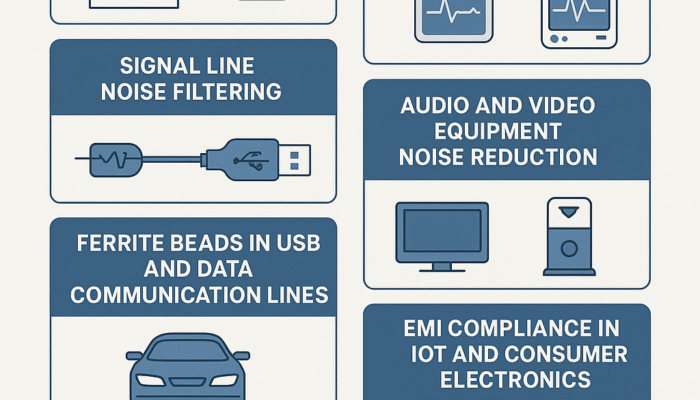
- Ferrite beads, a type of miniature inductor, are used to suppress high-frequency noise in circuits, especially in consumer electronics and data lines.
These components ensure electronic devices meet regulatory requirements for electromagnetic compatibility (EMC).
3. Signal Filtering and Tuning Circuits
In radio-frequency (RF) applications, inductors are essential for filtering, tuning, and impedance matching.
- LC Filters (Low-pass, High-pass, Band-pass): Inductors combined with capacitors create filters that allow only certain frequency ranges to pass.
- Tuned Circuits: In radio receivers, inductors are used to select the desired frequency band through resonance.
- Oscillators: Inductors, when paired with capacitors, can generate specific frequencies for signal generation.
These applications are vital for telecommunications, broadcasting, and signal processing.
4. Transformers and Energy Transfer
Inductors form the basis of transformers, which are used to transfer electrical energy between circuits through electromagnetic induction. While transformers have multiple windings, they are essentially two or more inductors coupled via a magnetic core.
Applications include:
- Power transmission and distribution
- Voltage isolation in power supplies
- Signal coupling in audio and RF circuits
Transformers wouldn’t function without the core principle of inductance.
5. Applications of Inductors Magnetic Storage and Inductive Charging
The principle of magnetic induction is used in:
- Inductive charging systems: For wireless power transfer, such as smartphone charging pads, electric toothbrushes, and even electric vehicles.
- Magnetic storage devices: Hard disk drives (HDDs) use magnetic fields to read and write data.
These technologies rely on coils and inductors to generate or respond to magnetic fields.
6. Current Sensing and Energy Measurement
Certain types of inductors, such as current transformers or shunt inductors, are used for:
- Monitoring AC current in industrial systems
- Protecting circuits from overcurrent
- Smart energy metering in residential or commercial buildings
The inductive element detects changes in current and generates a proportional signal for measurement or control purposes.

7. Automotive Applications
Modern vehicles, especially electric and hybrid models, incorporate inductors in:
- Motor drive inverters
- Battery management systems (BMS)
- EMI filtering for vehicle electronics
- Inductive sensors for speed, position, and rotation
Inductors help ensure the reliability and performance of automotive electronics.
8. Renewable Energy Systems
In solar inverters and wind energy systems, inductors are used to:
- Convert and regulate voltages from DC to AC
- Smooth current output in PV systems
- Reduce switching noise in power electronics
The increasing push for clean energy has boosted the demand for high-efficiency magnetic components like inductors.
9. Applications of Inductors Audio and Speaker Systems
In audio crossovers, inductors are used to:
- Separate high, mid, and low frequencies for multi-driver speakers.
- Prevent distortion by ensuring each driver receives only the intended frequency range.
In guitar amplifiers and analog tone circuits, inductors play a key role in shaping sound.
Factors That Influence Inductor Selection
Choosing the right inductor depends on several parameters:
- Inductance value (H or µH)
- Rated current and saturation current
- Core material (air, ferrite, iron powder)
- DC resistance (DCR)
- Operating frequency range
The proper selection ensures efficient operation and avoids overheating or signal distortion.
Future Trends in Applications of Inductors
With the growth of 5G, IoT, and electric mobility, inductors are becoming smaller, more efficient, and tailored for high-frequency applications. Emerging technologies such as:
- 3D-printed inductors
- Planar magnetic components
- MEMS-based inductors
…are setting new standards in miniaturization and performance.
Conclusion of Applications of Inductors
Inductors are indispensable components in a wide variety of electronic and electrical systems. Their applications span from simple power filtering to complex RF communication and energy transfer systems. As technology advances, so too will the role of inductors in shaping efficient, reliable, and compact devices. Understanding where and how inductors are used is essential for engineers, designers, and electronics enthusiasts alike.
Published by Abi Royen
Your Trusted Source for Electronics Insights