Introduction to Applications of Ferrite Beads
Applications of ferrite beads ~ Ferrite beads are passive electronic components used to suppress high-frequency noise in electronic circuits. Often appearing as small cylindrical or toroidal components, ferrite beads play a crucial role in electromagnetic interference (EMI) suppression and radio frequency interference (RFI) filtering. They are typically used in power lines, signal lines, and data cables to absorb high-frequency noise, ensuring stable and efficient operation of electronic systems.
In this article, we explore the key applications of ferrite beads, how they function, and why they are essential in today’s increasingly complex electronic environments.
1. EMI Suppression in Power Supply Lines
One of the primary applications of ferrite beads is in power supply lines, where they act as low-pass filters to block high-frequency noise from entering or leaving a circuit. As switching power supplies become more common in devices, EMI becomes a significant concern. Ferrite beads help maintain electromagnetic compatibility (EMC) by absorbing unwanted RF signals.
Use Cases:
- DC-DC converters in mobile devices
- Switching regulators
- AC-DC adapters
- Battery-powered devices (e.g., smartphones, tablets)
Ferrite beads placed on power lines can effectively block the noise generated by fast-switching components while allowing the DC current to pass freely.
2. Applications of Ferrite Beads Signal Line Noise Filtering
In digital circuits, high-speed signals often create crosstalk and noise. Ferrite beads are used in signal lines to filter out high-frequency components that can distort data or interfere with neighboring lines. This is especially important in sensitive analog circuits or mixed-signal systems.
Examples:
- USB lines
- HDMI and DisplayPort
- Audio signal paths
- Clock and data lines in microcontroller circuits
By placing ferrite beads close to the signal source or receiver, engineers can minimize signal degradation and improve overall performance.
3. Ferrite Beads in USB and Data Communication Lines
With the rise of high-speed data transmission, USB ports and other communication interfaces are vulnerable to EMI. Ferrite beads are frequently placed on USB power and data lines to ensure compliance with EMC regulations and to maintain data integrity.
Application Examples:
- USB chargers and hubs
- Ethernet and HDMI cables
- Laptop motherboards
- Industrial control interfaces
These beads help ensure that devices do not radiate excessive noise that might interfere with other nearby equipment.
4. EMI Reduction in Automotive Electronics
Modern vehicles contain a plethora of electronic control units (ECUs), sensors, and infotainment systems. These systems are interconnected and operate in harsh electromagnetic environments, making EMI suppression critical.
Common uses in automotive applications:
- Engine control units (ECUs)
- Infotainment systems
- Dashboard displays
- In-vehicle networking (CAN, LIN)
Ferrite beads are used to protect sensitive components and ensure reliable signal transmission in automotive systems. They also help pass stringent EMC tests required for automotive certification.
5. Applications of Ferrite Beads Protection in Medical Equipment
Medical devices must operate with precision and minimal electromagnetic interference. Ferrite beads are used to ensure clean power delivery and signal transmission, which is essential for accurate diagnostic and monitoring.
Use Cases:
- ECG and EEG monitors
- MRI machines
- Medical imaging equipment
- Portable diagnostic devices
Using ferrite beads reduces the risk of false readings caused by EMI and helps meet strict industry standards for safety and reliability.
6. Audio and Video Equipment Noise Reduction
High-end audio and video devices demand clean signal paths to maintain fidelity. Ferrite beads are used in these systems to prevent high-frequency noise from entering the signal path and distorting the output.
Applications include:
- Audio amplifiers
- Microphone systems
- Headphones and earphones
- High-definition displays
Ferrite beads are often embedded in cables and internal circuits to reduce hiss, buzz, and signal degradation.

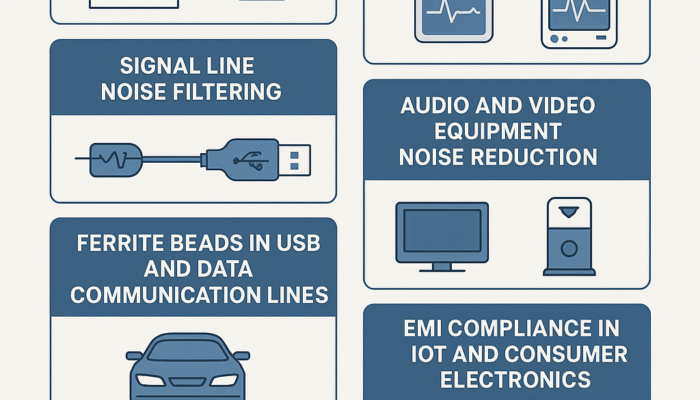
7. EMI Compliance in IoT and Consumer Electronics
As the Internet of Things (IoT) continues to expand, the number of wirelessly connected devices is growing rapidly. Ferrite beads help these devices meet EMI/EMC compliance requirements and reduce interference with other wireless systems.
Examples:
- Smart home devices
- Wearables
- Drones and robotics
- Smart meters
In compact, crowded circuit boards, ferrite beads are valuable tools to mitigate interference and improve signal clarity.
8. Use in Telecommunication Equipment
Telecom systems operate with high-frequency signals over long distances, making them particularly vulnerable to EMI and RFI. Ferrite beads are used in these systems to filter unwanted noise from transmission lines and prevent data loss.
Common implementations:
- Base stations
- Routers and switches
- Optical network terminals (ONTs)
- Satellite communication systems
They help improve the signal-to-noise ratio (SNR) and ensure stable communication even in noisy environments.
9. Applications of Ferrite Beads Embedded System Noise Management
In embedded systems, especially those using microcontrollers or FPGAs, switching transients and internal noise can affect both power and data integrity. Ferrite beads are used to isolate noisy subsystems and prevent coupling across different parts of the board.
Usage Areas:
- Industrial automation
- Robotics and control systems
- Smart sensors
- Home appliances
Careful placement of ferrite beads can drastically improve EMC performance and reduce debugging time in product development.
10. Ferrite Beads in RF and Microwave Circuits
Although ferrite beads are not ideal for high-power RF applications, they are used in support circuits to minimize parasitic signals and maintain RF integrity. For instance, they can isolate control lines or suppress harmonics in oscillator circuits.
Examples:
- Low-noise amplifiers (LNA)
- Antenna circuits
- RF signal conditioning
- Transceiver modules
In these contexts, ferrite beads act as RF chokes, ensuring that undesired frequencies are attenuated.
Conclusion of Applications of Ferrite Beads
Ferrite beads may appear simple, but their impact on electronic design and performance is significant. From suppressing EMI to ensuring clean signal and power lines, ferrite beads are an essential component in nearly all modern electronic devices. Understanding their applications helps engineers design more reliable, compliant, and efficient systems.
As electronics continue to evolve and become more compact and wireless, the role of ferrite beads will remain vital in addressing interference issues and improving device performance.
Published by Abi Royen
Your trusted source for electronics knowledge and engineering insights.