

Applications of active components ~ In the rapidly evolving field of electronics, active components are the building blocks that bring circuits to life. Unlike passive components that simply resist or store energy, active components have the ability to control current flow, amplify signals, and perform complex switching operations. From smartphones and computers to industrial automation and medical devices, active components are essential in virtually all modern electronic systems.
This article delves into the most common and impactful applications of active components, including transistors, diodes, integrated circuits (ICs), op-amps, and thyristors, while exploring how these components shape the functionality and innovation of contemporary electronics.
Applications of active components
1. Amplification and Signal Processing
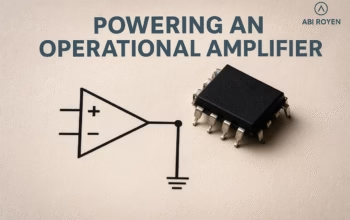
One of the most fundamental applications of active components is signal amplification. This is primarily carried out using transistors and operational amplifiers (op-amps).
- Transistors (such as BJT and MOSFET) are widely used in analog electronics to amplify weak signals, allowing them to drive speakers, sensors, or display devices.
- Op-amps are used in audio systems, instrumentation, and analog computers to perform operations like amplification, filtering, summing, and integration.
Real-world examples:
- Audio amplifiers in home theater systems
- Microphone signal boosters
- Analog signal conditioning in sensor circuits
2. Switching and Digital Logic Control
Active components enable high-speed switching, which is vital in digital electronics.
- Transistors, especially in the form of CMOS technology, act as fast switches inside microprocessors and digital logic circuits.
- Logic gates (AND, OR, NOT, etc.), built using transistors, are the foundation of binary computing and digital control systems.
Applications include:
- Microprocessors and microcontrollers
- Memory chips (RAM, ROM, Flash)
- Programmable logic devices (PLDs)
- Timing and clock generation circuits
3. Rectification and Voltage Regulation
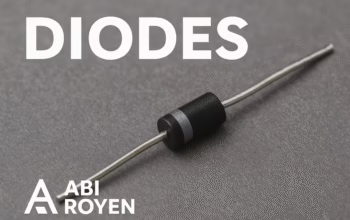
Diodes are active components primarily used for rectification, converting alternating current (AC) to direct current (DC). They are also used for voltage clamping, protection, and modulation.
- Zener diodes are widely used in voltage regulation to maintain a constant voltage level across sensitive components.
- Bridge rectifiers use four diodes to provide full-wave rectification in power supplies.
Practical applications:
- DC power supply circuits
- Battery charging systems
- Voltage reference sources for analog circuits
4. Oscillators and Timing Circuits
Active components such as transistors, op-amps, and IC timers like the 555 timer are used to create oscillators and timers.
These circuits are crucial in:
- Clock generators for microprocessors
- Pulse-width modulation (PWM) in motor controllers
- Timing delays in automation systems
Examples:
- Quartz oscillator circuits in watches and smartphones
- Tone generators in alarms
- Frequency synthesizers in RF communication
5. Signal Modulation and Demodulation
In communication systems, active components enable modulation and demodulation, which are essential for transmitting and receiving information over various media.
- Mixers, modulators, and demodulators use transistors and ICs to convert baseband signals to RF frequencies and vice versa.
- Phase-locked loops (PLLs) use active components for frequency synthesis and demodulation.
Used in:
- FM and AM radio receivers
- Satellite communication
- Wi-Fi and Bluetooth devices
6. Applications of Active Components on Power Control and Conversion
Power electronics heavily rely on active components for power control, inversion, and DC-DC conversion.
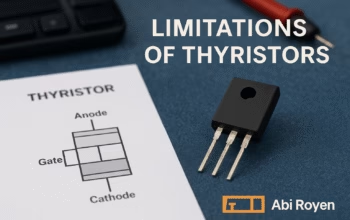
- Thyristors, IGBTs, and MOSFETs are used in motor drives, inverters, and power converters to handle high voltages and currents.
- Switching regulators (like buck and boost converters) utilize active switching elements to regulate voltage efficiently.
Typical applications:
- Electric vehicle (EV) motor controllers
- Solar inverters
- Switch-mode power supplies (SMPS)
7. Microprocessor and Embedded Systems
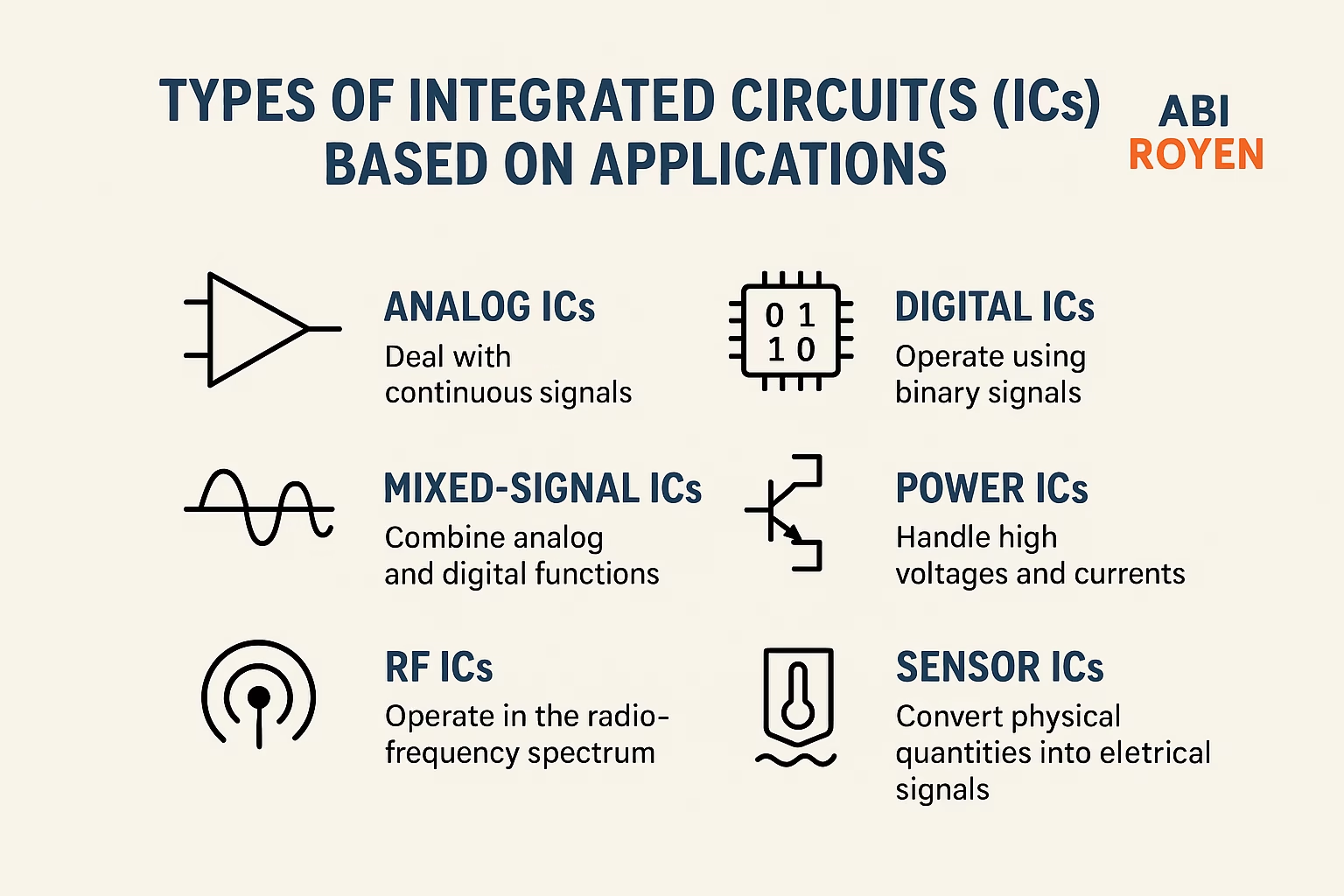
The heart of modern digital systems is the microprocessor, which is a highly complex IC made of millions (or billions) of transistors.
- Microprocessors control everything from household appliances to advanced robotics.
- Embedded systems integrate microcontrollers with memory and input/output components to perform specific tasks autonomously.
Common devices:
- Smart TVs and smartphones
- Industrial PLCs (Programmable Logic Controllers)
- Wearables and smart home devices
8. Feedback and Control Systems
Active components play a critical role in closed-loop control systems, where output is continuously adjusted based on feedback.
- Op-amps are often used in feedback circuits to maintain stability and precision.
- Transistors and amplifiers help control actuator behavior in real time.
Industries that benefit:
- Robotics and automation
- HVAC control systems
- Flight control systems in aerospace
9. Applications of active components Sensing and Detection
While many sensors themselves may be passive, active components are crucial for signal conditioning, amplification, and output formatting in sensor systems.
- Signal amplifiers and ADCs (analog-to-digital converters) are used to make sense of weak signals from sensors.
- Photodiodes and transimpedance amplifiers detect and process light in optical systems.
Applications:
- Biomedical devices (ECG, EEG)
- Environmental monitoring
- Industrial sensing (temperature, pressure, motion)
10. Data Storage and Memory Circuits
Memory devices are a type of active component, storing data for both temporary and permanent use.
- Flash memory, DRAM, and EEPROM are based on transistor technology.
- Active control circuitry manages reading, writing, and erasing operations.
Used in:
- SSDs and USB drives
- Embedded systems
- Consumer electronics
Conclusion of Applications of active components
Active components form the core of every modern electronic system. Their ability to amplify, switch, process, and regulate electrical signals enables the development of advanced technologies that define contemporary life. From the smallest hearing aid to the largest industrial control systems, these components are indispensable.
Understanding the diverse applications of active components not only helps in the design and development of electronic systems but also empowers professionals and students to innovate in the ever-evolving field of electronics.