Applications Fixed Resistors ~ Fixed resistors are among the most fundamental and widely used components in electronic circuits. As passive components, their primary role is to resist the flow of electrical current and manage voltage levels within a circuit. Despite their simplicity, fixed resistors serve critical functions in devices ranging from smartphones to industrial control systems. In this article, we’ll explore the common applications of fixed resistors and how they contribute to reliable, functional, and safe electronic systems.
What Are Fixed Resistors?
Fixed resistors are components designed to have a specific resistance value that does not change with temperature, voltage, or time (under normal operating conditions). Their resistance is set during manufacturing and is used to control current flow, divide voltages, and dissipate energy in a circuit.
They are available in various types, such as:
- Carbon composition resistors
- Metal film resistors
- Wire-wound resistors
- Thick and thin film resistors
Each type offers different characteristics in terms of precision, temperature stability, and power rating.
Common Applications Fixed Resistors
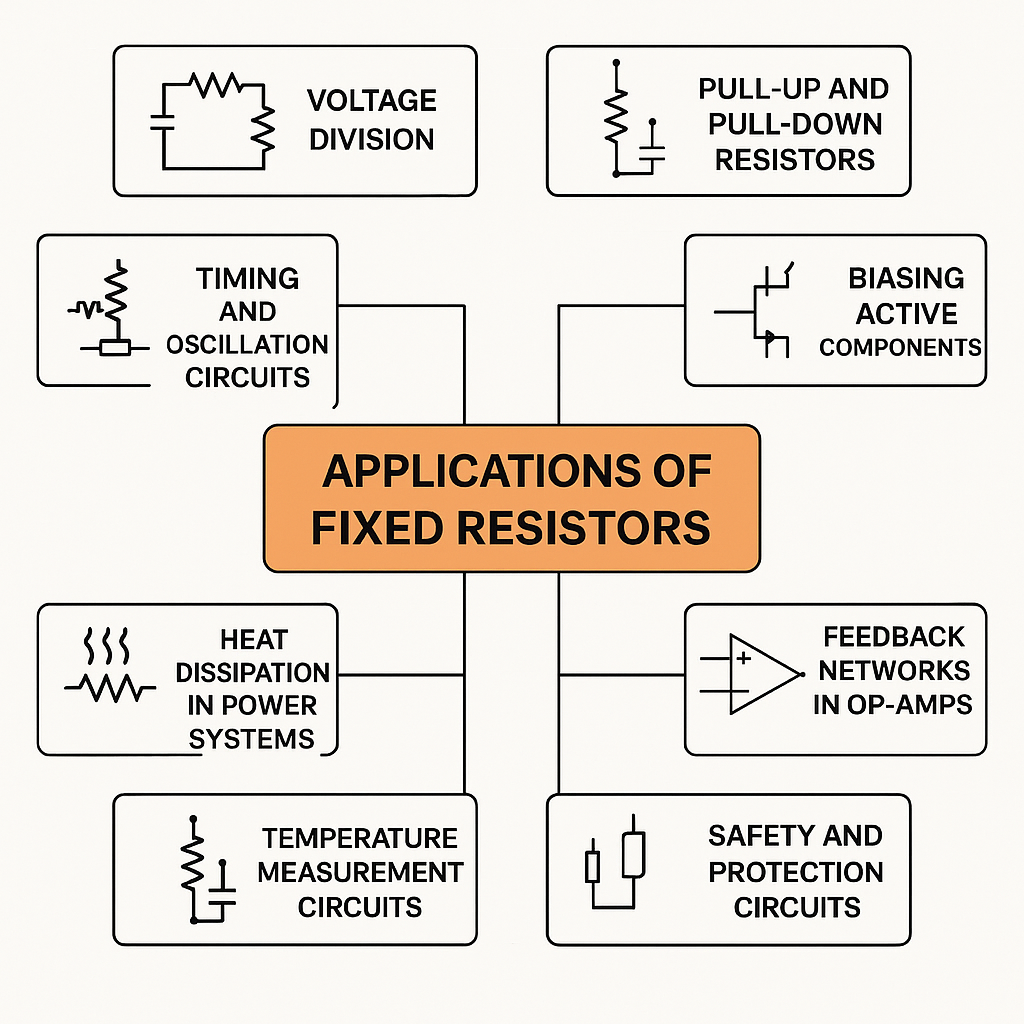
1. Voltage Division
One of the most frequent applications of fixed resistors is in voltage divider circuits. By connecting two or more resistors in series, engineers can create a known ratio of voltage from a higher source voltage.
Example:
In a simple voltage divider using two equal-value resistors, the output voltage will be half of the input voltage. This technique is widely used in:
- Sensor interfacing
- Biasing transistors
- Signal conditioning circuits
2. Applications Fixed Resistors: Current Limiting
Fixed resistors are often placed in series with LEDs or other sensitive components to limit the current and prevent damage.
Real-World Use:
In an LED circuit, a resistor is used to limit the current to a safe level, ensuring the LED operates within its rated current and voltage parameters. This protects the component from overheating or burning out.
3. Pull-Up and Pull-Down Resistors
In digital electronics, fixed resistors are used as pull-up or pull-down resistors to ensure logic inputs settle at expected values when no active device is driving the line.
Applications:
- Microcontroller input pins
- I2C and SPI communication lines
- Switch debouncing circuits
4. Applications Fixed Resistors: Biasing Active Components
Fixed resistors are crucial in biasing transistors and other active devices to set the proper operating point for amplification or switching.
Used In:
- Audio amplifiers
- RF circuits
- Analog signal processing
5. Timing and Oscillation Circuits
When combined with capacitors or inductors, fixed resistors help define timing intervals and oscillation frequencies.
Typical Applications:
- RC time constant circuits
- Oscillator circuits
- Pulse generators
6. Applications Fixed Resistors: Signal Attenuation
Fixed resistors can be used to attenuate signals by reducing their amplitude. This is often important in audio and RF circuits where a lower signal level is required.
Examples:
- Audio volume control circuits
- RF signal level adjustment
- DAC/ADC input conditioning
7. Heat Dissipation in Power Systems
High-wattage fixed resistors are used to dissipate energy as heat in braking circuits, dummy loads, and power supplies.
Real Use Cases:
- Motor braking resistors in industrial drives
- Dummy loads for generator testing
- Voltage-dropping resistors in lighting systems
8. Feedback Networks in Op-Amps
In operational amplifier (op-amp) circuits, fixed resistors define the gain of the amplifier through feedback and input resistance ratios.
Found In:
- Audio preamplifiers
- Signal amplifiers
- Instrumentation amplifiers
9. Temperature Measurement Circuits
Fixed resistors are often part of voltage divider circuits that include thermistors or RTDs for temperature sensing. The fixed resistor helps convert a variable resistance into a measurable voltage.
10. Applications Fixed Resistors: Safety and Protection Circuits
In protection circuits, fixed resistors serve as fusible links or current-sensing elements to prevent overcurrent conditions.
Application:
- Current sense resistor in battery management systems (BMS)
- Pre-charge resistors in EV systems
- Series resistors in surge protection devices

Fixed Resistors in Different Industries
Consumer Electronics
Used in almost every device: smartphones, TVs, computers, chargers, and more.
Automotive Systems
Essential in dashboard electronics, ECUs (Electronic Control Units), and lighting systems.
Industrial Automation
Help in controlling robotic arms, sensors, and programmable logic controllers (PLCs).
Medical Equipment
Used in diagnostic and monitoring devices where precision and safety are critical.
Aerospace and Defense
High-precision, robust fixed resistors are used in avionics and military-grade systems.
Advantages of Using Applications Fixed Resistors
- Simplicity and Reliability
Fixed resistors offer stable and predictable performance with minimal maintenance. - Wide Range of Values
Available in resistance values from less than 1 ohm to millions of ohms. - Cost-Effective
They are inexpensive and available in large quantities for mass production. - Compact Sizes
Suitable for surface mount and high-density PCB layouts.
Conclusion of Applications Fixed Resistors
Fixed resistors, though simple in design, are foundational to electronic circuit operation. Their role in controlling voltage, limiting current, shaping signals, and protecting devices cannot be overstated. From basic consumer gadgets to high-end industrial machinery, fixed resistors ensure reliable and predictable circuit behavior. Understanding their applications enables better circuit design, enhanced safety, and optimal performance in virtually every electronic product.
Boost Your Electronics Knowledge at Abi Royen
Explore more insightful guides on electronic components, resistor types, and practical design tips at Abi Royen – Your Trusted Source for Electronics Knowledge.