Introduction of Analog Voltage Regulator ICs
Analog Voltage Regulator ICs ~ In the world of electronics, precision, stability, and efficiency are critical. One of the essential components that help achieve these goals is the analog voltage regulator IC. These devices are specifically designed to maintain a stable output voltage regardless of fluctuations in input voltage or variations in load current. From consumer electronics to industrial equipment, analog voltage regulators play a vital role in ensuring safe and reliable operation.
This article explores the different types of analog voltage regulator ICs, how they work, their key functions, benefits, and real-world applications.
What is an Analog Voltage Regulator ICs?
An analog voltage regulator IC is a semiconductor device that maintains a constant output voltage despite changes in input voltage or output load. Unlike digital voltage regulators that operate with switching techniques and PWM signals, analog regulators provide continuous regulation using analog components such as transistors, resistors, and capacitors.
These ICs are often used in applications where low noise, simplicity, and linear voltage regulation are required.
Main Types of Analog Voltage Regulator ICs
There are two main categories of analog voltage regulators:
1. Linear Voltage Regulators
Linear regulators are the most common type of analog voltage regulators. They work by adjusting the resistance in the pass element (usually a transistor) to maintain a steady output voltage.
Key Features:
- Simple design and implementation
- Low output noise
- No switching frequency (ideal for noise-sensitive analog circuits)
Examples:
- Fixed linear regulators (e.g., 7805, 7812)
- Adjustable linear regulators (e.g., LM317)
2. Low Dropout (LDO) Regulators
LDO regulators are a subtype of linear regulators designed to operate with a very small difference between the input and output voltage (known as the dropout voltage).
Advantages:
- Higher efficiency at low input-output differential
- Suitable for battery-powered and low-voltage applications
- Improved thermal performance
Popular LDO ICs:
- LT1763
- TPS7A47
- MIC5219
How Do Analog Voltage Regulator ICs Work?
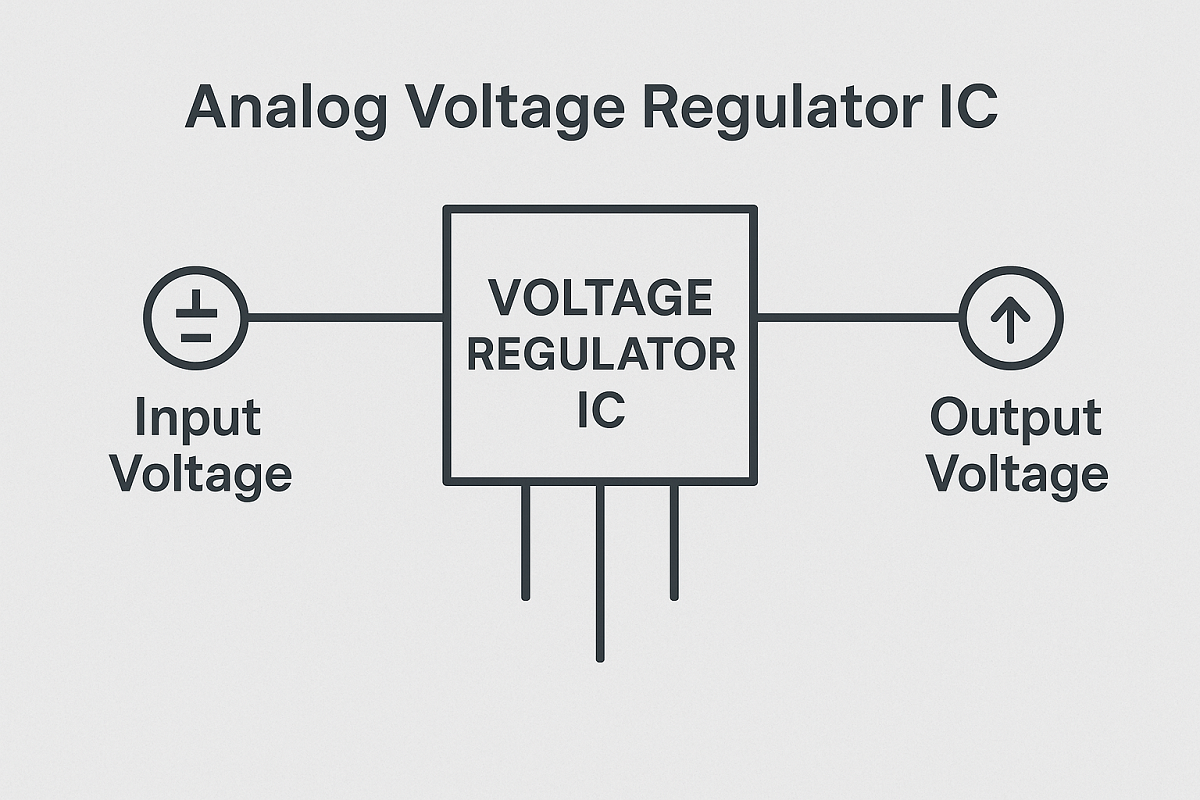
Analog voltage regulators work on the principle of feedback control. They continuously compare the output voltage to a reference voltage and adjust the pass transistor’s conduction to maintain a stable output.
Core Components:
- Reference voltage source (e.g., a bandgap reference)
- Error amplifier
- Pass transistor (series element)
- Feedback network
As the input voltage changes or the load fluctuates, the feedback system dynamically adjusts the pass element to keep the output voltage within desired limits.

Key Functions and Features
- Voltage Regulation:
Maintains a steady output voltage despite input or load variations. - Thermal Protection:
Many ICs include built-in over-temperature shutdown to prevent damage. - Short-Circuit Protection:
Prevents excessive current flow in case of output short-circuits. - Low Noise Output:
Crucial for sensitive analog and RF circuitry. - Compact Packaging:
Available in small SMD packages for portable and space-constrained applications.
Benefits of Using Analog Voltage Regulator ICs
- Simplicity in Design: Fewer external components compared to switching regulators.
- Lower Noise: No high-frequency switching means cleaner power for analog and audio circuits.
- Predictable Behavior: Ideal for applications requiring stable and precise voltage.
- Fast Transient Response: Quick adjustment to changes in load or input voltage.
Applications of Analog Voltage Regulator ICs
Analog voltage regulators are used across a broad range of electronics sectors, including:
1. Consumer Electronics
- Smartphones
- Televisions
- Audio systems
2. Automotive Systems
- ECU (Electronic Control Unit)
- Infotainment systems
- Dashboard controls
3. Industrial and Instrumentation
- Data acquisition systems
- Measurement and control instruments
- Sensors and transducers
4. Medical Devices
- Portable diagnostic equipment
- Imaging systems
- Wearable health monitors
5. Communications and Networking
- Routers
- Modems
- RF equipment
Choosing the Right Analog Voltage Regulator IC
When selecting an analog voltage regulator IC for a project, consider the following parameters:
- Input and output voltage range
- Output current rating
- Dropout voltage
- Power dissipation
- Load and line regulation
- Thermal characteristics
- Package type and PCB footprint
Manufacturers such as Texas Instruments, Analog Devices, STMicroelectronics, and ON Semiconductor offer a wide selection of analog regulators tailored to specific design needs.
Future Trends in Analog Voltage Regulation
Despite the rise of digital and switching regulators, analog voltage regulator ICs continue to evolve. Future innovations focus on:
- Ultra-low dropout designs
- Improved efficiency and thermal handling
- Smaller package sizes
- Integration with PMICs (Power Management ICs)
- Analog-digital hybrid regulation for smart devices
Conclusion
Analog voltage regulator ICs remain indispensable in modern electronic systems. Their simplicity, low noise performance, and reliability make them ideal for a wide array of applications. Whether you are designing consumer gadgets, automotive modules, or industrial controllers, understanding and choosing the right analog regulator can significantly influence your project’s success.
Suggested Readings:
- “Understanding Linear vs Switching Voltage Regulators”
- “LDO Regulators for Low-Power Applications”
- “How to Select Voltage Regulators for Audio Systems”