In the field of electronics and communication, one of the fundamental challenges is maintaining signal integrity and clarity. Weak, distorted, or noisy signals can compromise system performance, especially in sensitive applications such as medical devices, audio systems, wireless communications, and instrumentation. This is where Amplification Signal Processing plays a vital role.
Amplification signal processing involves boosting signal strength while preserving its quality and minimizing distortion. This process is essential in almost every electronic system, from consumer gadgets to advanced scientific equipment.
1. What is Amplification Signal Processing?
Amplification signal processing refers to the manipulation of signals using electronic amplifiers to increase their amplitude. It is a crucial part of both analog and digital signal processing systems.
The main goal of amplification is to:
- Strengthen weak signals
- Preserve signal fidelity
- Improve the signal-to-noise ratio (SNR)
- Prepare signals for further processing, transmission, or analysis
Unlike basic amplification, which might simply increase the volume of a signal, amplification in signal processing involves intelligent design to minimize distortion, clipping, and noise addition.
2. Types of Electronic Amplifiers Used in Signal Processing
Different types of amplifiers are used depending on the application’s frequency, power requirements, and signal characteristics.
A. Voltage Amplifiers
These amplify the voltage level of the input signal and are commonly found in audio systems, sensors, and communication circuits.
B. Current Amplifiers
Used when the primary goal is to increase the current of a signal, such as in actuator control or driving loads.
C. Power Amplifiers
They increase both voltage and current to deliver higher power to a load. These are common in RF transmitters and loudspeaker systems.
D. Operational Amplifiers (Op-Amps)
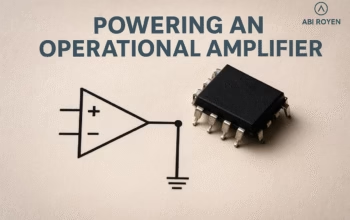
Op-Amps are highly versatile and used in signal conditioning, filtering, and analog computing. They can amplify very small signals and are the backbone of analog signal processing.
E. Instrumentation Amplifiers
Designed for high-accuracy amplification of differential signals, often used in biomedical and sensor systems due to their high CMRR (Common-Mode Rejection Ratio).
3. Core Functions in Amplification Signal Processing
Amplifiers are not just about boosting the signal. Their configuration determines specific signal processing tasks such as:
A. Signal Conditioning
Before a signal can be digitized or analyzed, it often needs to be cleaned, scaled, and filtered. Amplifiers help in:
- Gain adjustment
- Noise filtering
- Impedance matching
B. Signal Isolation
Through differential amplifiers and isolation amplifiers, signal processing circuits can isolate noise sources and ground loops.
C. Dynamic Range Expansion
By amplifying weak signals and attenuating stronger ones, systems can operate efficiently across a broader range of input levels.
4. Key Parameters in Amplification Signal Processing Design
To design efficient amplification systems, engineers consider several parameters:
- Gain (Voltage/Current/Power Gain): Ratio of output to input signal.
- Bandwidth: Frequency range over which the amplifier operates effectively.
- Linearity: How faithfully the amplifier reproduces the input signal.
- Noise Figure: A measure of noise added by the amplifier.
- THD (Total Harmonic Distortion): Indicates signal distortion due to harmonics.
- Input and Output Impedance: Critical for impedance matching and minimal signal reflection.
5. Real-World Applications of Amplification Signal Processing
A. Audio Processing
Amplifiers boost microphone signals for mixing, effects, or broadcasting while preserving tonal quality.
B. Medical Instrumentation
Electrocardiograms (ECG), EEG, and biosensors rely on clean amplification of microvolt-range signals for accurate diagnosis.
C. Wireless Communication
RF signals are often extremely weak and require multi-stage amplification for modulation and transmission.
D. Industrial Automation
Sensors used in automation systems generate low-level signals that need amplification before being processed by controllers.
E. Scientific Research
Lab instruments such as oscilloscopes, spectrum analyzers, and photomultiplier tubes depend heavily on signal amplification.
6. Challenges in Amplification Signal Processing
Despite its benefits, designing reliable amplification systems comes with challenges:
- Noise Sensitivity: Amplifiers can introduce or amplify noise if not properly designed.
- Power Efficiency: Especially in portable or battery-operated devices.
- Thermal Stability: Amplifiers can generate heat, which affects performance.
- Non-linearity: Can cause distortion if the amplifier is pushed beyond its limits.
7. Techniques to Improve Amplification Signal Processing Performance
To mitigate the challenges, engineers apply techniques like:
- Feedback Control: Negative feedback improves stability and reduces distortion.
- Shielding and Grounding: Protects from EMI and external noise.
- Filtering: Using low-pass, high-pass, or band-pass filters before or after amplification.
- Gain Staging: Distributing gain across multiple amplifier stages to maintain signal integrity.
8. Role of Digital Signal Processing (DSP)
In modern systems, analog amplification is often followed by digital signal processing. Here’s how they work together:
- Analog Amplification: Boosts the signal to a level suitable for analog-to-digital conversion.
- DSP: Further refines the signal using algorithms (e.g., noise cancellation, equalization).
In high-precision applications, hybrid systems combine both analog and digital amplification techniques.
9. Future Trends in Amplification signal processing
As electronic systems become smaller and more powerful, amplification signal processing is evolving with:
- Miniaturized IC Amplifiers: System-on-Chip (SoC) with built-in amplification features.
- Low-Power Designs: Especially for IoT, wearable, and medical devices.
- Adaptive Gain Control: AI-based automatic gain control for dynamic environments.
- High-Fidelity Audio Systems: Pushing the boundaries of sound clarity using advanced amplifier topologies.
Conclusion of Amplification signal processing
Amplification signal processing is at the heart of modern electronics. Whether it’s ensuring clear audio, enabling accurate sensor measurements, or supporting high-speed communication, the importance of precise, low-noise amplification cannot be overstated.
Understanding the principles of amplifier types, signal handling, and noise control gives engineers the tools they need to design efficient, reliable, and high-performance electronic systems.
For anyone involved in electronics design, instrumentation, or communication systems, mastering amplification signal processing is a vital step toward innovation and excellence.
📌 Article Summary for Abi Royen Website
- Focus: Fundamentals and applications of amplification in signal processing.
- Audience: Electronics engineers, students, hobbyists, professionals in automation, medical electronics, audio engineering.
- Benefit: Enhances understanding of amplifiers’ role in boosting signal quality, noise reduction, and real-world performance.